Like anything with diehard enthusiasts, the home theater space is sometimes subject to perfectionism. There are people who, knowing the options out there, refuse to settle for anything less than the best — or at least the best within their budget. When budgets are high, it can lead to some truly wild builds, with Atmos setups that rival your local multiplex for cinematic immersion.
For decades, Dolby has been happy to oblige audiophiles with a variety of standards, Atmos being its current flagship. One of its more recent creations is something called Dolby MAT. It’s not a totally new audio format, per se — but it can have a huge impact on how audio is processed, and you may have to mess around with settings to make it work as intended.
 Quiz
QuizDolby sound engineering
Trivia challenge
From noise reduction to immersive audio — how well do you really know the science behind Dolby sound?
HistoryTechnologyFormatsCinemaInnovation
In what year did Ray Dolby found Dolby Laboratories?
Correct! Ray Dolby founded Dolby Laboratories in 1965 in London, England. The company initially focused on professional recording studio equipment before expanding into consumer and cinema audio.
Not quite. Dolby Laboratories was founded in 1965 by Ray Dolby in London. He had previously worked at Ampex and developed his noise reduction ideas while studying at Cambridge University.
What was the primary purpose of the original Dolby A noise reduction system introduced in 1965?
Correct! Dolby A was designed to reduce the audible tape hiss that plagued professional studio recordings. It worked by encoding audio during recording and decoding it on playback, effectively masking the noise floor of magnetic tape.
Not quite. Dolby A was a noise reduction system aimed squarely at reducing tape hiss in professional studio environments. It used a compander approach — compressing audio on the way in and expanding it on the way out — to suppress background noise.
Which 1975 film was the first to be released with a Dolby-encoded stereo optical soundtrack?
Correct! Lisztomania (1975), directed by Ken Russell, was the first film released with a Dolby-encoded stereo optical soundtrack. This marked a major turning point in bringing high-quality stereo audio to cinema audiences.
Not quite. The first film with a Dolby-encoded stereo optical soundtrack was actually Lisztomania in 1975. While Star Wars (1977) and A Star Is Born (1976) were landmark Dolby films, Lisztomania holds the historical first.
Dolby Digital is also known by which technical designation used in industry documentation?
Correct! Dolby Digital is technically designated AC-3, which stands for Audio Codec 3. It was developed in the early 1990s and became the standard audio format for DVD video, digital broadcast, and cinema releases.
Not quite. Dolby Digital’s technical designation is AC-3. The AC stands for Audio Codec, and it was the third generation of Dolby’s perceptual audio coding technology, succeeding AC-1 and AC-2.
What audio object-based feature distinguishes Dolby Atmos from earlier surround sound formats like Dolby 7.1?
Correct! Dolby Atmos uses audio objects — individual sounds with positional metadata — rather than fixed channel assignments. This allows a renderer to place sounds anywhere in three-dimensional space and adapt the mix to any speaker configuration, from a home soundbar to a 64-speaker cinema.
Not quite. The key innovation in Dolby Atmos is object-based audio. Instead of assigning sounds to fixed channels, each sound element carries metadata describing its position, allowing the system to dynamically render it for whatever speaker layout is available.
Dolby Vision is a proprietary HDR format that competes directly with which open HDR standard commonly found on televisions and streaming services?
Correct! Dolby Vision competes most directly with HDR10 and its dynamic metadata extension HDR10+. While HDR10 is an open, royalty-free standard, Dolby Vision requires licensing and supports dynamic metadata for scene-by-scene brightness optimisation, often delivering superior results.
Not quite. Dolby Vision’s main competitors are HDR10 and HDR10+. HDR10 is the baseline open standard, while HDR10+ adds dynamic metadata — a feature Dolby Vision pioneered. Dolby Vision supports up to 12-bit color depth and 10,000 nits peak brightness in its specification.
What does Dolby MAT stand for, and what is its primary function in modern audio delivery?
Correct! Dolby MAT (Metadata-enhanced Audio Transport) is a lossless bitstream container that carries Dolby TrueHD audio along with Dolby Atmos object metadata over HDMI connections. It is what allows modern AV receivers and soundbars to receive full lossless Atmos signals from Blu-ray players and streaming devices.
Not quite. Dolby MAT stands for Metadata-enhanced Audio Transport. It is a lossless container format that wraps Dolby TrueHD audio and Dolby Atmos object metadata, enabling high-fidelity Atmos delivery over HDMI. Without MAT, devices can only receive a lossy Dolby Digital Plus version of an Atmos stream.
Which legendary rock concert film from 1978 is widely celebrated as a showcase for Dolby Stereo’s capabilities in cinema?
Correct! The Last Waltz (1978), Martin Scorsese’s documentary about The Band’s farewell concert, is frequently cited as a landmark demonstration of Dolby Stereo in cinemas. The film’s rich multi-track recording benefited enormously from the format’s improved dynamic range and channel separation.
Not quite. The Last Waltz (1978) is the celebrated Dolby Stereo showcase. Directed by Martin Scorsese, the film captured The Band’s final concert with exceptional audio quality that highlighted what Dolby Stereo could achieve over conventional mono and optical formats of the era.
Your Score
/ 8
Thanks for playing!
What is Dolby MAT, and what are its advantages?
A strange acronym with meaningful impact

MAT is short for Metadata-enhanced Audio Transmission. That’s quite the mouthful, but the gist is that it’s built to be a more efficient way of delivering lossless audio while also enabling Atmos spatial data. Lossless, if you’re unfamiliar, means that there’s no information lost via compression. You’ll hear the full range your speakers are capable of. It’s sometimes difficult to tell the difference versus high-bitrate compression, and lossless doesn’t usually have a footprint outside Blu-rayor music streaming — but there people who swear it sounds dramatically better, so it makes sense to use it whenever bandwidth allows.
The tech is often described as a container format. While raw audio is passed along in PCM (pulse-code modulation) form, Atmos metadata tells your equipment how to turn that into spatialized output when available. You might wonder why any of this is necessary, given that it was already possible to package lossless Atmos, but the answer to that is real-time performance. By simply dumping raw audio with some metadata, a source device can get away without any encoding.
MAT is sometimes preferred for efficiency even when audio quality might be less than spotless. The Apple TV 4K, for instance, relies on MAT for a feature called Continuous Audio. Apple promises “seamless transitions across audio formats without glitches or dropped signals,” which has some obvious appeal, despite most video services relying on compressed audio tracks. The tech is also used by game consoles like the Xbox Series X, which have way more on their plate than just sound and a 4K image.
One additional thing to mention is that MAT depends on eARC, which in turn is only available with HDMI 2.1 or higher. HDMI 2.0 doesn’t have enough bandwidth. If you plug a speaker into a vanilla ARC port, the best you’ll be able to do is compressed Atmos, no matter if every other device has a 2.1 connection.
The downsides to Dolby MAT
And how to deal with them

One flaw is the way this affects stereo upmixing. Often, devices like receivers are able to take a stereo feed and enhance it with surround elements — but MAT can cause stereo mixes to be flagged as Atmos, disabling this processing. You’ll still get usable audio, just something that’s distinctly unimpressive. You’ll wonder what you paid all that money for. This has been a particular gripe with the Apple TV’s Continuous Audio, and you should read up on my guide if you’re having problems with that device, since there are multiple ways of approaching MAT issues.
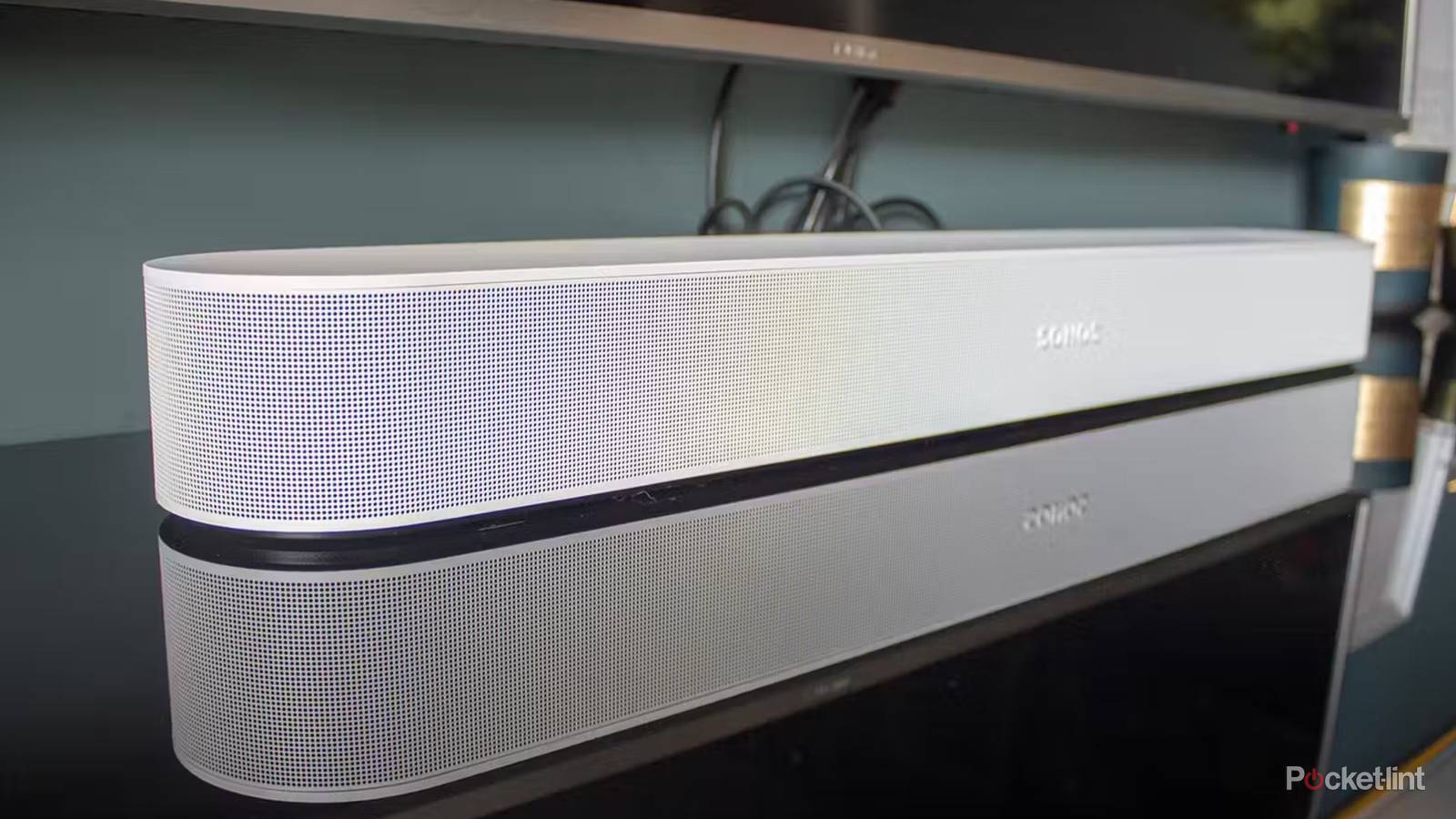
More seriously, there’s the potential for audio artifacts if corrupt data isn’t filtered out of the PCM stream. The best known example of this is Sonos’ Arc and Beam soundbars, which for a few years were occasionally experiencing something called the “pop of death.” This didn’t actually kill a speaker, but the sound was so loud and disruptive that people hated it. The company released a software fix in November 2023 that improved the Dolby decoding process.
Regardless of whether you’re dealing with any brand-specific issues, you may need to update settings to make things work properly. When a source device is connected directly to your TV, you’ll want to force the TV to use passthrough audio instead of its Auto or PCM modes, since choosing PCM may ironically kill that Atmos metadata on its way to your soundbar. You may also need to manually enable eARC, and configure HDMI inputs to use their “enhanced” mode. By default, a lot of TVs limit HDMI functionality for the sake of compatibility, despite the fact that I’ve never heard anyone complain about things breaking.
Presumably, Dolby and its partners will continue sorting these problems out. In the interim, it’s worth asking yourself how much you care about going lossless or minimizing disruptions. If those aren’t major concerns, detouring MAT may be preferable, assuming it’s possible.


5/5


