.png "Long-Haul Networks and Bandwidth Growth")
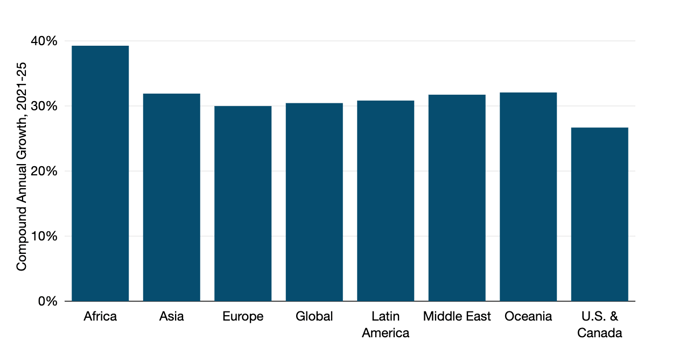
Used International Bandwidth Growth by Region
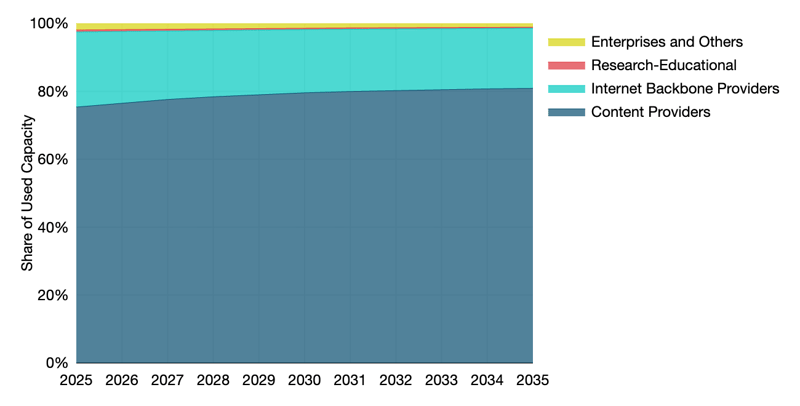
While it is not possible to disaggregate AI-specific demand, our content provider bandwidth category includes the networks of major hyperscalers, cloud providers, as well as AI platform companies and neoclouds. These are the networks most heavily impacted by AI.
The companies in this category are the dominant users of international bandwidth and accounted for 75% of all used capacity globally in 2025. International content provider bandwidth is expected to increase 9-fold from 2025 to 2035.
Used International Bandwidth by Source
Mapping future capacity growth
Major cloud service providers (Amazon, Microsoft, Google) along with Meta (which lacks a cloud business) have global networks that carry a wide mix of traffic types, including AI-based demand. Since AI inference is largely cloud-based, looking broadly at major cloud region locations is a useful way to see which locations in each region are key nodes for future capacity growth. The map below reveals the focus on cloud regions in the U.S., Europe, and Asia. The investment from these companies in new terrestrial fiber and submarine cable systems is heavily influenced by the need to interconnect these sites.
Select Proprietary and Cloud Region Data Center Locations, 2026
.png?width=700&height=400&name=unnamed%20(5).png)
Notes: Map depicts major proprietary data center and cloud region locations. Companies depicted here are also present in many other shared locations. Campus expansions in existing locations are not depicted with the “Planned” icon.
Two of the major AI platform companies rely on the major hyperscalers’ networks for global reach and massive compute, they aren’t content just being standard cloud tenants. Both OpenAI and Anthropic are actively building out their own private networks to interconnect critical data centers, meaning they are increasingly acting like network operators in their own right.
Because AI’s appetite for power is seemingly endless, major hyperscalers aren’t just letting workloads sit idle. Operators like Google are actively routing computing workloads dynamically across different data centers worldwide to optimize for power and compute availability. Engaging in this approach requires a robust, high-capacity mesh network acting as a global load balancer.
It’s not all AI
AI has the potential to reshape global network topologies by forcing networks to follow the quest for energy and compute efficiency. But let’s be careful to not attribute increasing international bandwidth demand requirements simply to AI. Bandwidth demand for cloud services, video, social media, and the long-tail of applications that are not directly tied to AI is massive and still growing. Global network expansion will also continue to be needed along traditional corridors.
Get more intelligence like this
Our Transport Networks Research Service delivers data and analysis on long-haul networks and the undersea cable market, with forecasts of international bandwidth supply, demand, prices, and revenues. Learn more and get research samples delivered to your email.




.png&description=Long-Haul+Networks+and+Bandwidth+Growth)