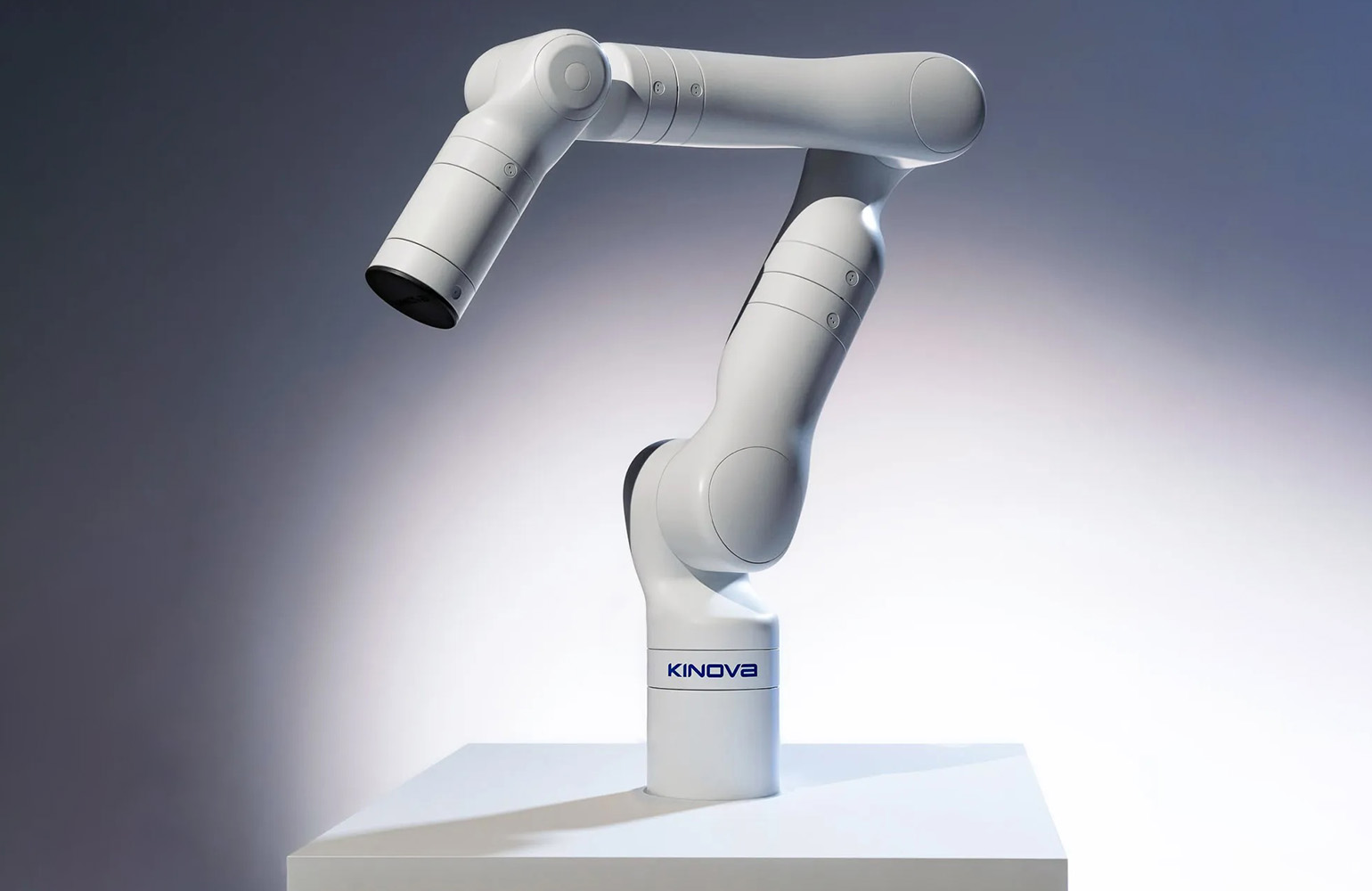
Designed for precision-driven surgical robotics, KIMA combines calibrated accuracy, repeatable motion control, and compact clinical integration. | Source: Kinova
Kinova Inc. recently marked its 20th anniversary by launching KIMA, a medical robotic arm purpose-built for clinical environments. The company said KIMA can support practitioners across a broad spectrum of applications, from endoscopy and bronchoscopy to complex surgical interventions.
“KIMA represents a shift in how medical robotics should be built,” said François Boucher, vice president of strategic growth at Kinova. “We designed this robotic arm specifically for clinical realities, applying absolute quality manufacturing standards to pave the way for technologies better aligned with the needs of patients and practitioners.”
Founded in 2006, Kinova is a global developer of assistive and collaborative robotics. The Boisbriand, Quebec-based company designs, develops, and assembles its products in Canada. It offers robotics for medical, industrial, and research use cases.
Kinova built KIMA to fit into modern operating rooms
Operating rooms and clinical environments often rely on multiple robots, advanced medical devices, and clinical equipment that must coexist within space constraints. Kinova said it engineered every KIMA component to optimize volume, weight, and form factor, helping maximize workspace efficiency while integrating into medical solutions.
Kinova said it designed KIMA from the ground up for clinical use and did not adapt the robot from industrial technology. KIMA natively integrates IEC 62304 Class C software and ISO 14971 safety standards. With a 3 kg (6.6 lb.) payload class and a lightweight frame under 13 kg (28.6 lb.), it eliminates bulky control boxes.
Every joint includes redundant torque sensors and supports advanced monitoring functions designed for medical environments. This architecture helps monitor joint-level performance and supports the safety requirements of medical robotic applications, Kinova said.
KIMA features an open architecture using EtherCAT communication protocols and a control library in a controller-less design, enabling direct control and easier integration into existing medical platforms. Instrument drives include power and passthrough I/O capabilities, facilitating the integration of surgical instruments and medical devices, noted the company.
Partners ease integration of modular platform
KIMA is supported by a network of technology partners, including QNX, RTI, MedAcuity, MPE, and Acontis. They help to minimize integration complexity, according to Kinova. This modular platform enables innovators, from startups to global medtech leaders, to accelerate the development of advanced clinical solutions, it said.
Last year, Kinova partnered with Bota Systems AG to bridge the simulation-to-reality gap with multimodal interaction sensing and to accelerate robot development. The company said the integration of its Gen3 robotic manipulator with Bota Systems’ SensONE T15 force-torque sensor will create “a seamless and powerful solution for experimentation.”
“The important thing is not the size of the steps we take, but the willingness to keep moving forward, one step at a time, in the same direction,” said Charles Deguire, co-founder and CEO of Kinova.
 Submit your session idea for the 2026 RoboBusiness
The post Kinova launches KIMA medical robotic arm appeared first on The Robot Report.


