Viewpoint, Comarch Communications
The European telecommunications market is expected to grow slowly, at just 2% to 3% by 2029. Because of this slow growth and the challenges of a complex global economy, operators are rethinking how they work. The industry is now looking beyond traditional consumer cellular services, which are only growing at 3% to 4%, and is moving toward broader communication ecosystems, including mission-critical networks, satellite infrastructure, and massive IoT deployments.
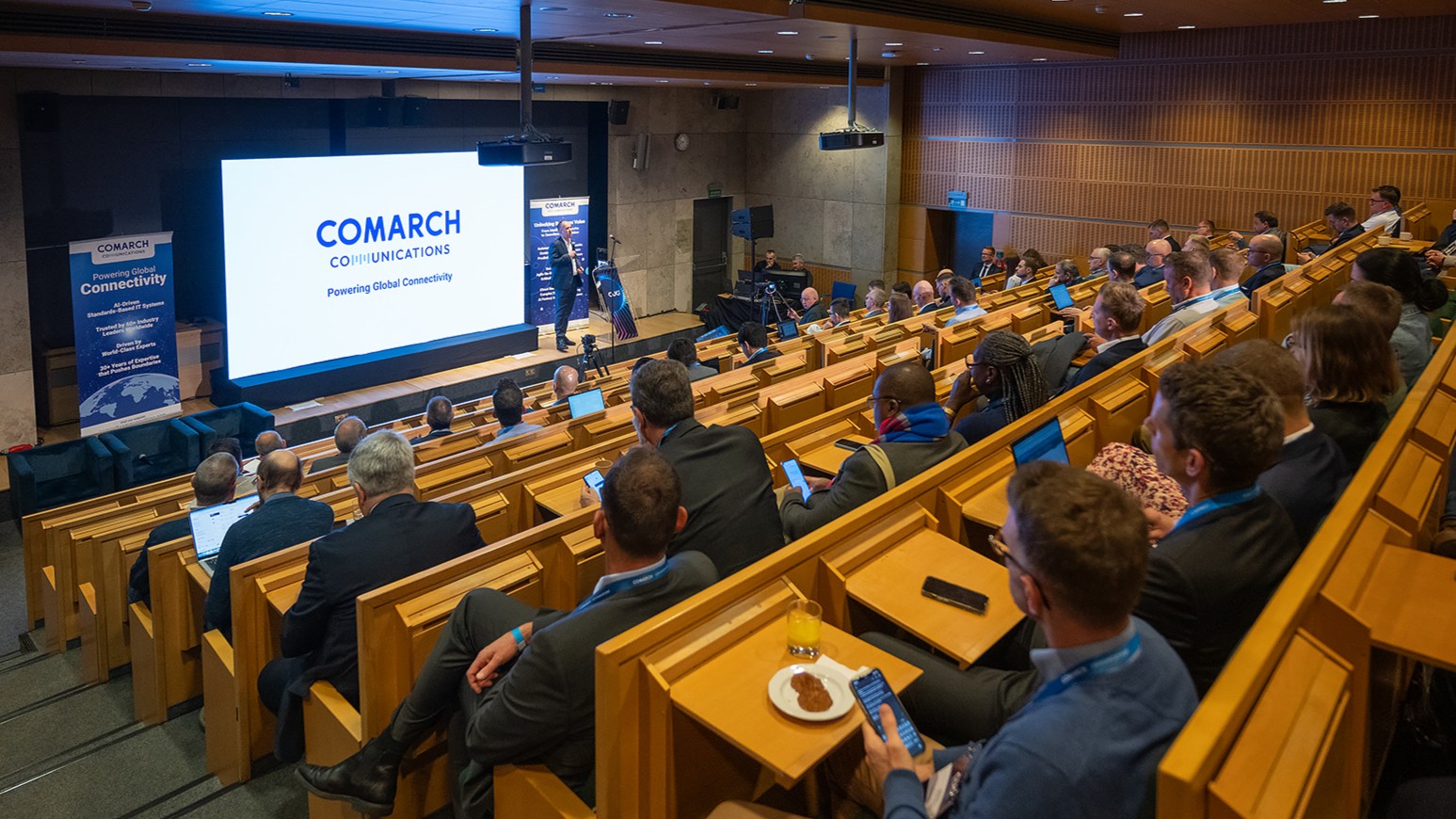
These challenges and emerging trends were extensively discussed at the recent Comarch User Group gathering, highlighting the critical paths operators must take to stay competitive. The event hosted over 700 partners from 53 countries across 8 streams, including 201 connectivity experts.
Economic pressures and productivity demands
The global economy now demands high levels of investment, especially in technology. Major countries are spending heavily. China, for example, is allocating 25% of its GDP to infrastructure and technology, creating far more value than Europe’s tech investments. In this competitive environment, traditional efficiency methods are not enough. Communication Service Providers (CSPs) need to boost productivity by quickly adopting new technologies.
“Global markets are pivoting towards AI adoption, where traditional efficiency methods simply won’t be enough to keep pace with the global economy. As we emphasized alongside our partners at the recent Comarch User Group, CSPs must fundamentally rethink their operational models. We can no longer rely solely on consumer cellular services, we must pivot aggressively toward broader, more complex ecosystems and services that encompass mission-critical networks, massive IoT deployments, and autonomous multi-orbit satellite infrastructure,” commented Marcin Kaleta, CEO at Comarch Communications.
Tackling complexity with Agentic AI
One of the main challenges for CSPs is handling the growing complexity of their networks. Right now, up to 40% of network outages are caused by human error, and 88% of digital transformations do not meet their goals. To address this, the industry is moving from basic automation, which depends on humans following rules, to Agentic AI, where systems take on more responsibility within set policies.
Client case studies presented at the Comarch User Group this year highlighted that changing systems to support intent-based actions allows for as much as 30% to 40% cut in Network Operations Center costs and a 10% to 20% faster Mean Time to Repair (MTTR). However, only 6% of CSPs have the data streaming abilities needed to fully use advanced AI models, meaning that technical readiness is still a big hurdle.
Massive IoT deployments and API Economy
Integrating Massive IoT into 5G networks brings new physical and technical challenges. The old way of constantly checking devices drains batteries and can overload the network. During the inaugural IoT Connectivity Forum at CUG 2026, experts detailed that switching to an event-driven setup and using the 5G RedCap standard makes it easier to manage connected devices. Standardizing CAMARA interfaces and Network Exposure Functions (NEF) also helps operators move toward an “API economy.” This change enables them to monetize network Quality of Service (QoS) through targeted microservices, making CSPs more than just simple data carriers.
Overcoming technology debt with modular systems
To take advantage of these new revenue opportunities, operators need to address their existing technology debt. Old, monolithic systems often slow down IT teams and pose significant risks when changes are made. Instead of replacing everything at once, the industry is moving to composable Business Support Systems (BSS) using the TMF Open Digital Architecture. This modular approach allows for targeted upgrades, such as adding cloud-native billing engines that can scale resources as needed.
Jacek Prokop, BSS Product Marketing Manager at Comarch Communications, highlighted this topic, referring to monolithic legacy systems as a “silent killer”. To mitigate the risks of migrating away from these monoliths, he introduced the concept of operational digital twins within a modular architecture present in Comarch Communications’ Composable BSS suite: “We are giving you a secure, isolated sandbox where you can clone and test your real production data, like orders and products, without ever touching the live system.”
Sovereign networks in the face of global instability
Geopolitical instability has made connectivity more than just a basic service – it is now seen as a key part of national sovereignty. There is a clear gap in space infrastructure: the US has many more satellites and launches them much more often than Europe. To reduce this dependency, programs like the European Union’s IRIS² are investing €10 billion in building a secure, multi-orbit satellite network. Running this kind of infrastructure requires ground software that can manage complex data and mission control autonomously, without relying on other countries.
Preparing core architecture for the next decade
As the industry faces economic pressures and the need to improve productivity quickly, it is important to focus on core architecture rather than individual use cases. Building modular systems and supporting operational independence will be key for operators who want to profit from new ecosystems.
Looking ahead, CSPs need to ask themselves an important question: Is our data architecture strong enough to support autonomous agents and sovereign networks so we can stay competitive in the next decade?


