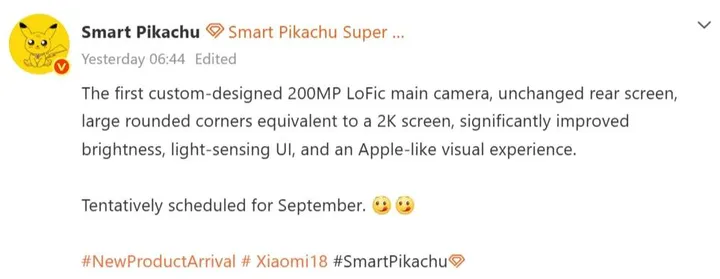
Months before an expected September launch, the
Xiaomi 18 series is already generating serious leak activity from the most reliable names in the Chinese tipster scene. The headline addition this week: the
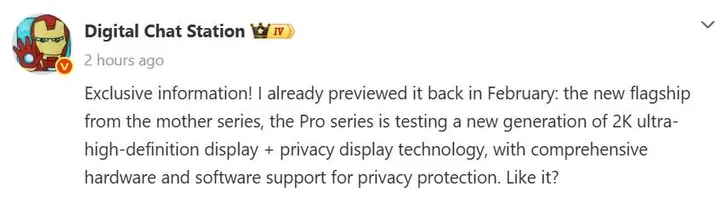
Xiaomi 18 Pro is reportedly
being tested with a hybrid hardware-software privacy display — the kind of tech currently exclusive to the Samsung Galaxy S26 Ultra. Pair that with dual 200MP cameras across the Pro lineup, an AI hardware button, and battery capacities that dwarf last year’s models, and you’ve got a flagship cycle that looks genuinely ambitious on paper.
Summary
- The Xiaomi 18 Pro is being tested with a privacy display combining hardware and software solutions to limit viewing angles — closely following Samsung’s Galaxy S26 Ultra approach.
- The Pro and Pro Max get dual 200MP cameras: a new LOFIC main sensor and a 200MP periscope telephoto at 85mm — replacing the 50MP/115mm lens from the Xiaomi 17 series.
- Displays range from a 6.3-inch 2K LTPO OLED on the Pro to a 6.9-inch 2K LIPO OLED with ultra-narrow bezels on the Pro Max; all models upgrade from the Xiaomi 17’s 1.5K panels.
- The base Xiaomi 18 gets a 7,000mAh-class silicon-carbon battery (up from 6,330mAh on the 17); the Pro Max hits 8,500mAh with 100W wired and 50W wireless charging.
- All three models launch in September running HyperOS 4 on Android 17, powered by Qualcomm’s Snapdragon 8 Elite Gen 6 on a 2nm process — with the Pro Max getting the higher-tier SM8975 variant with LPDDR6 RAM.
Privacy Display: Hardware, Software, or Both?
Samsung introduced hardware-level Privacy Display on the
Galaxy S26 Ultra earlier this year and the response from reviewers was unanimously positive — narrow viewing angles that prevent shoulder-surfing without degrading the owner’s experience. Xiaomi is reportedly heading in the same direction for the 18 Pro, though with a key distinction: the current leak suggests a hybrid hardware-software implementation rather than pure hardware. That mirrors the approach Xiaomi is exploring in HyperOS 4, which was confirmed to include software-based privacy angle narrowing. Whether the final product uses a dedicated hardware layer — as Samsung does — or leans primarily on software will determine how effective it actually is in practice.
The timing isn’t coincidental. Digital Chat Station flagged that Samsung is also testing privacy display extensions for future Galaxy models. What was an Ultra-exclusive feature in February is rapidly becoming a benchmark the rest of the premium segment feels obligated to match.
The Camera Math This Year Is Different
Every major Xiaomi flagship ships with a
200MP main camera now — that’s not the news. The news is the telephoto. The
Xiaomi 17 Pro and Pro Max used a 50MP periscope lens at 115mm with 5x optical zoom. The 18 Pro lineup is reportedly switching to a 200MP periscope sensor at 85mm, marketed as approximately 3x to 3.5x optical zoom. That’s a shorter native focal length, but the resolution jump means Xiaomi can offer lossless digital zoom well beyond 85mm — effectively replacing optical reach with sensor resolution. Whether that trade-off works as well in practice as it does in theory is the question every review will need to answer.
“Dual 200MP cameras — main and telephoto — across the Xiaomi 18 Pro lineup would make it one of the most resolution-aggressive camera systems on any Android flagship this year, competing directly with Vivo’s X500 Ultra and Oppo’s Find X10 Ultra.”
AI Button, Bigger Battery, and Two Chip Variants
The AI button on the
Xiaomi 18 Pro is confirmed by multiple tipsters. One press triggers Miclaw, Xiaomi’s on-device AI agent. A double tap connects to the Xiaomi SU7 electric car — checking status or starting it remotely. A long press runs smart home routines. Three gestures, zero software menus. It’s a practical implementation of hardware AI shortcuts that goes meaningfully beyond Apple’s Action Button in terms of ecosystem integration.
Battery capacity is the most unambiguous upgrade. The base Xiaomi 18 jumps from 6,330mAh to somewhere in the 7,000–7,800mAh range using silicon-carbon cell technology. The Pro Max hits 8,500mAh with 100W wired and 50W wireless charging. On the chip side, Qualcomm will reportedly offer two 2nm variants: the standard Snapdragon 8 Elite Gen 6 (SM8950) for the base and Pro, and the SM8975 Pro variant — with full-power GPU, maxed cache, and LPDDR6 RAM — reserved for the Pro Max.
None of this is confirmed by Xiaomi. September will tell.