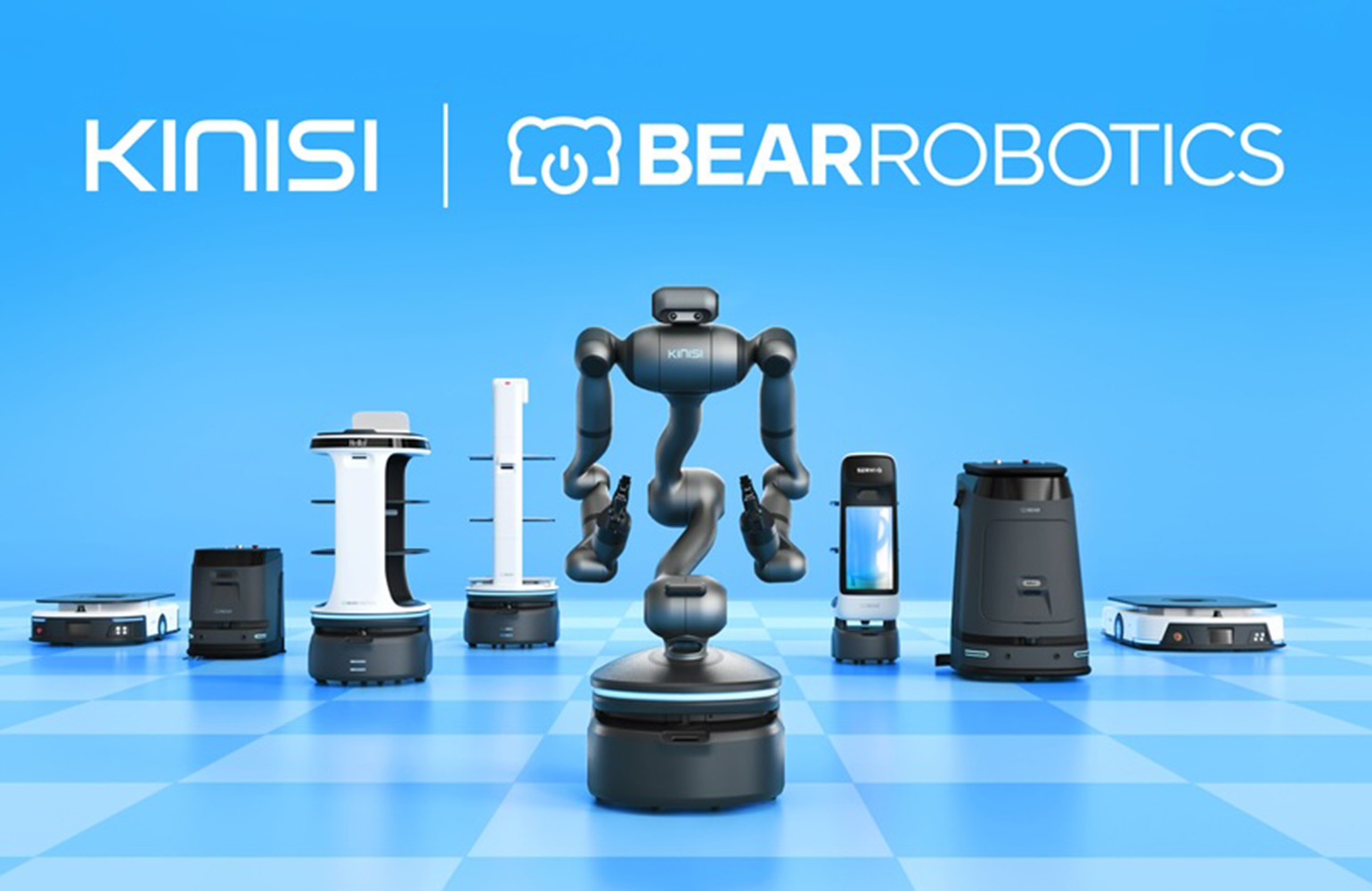
Kinisi Robotics’ KR1 will join Bear Robotics’ portfolio of service robots. | Source: Bear Robotics
Bear Robotics today announced it has signed a definitive agreement to acquire Kinisi Robotics. The transaction will make Kinisi part of Bear.
On closing, Kinisi’s KR1 humanoid robot, its Bristol-based engineering team, and its physical AI capabilities will be integrated into Bear Robotics, completing Bear’s end-to-end physical AI robotics platform. The companies expect to close the transaction in the coming days.
“Bear was built to put robots to work in the real world, and we’ve spent years building the platform to do it: thousands of robots deployed, one cloud orchestration stack, real enterprise customers, and a manufacturing supply chain behind them. Kinisi completes that platform,” John Ha, the founder and CEO of Bear Robotics, said. “Its manipulation AI is the layer that lets our robots move from navigating and delivering to actually handling the work in front of them. Most companies are trying to get from a pilot to a product; we’re expanding from a deployed commercial fleet into full Physical AI automation. I want to thank the Kinisi team for what they’ve built in the KR1, our customers and partners for their continued trust, and our employees and investors for backing this next chapter. This is the start of a much bigger chapter for Bear.”
Why is Kinisi acquiring Bear?
Kinisi has been building on Bear’s production navigation stack since the company began. This stack is the same technology that powers Bear’s commercial fleet. That technical relationship gave Bear an unusually clear view into the quality of Kinisi’s engineering, the maturity of its KR1 manipulation platform, and the depth of its physical AI research.
This relationship also shows why the two companies are stronger together, Bear said. This isn’t a robot arm bolted onto someone else’s machines. Bear’s delivery robots, floor cleaners, and, with Kinisi, humanoids all run on one platform and work as a single coordinated team, not a patchwork of products from different vendors.
The two sides also feed each other: Bear’s fleet produces a constant stream of real-world data from thousands of sites, while Kinisi’s hands-on data-capture tools add manipulation examples cheaply and quickly. Together, the companies can train Kinisi’s AI models faster than either company could alone. In one step, Bear gains the manipulation technology and the research team it would otherwise have spent years building, it claimed.
The acquisition also reunites Bear with Brennand Pierce, a co-founder of Bear. Bear said it looks forward to welcoming Bren and the team he has assembled back into the company once the transaction closes.
Bear has shipped more than 16,000 robots worldwide
Since its founding in 2017, Bear has shipped more than 16,000 service robots into commercial service worldwide. Bear’s robots already work together as one coordinated team through agentic multi-robot orchestration, moving freely through busy, changing spaces instead of following fixed tracks or routes.
Most robotics companies are still trying to get from pilot to product; Bear is already there, with the robots, customers, manufacturing, and real-world data in place. The company said Kinisi adds the missing piece, an AI that lets robots handle objects. This means the same fleet can go beyond moving and cleaning to picking, sorting, and handling physical work.
With the acquisition, Kinisi brings a range of benefits to Bear, including:
- The KR1 humanoid robot is a wheeled humanoid platform designed for picking, placing, sorting, and moving objects across industrial, logistics, and hospitality environments.
- Kinisi’s proprietary manipulation models include a vision-language-action (VLA) model and a robot foundation model (RFM). Kinisi built these on a modern AI infrastructure stack, spanning imitation learning, reinforcement learning, agentic task control, and computer vision for object detection, localisation, segmentation, tracking, and classification.
- Kinisi created an in-house gripper and end-effector design, plus a low-cost, robot-agnostic glove that captures manipulation demonstrations by hand. This allows it to decouple training-data collection from robot time and scale the demonstrations the models learn from.
- Kinisi’s European engineering hub in Bristol extends Bear’s footprint into the United Kingdom alongside its existing Bay Area operations.
What does this mean for Kinisi’s partners and customers?
Until closing, Bear Robotics and Kinisi Robotics continue to operate as separate, independent companies. Existing customer relationships, pilots, evaluations, and points of contact on each side continue unchanged in the interim period.
On closing, this acquisition will expand the range of work Bear’s robots can do, on the same platform that Bear customers already rely on. Kinisi customers’ point of contact and in-flight pilot will continue uninterrupted under Bear, with the operational scale of Bear behind every deployment, including production manufacturing, fleet management, deployment services, and customer support.
“Signing this agreement is the right next step for Kinisi and for the KR1. We built Kinisi on Bear’s navigation stack from day one because we believed it was the strongest foundation in the industry. What Bear has that no one else does is a real physical AI platform already operating at commercial scale – deployed robots, enterprise customers, manufacturing, and cloud orchestration,” Brennand Pierce, the founder and CEO of Kinisi Robotics, said. “Manipulation is the missing layer, and that’s what Kinisi brings. Together, we’re not building one humanoid in isolation; we’re completing an integrated, multi-robot automation platform. I’m excited about what we’re going to build.”
The Bristol office will continue as a strategic engineering hub for Bear. On closing, Pierce will join Bear’s leadership team as Chief Robotics Officer, continuing to lead the Kinisi engineering organisation with the KR1 platform under his direction.
 Submit your session idea for the 2026 RoboBusiness
The post Bear Robotics acquires Kinisi Robotics to boost its physical AI capabilities appeared first on The Robot Report.


