1
Speaking at the opening keynote of MWC Shanghai 2026, Zhong Zhihong, chief engineer at China’s Ministry of Industry and Information Technology, said China will continue to accelerate the deployment of next-gen digital infrastructure while advancing research into 6G
In sum – what to know:
Economic growth – Mobile technologies generated $1.5 trillion for China’s economy in 2025 and are projected to contribute $2.1 trillion by 2030, according to the GSMA.
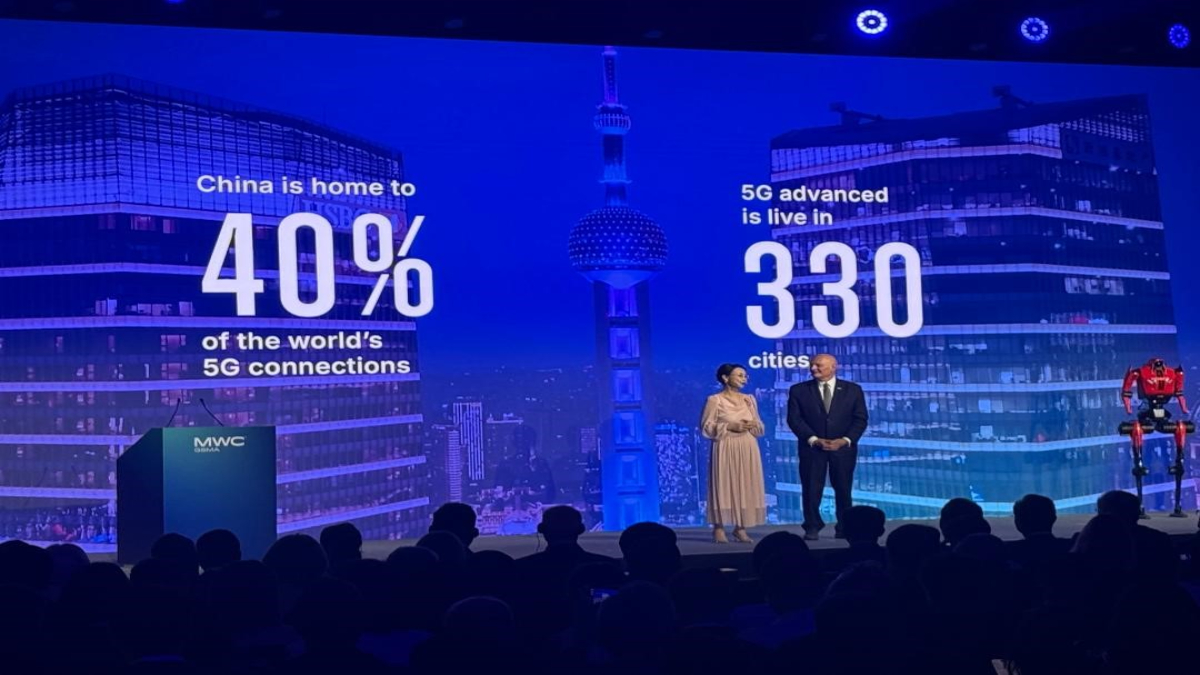
5G-A expansion – China has emerged as one of the world’s leading 5G-A markets, with coverage extending to more than 330 cities and user numbers surpassing 10 million.
AI-driven networks – Chinese operators are increasingly adopting AI-enabled, scenario-based network management to support a growing diversity of devices and services.
SHANGHAI — Mobile technologies are expected to contribute $2.1 trillion to China’s economy by 2030, up from $1.5 trillion in 2025, according to a new report released by the GSMA at the opening of MWC Shanghai 2026.
The report, dubbed ‘The Mobile Economy China 2026’, forecasts that the mobile sector’s contribution to the Chinese economy will grow at a compound annual growth rate (CAGR) of 7% through the end of the decade, nearly double the country’s projected overall GDP growth rate of 3.8%.
According to the GSMA, mobile technologies and services generated 7.2% of China’s GDP in 2025, equivalent to $1.5 trillion in economic value. Productivity improvements accounted for the largest share of benefits, contributing $990 billion, while the direct contribution of the mobile ecosystem reached $380 billion.
The industry body said mobile technologies are playing an increasingly important role in supporting economic resilience and competitiveness by enabling digital transformation across industries through 5G, IoT and AI.
Speaking at the opening keynote of MWC Shanghai 2026, Zhong Zhihong, chief engineer at China’s Ministry of Industry and Information Technology (MIIT), said China will continue to accelerate the deployment of next-generation digital infrastructure while advancing research into 6G technologies.
“We need to step up the planning and development of new generation communication networks and computing networks, promoting evolution for dual gigabit network to dual 10 gigabit network,” Zhong said. The official also stressed the importance of accelerating “the research and development of core technologies as 6G development of standards” while proactively cultivating industrial ecosystems around the future technology.
Zhong added that China aims to further integrate advanced communications and AI across the economy, noting that large language models should be “better integrated with agriculture, education, medical and other fields and sectors.”
The GSMA report also highlighted China’s leadership in the commercialization of 5G-Advanced. By 2025, the country had become one of the world’s most active 5G-Advanced markets, with commercial launches by major carriers including China Mobile, China Telecom, and China Unicom in mainland China, as well as operators in Hong Kong and Macau.
Momentum has continued into 2026. The report cited the launch by China Telecom Shanghai of what it described as China’s first commercial “5G-Advanced × AI massive-uplink network,” featuring more than 5,000 upgraded sites, peak uplink speeds of 1 Gbps, and continuous 20 Mbps uplink coverage in key urban areas.
Commercialization is also expanding beyond faster speeds. Operators are increasingly using 5G-Advanced to deliver differentiated services in scenarios such as stadiums, tourism sites, transportation hubs, and live events, combining enhanced uplink capabilities, differentiated packages and new monetization opportunities, the GSMA report said.
By the end of 2025, 5G-Advanced coverage in mainland China had reached more than 330 cities, while the number of users surpassed 10 million by mid-2025, according to the report.
The GSMA also noted that China’s next phase of 5G development will be shaped by increasingly diverse traffic patterns. Networks are now supporting a broader range of connected devices, including wearables, industrial cameras, connected vehicles, drones, and asset-tracking devices, each with distinct connectivity requirements.
As a result, Chinese operators are moving toward more dynamic, scenario-based resource allocation under 5G-Advanced. Examples highlighted in the report include China Mobile’s differentiated premium service offerings for high-density events, joint efforts by China Telecom and China Unicom to orchestrate resources across shared infrastructure, and AI-driven network resource allocation initiatives developed by China Telecom and ZTE.
Overall, the report suggests that China is moving beyond nationwide 5G deployment toward a more differentiated and intelligent connectivity model, with 5G-Advanced, AI ,and new device categories reshaping network architectures and service delivery.
However, Chinese operators are still working to fully monetize existing 5G networks, highlighting a gap between technological ambition and commercial returns.
Hrushikesh Mahananda, telecom analyst at GlobalData, recently told RCR Wireless News: “Despite China being the world’s largest 5G market, mobile services revenue growth is expected to remain relatively moderate due to several structural and competitive pressures.”
The analyst added that intense price competition, market saturation and regulatory emphasis on affordable connectivity continue to weigh on average revenue per user (ARPU), pushing operators to increasingly focus on enterprise 5G applications and industrial digitalization.
To diversify revenue streams, Chinese operators are expanding beyond traditional consumer connectivity into areas such as private 5G networks, cloud computing, edge services, and AI-enabled platforms. Mahananda said that Chinese carriers are also monetizing 5G through industry-specific applications in sectors including manufacturing, mining, ports, healthcare and transportation, where capabilities such as low latency and network slicing offer clearer enterprise value propositions.


