Updated July 2, 2026 01:34PM
Socks don’t get the respect they deserve. During long days on the trail, socks play multiple roles for hikers, all of them essential. They decrease friction between your skin and boot, preventing blisters; they wick away sweat; they add extra padding around high-impact areas on your foot.
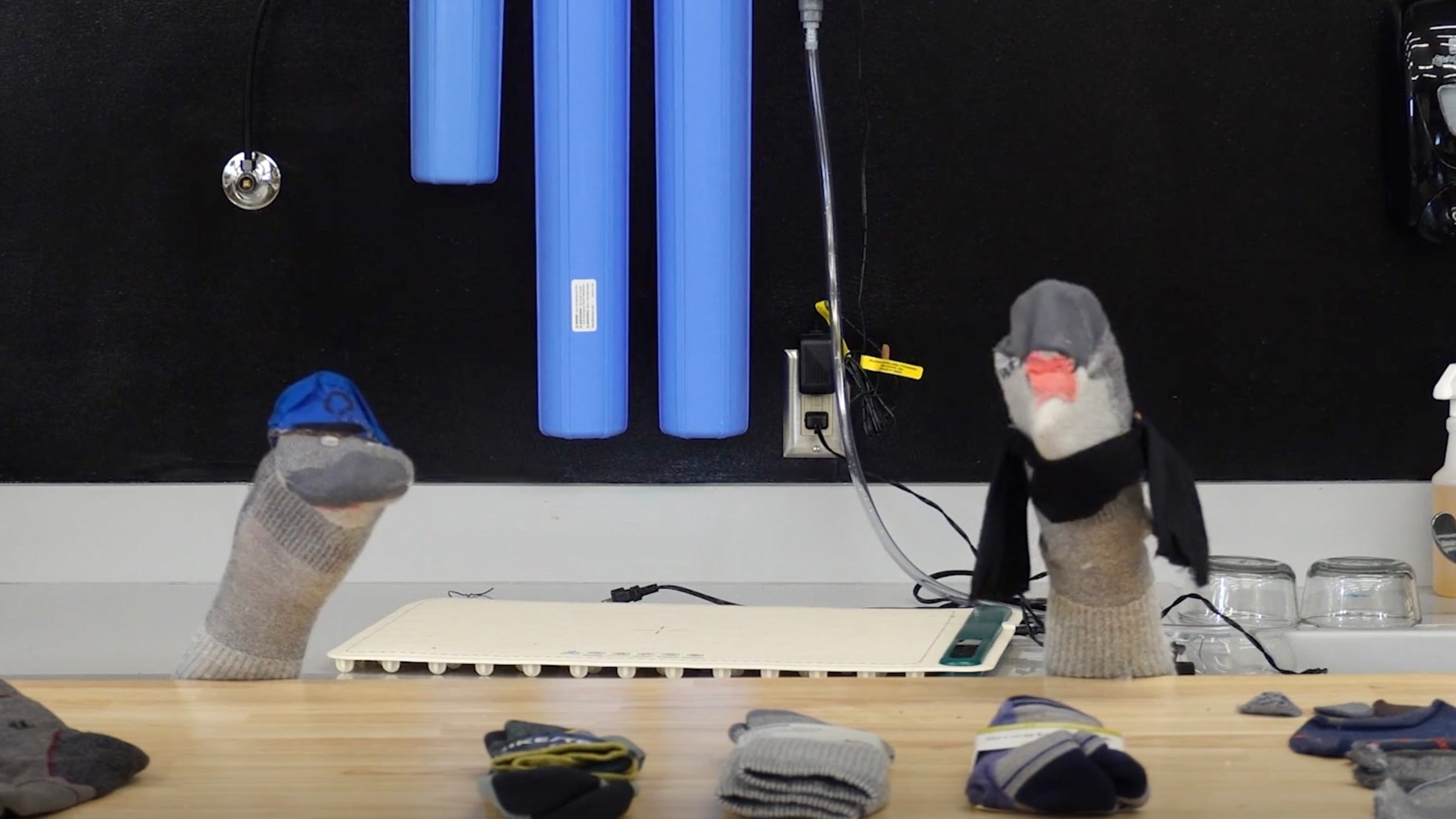
Our testers have spent countless days on trail evaluating the best hiking socks on the market. We took some of our favorites to the Outside Lab at CU Denver to get a more objective measure of how they performed. Backpacker Editor-in-Chief Adam Roy, Outside Lab Test Editor Adam Trenkamp, and a couple of sock puppet friends walk you through what you need to know.
Transcript
Puppet Adam Trenkamp: Hello. I’m Adam Trenkamp, Outside’s lab test editor.
Puppet Adam Roy: And I’m Adam Roy, editor-in-chief at Backpacker.
Puppet Adam Trenkamp: We’re here in the Outside Lab in Denver, Colorado, and we are here to talk about my personal favorite piece of gear…
Puppet Adam Trenkamp: Socks.
Puppet Adam Roy: Socks! Everyone wears wool hiking socks. Adam, what type of testing are we doing today?
Puppet Adam Trenkamp: We are going to absolutely destroy them to see when they break.
Puppet Adam Roy: That sounds like fun. Let’s dive in.
Puppet Adam Trenkamp: Just don’t put me in the machine.
Adam Roy: Socks are one of those important pieces of gear that backpackers just don’t think about that much, and we’ll admit they’re not the sexiest piece of apparel, but they are essential if you’re going to have a good hike. The right sock will be durable and it’ll prevent blisters. But how do you know which one to pick? Well, that’s where we come in. Adam, I understand we’re going to be doing some tests on socks today to understand how they perform. Could you walk me through them?
Adam Trenkamp: So what we’re going to do is actually look at two hiker-favorite brands and then one sort of more budget-friendly house brand. So we have some Smartwool socks, some Darn Tough socks, and then actually the REI merino socks as well. They’re all the same weight for cushioning, marked as lightweight. And what we really wanted to see was how they all perform in terms of durability through a few different tests, and then comfort as well.
And for comfort, we designated that as both drying time—if your sock gets wet from either sweat or rain, how quickly does it dry and you have warm, dry socks for the next day or the rest of the day—and then also how well do they breathe. So not only is breathability important in your shoes, but it’s also important in your socks. If it’s kind of keeping all that moisture around, you’re getting like, you know, jungle foot. That’s not really what you want. So we wanted to test that and see how each of these compared.
Adam Roy: All right, well let’s go do some science.
Adam Trenkamp: Science.
Adam Roy: So let’s start by talking about comfort. This is going to be the first thing you notice when you put on a sock; durability kind of comes later. How do you test comfort in the lab?
Adam Trenkamp: Yeah, so we can’t really test the way it feels to you. That’s a very subjective thing. So by making all of the cushioning the same—they’re all considered lightweight—what we focused on was both breathability of the sock—how well does it let your sweat escape the sock and then hopefully out of your shoe—and then we also looked at drying time. Inevitably, when you’re outdoors, at some point your socks are going to get wet. Either that be from sweat, or from rain, or from stomping through some creeks, at some point they’re going to get wet. We want to know how quick before they’re dry again.
Adam Roy: Tell me about how you test breathability. I assume you’re not just putting these on and sweating them up.
Adam Trenkamp: That would be less scientific, but also maybe more fun.
Adam Roy: More smelly.
Adam Trenkamp: Yeah, a little smellier. No, so what we do is we actually cut some samples out of the socks, not dissimilar from these, and we stretch it over a glass bowl of water which is then heated up. Your shoe gets pretty hot inside; your body temp when you sweat gets pretty warm. So what we try to do is maintain that body temp in the water itself to create moisture vapor similar to sweat, and then we measure it over time.
So every two hours we take a measurement of that over a six-hour period and see how much water is allowed to escape through the sock. And then we remove the sock from the dish and weigh it again post-test to see how much water gained into the sock as well. So at a point, moisture vapor may stop coming through and it’s just gathering in your sock and creating that sweaty, jumbled mess that’s real fun to hit your friends with when you take it off at camp. You should—you should try it. Just trust me.
So then, to test drying time after that, what we do is fully soak the sock and then wring it out. And then from there, we just let it sit and see how long it takes to dry, and we do that by weight and feel. So we weigh the sock when it’s dry, we weigh the sock when it’s fully saturated at the start of the test, and then we take a weight every 30 minutes until the sock reaches its original weight.
Adam Roy: So let’s talk about durability next. Obviously, nobody wants to blow out a sock on the first or second hike you use it on. I’ve had that happen—no fun. Some of these models actually make pretty big claims. Darn Tough has a lifetime warranty. Tell me about how you tested durability. You had two tests, you said.
Adam Trenkamp: Yeah, so for durability we did two different tests, and one of those actually breaks down into three different tests. So we started with abrasion. Think about when your sock is in the shoe itself: it’s rubbing on the footbed of the shoe, it’s rubbing on the heel of the shoe, it’s maybe rubbing in like the toe box itself. You know, the typical zones you get a hole—you blow out the heel, your big toe starts peeking through, something like that, right? We wanted to see how well do each of these socks hold up to that sort of wear.
Again, I didn’t put them on and let my toenails grow and see if I could scratch through. Might have been a good test; harder to get actual science out of that. So we used our AquaAbrasion tester that we use on a lot of textiles here in the Outside lab. And for that then, we did a zone of the heel, we did an abrasion zone from the top of the foot and toe area, and then also a footbed zone, so right underneath the foot, seeing as those are kind of the three main hot zones you might wear through, get a hole, or it’s just rubbing in the shoe.
And then we applied an abrasive pad that is a wool to sort of match the inside of a shoe. We’re not going to look at as much grit; hopefully you’re not getting a ton of dirt inside your shoes. It happens, that’s going to increase abrasion there. For our testing, we tried to just pretend your shoe stays comfortable and clean throughout a hike, and ran them for 100,000 cycles each, which equates to about 100 miles of wear, and looked at how much material was lost and what they look like. That’s how we did our abrasion test.
Next, what happens on the most important part of the sock, I think—the style part? We’ll call that in crew socks the part that sticks out of your shoe, gives you a little bit of flair if you like wearing designs, colors, thing, thing like that. Basically, it’s ankle coverage. When you’re walking down the trail—I’ve had this happen a lot and it’s really frustrating—a rogue rock, stick, root, something grabs the edge of your sock, rips a hole. We wanted to see how tough are these socks, how much can they take from that.
We went a little unrealistic and maybe construction-site style. We drilled a screw through a block of wood, put it in a clamp, and let it run across the sock repeatedly until it ripped a hole. And we counted how many times passed the sock it took before it ripped an actual hole, and then we could compare the socks apples to apples.
Adam Roy: So going into this test, what did you expect to find and how did that match up with the reality of the results?
Adam Trenkamp: Yeah, it’s a great question. Just based on the construction of the socks, I expected the two bigger name-brand ones in Darn Tough and Smartwool to perform better, especially in the snag test. They have a much tighter weave, and so it seems like less material to grab or at least to be loose and pulled loose in both the snag and the abrasion test as well, having that nice tight weave. Whereas the REI house sock initially looks and feels much thicker, but as you get into it you can tell, and from the results of breathability, that it’s just got a looser weave. So it’s kind of more loftier material, and that to me would say it’s going to grab a little easier in the snag test, maybe even the abrasion test as well, it’s just going to lose more material from there and not be as durable.
Now, in the snag test, it did not perform as well as the other two, but it still performed very well. I expected it to rip quickly; it did not rip quickly. I would still go on the trail confidently in those socks. The Darn Tough and Smartwool performed a little better in that snag test, but in the abrasion test, they were relatively the same, which is good for in-shoe durability. And then in drying time and breathability, sort of the same thing. I expected the REI sock, being a little loftier, looser sort of weave, to not dry as quickly. It actually dried very, very quickly.
Adam Roy: So overall, do you think there was one of these that came out on top, that outperformed the others?
Adam Trenkamp: Overall, the Darn Tough sock actually performed better through all of the tests than the others did, where it never really had a dip in any one zone. I would have thought going into the drying time test, based on the way they initially feel, that the REI sock would have been very slow to dry compared to the others, when in fact it was actually the Smartwool sock that was the slowest to dry in our time by about 90 minutes. The REI sock and Darn Tough sock had the exact same drying time.
Adam Roy: Well, I think we can get a clue when we look at what these are actually made of, like the construction is different on all of these. So if you’re not familiar, a merino sock is pretty much never 100 percent merino. Basically every manufacturer adds in some elastane for stretch and some nylon for both durability and drying time, and each of these has a different blend of yarn in it. So the Darn Tough is 54 percent nylon, so this is actually mostly nylon, 43 percent merino, and 3 percent lycra.
So the Smartwool, in contrast, is actually mostly merino. Looking at the yarn blend on the back, it’s 59 percent merino wool, 39 percent nylon, 2 percent elastane. That’s not a huge difference, but I could see how that might be enough to increase water retention. The only thing that confuses me is I took a peek at this earlier, and this REI sock is actually more merino by percentage than either of the others. It’s 80 percent merino, only 19 percent nylon, and 1 percent lycra. I’m a little surprised that this one dried so quickly.
Adam Trenkamp: Yeah, me too. And I think what it has to do is with the actual construction of the sock. As we mentioned before, it has sort of that lighter weave that feels like it gives it a little more loft, and I think that has to do with how quickly it was able to dry and not really retain as much moisture.
Adam Roy: So you think it’s not just the material, it’s how the sock is made that affects its drying time.
Adam Trenkamp: Yeah, I think both have a play.
Adam Roy: So in the end, all of these socks performed well. You would feel confident hiking in any of them, you know, on a long trip where you might not have a chance to resupply. But you do get what you pay for. These name-brand socks did somewhat outperform the REI in some of the tests.
Adam Trenkamp: Yeah, so the name—the name-brand socks really were just a touch above, but the REI sock kind of performed right down the middle where you would want it to. It was never low, it wasn’t a superlative in any of the tests, but again, it was never a low-performing sock in the test.
Adam Roy: So Adam, tell me about how hikers can use this information to decide which socks to buy.
Adam Trenkamp: Yeah, it’s kind of a tough call since they all performed pretty well. What we showed with our testing here is that there are some potential environmental considerations. In terms of durability, they all performed pretty well. If for some reason you find yourself hiking through a lot of thorn bushes—I don’t know what you’re doing, you need to change where you hike—but maybe pick up the Darn Tough because it did perform our best in the snag test overall. But I’d trust any of them.
Think about if you’re in a humid or wet zone or maybe a—a place where breathability is extra important because it is quite hot and you want to keep your feet cool. If you live in a really wet zone, you’re going to want to make sure you get one of the socks that dries a lot quicker.
Adam Roy: So tell me about where we could go from here. What other tests could we do in the future that you have not done so far?
Adam Trenkamp: I mean, there’s one test that immediately comes to mind and that is the smell test. Yeah, you know, I’m happy to go out there, do a lot of miles, and hike, and then let you smell my socks afterwards and tell me which ones are worse. I’m happy, Adam, if you would be my experiment assistant. We can do that. Otherwise, we might have to find another method.
Adam Roy: Hold on one sec, let me just…
Adam Roy (as puppet): No f*****g way!
Adam Roy: But as we all know, lab tests are only half of the equation. You have to get out—out into the field and see how things perform. You can see the results of our field tests on backpacker.com, and we also want to hear your experience. You can tag us in your posts on Instagram @backpackermag or go to backpacker.com and talk to us through the activity feed. Until next time, I’m Backpacker’s editor-in-chief, Adam Roy.
Adam Trenkamp: I’m lab test editor Adam Trenkamp.
Adam Roy (as puppet): We’ll see you next time!
Adam Trenkamp: Oh yeah, it’s a perfect twin. You can’t even tell who was speaking there. They look… they’re identical.
Puppet Adam Trenkamp: The more we test…
Puppet Adam Roy: …the more you know!


