255
Huawei tells MWC Shanghai 2026 that operators are entering an era in which AI applications, intelligent agents, and real-time interactions place new demands on mobile and transport networks
In sum – what to know:
AI-first networks – Huawei argued that AI applications are changing telecom network requirements, pushing operators beyond traditional connectivity toward AI-ready communication and computing infrastructure.
Computing evolution – The vendor said flatter optical networks, low-latency WAN architectures, and lossless transport will be essential to support distributed AI workloads and nationwide computing resources.
Technical progress – Huawei said it is working with operators on technologies including dynamic wireless slicing, AI traffic transmission mechanisms, and wide-area lossless networking to improve AI service performance.
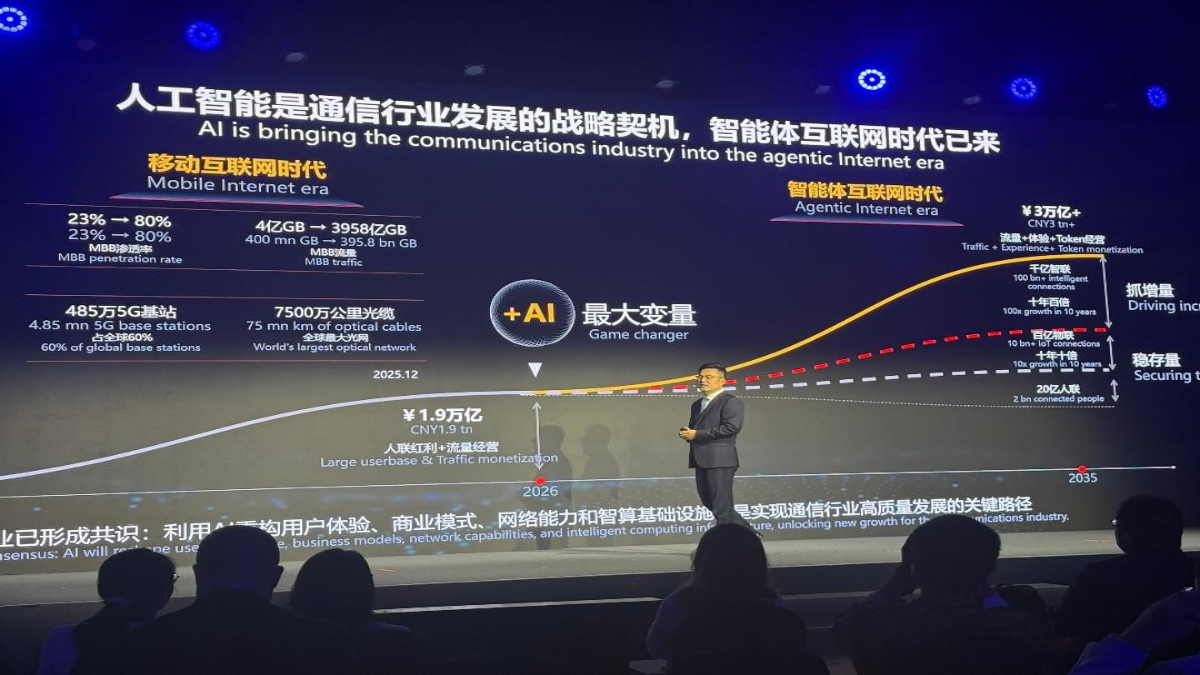
SHANGHAI—Huawei used its keynote presentation at the recent MWC Shanghai event to argue that artificial intelligence is reshaping how operators should build and monetize mobile networks, with future growth depending on AI-ready communication and computing infrastructure rather than traditional connectivity alone.
According to Liu Kang, president of ICT marketing and solution sales at Huawei, operators are entering an era in which AI applications, intelligent agents, and real-time interactions place new demands on mobile and transport networks. Huawei said future network performance will increasingly be measured by AI service quality, interaction fluency, and response reliability, alongside conventional metrics such as coverage and throughput.
The executive described two core operator businesses going forward: traditional communication services and computing services. While previous network generations primarily supported voice and mobile broadband, the company argued that AI workloads require networks capable of supporting distributed computing resources with low latency, high reliability, and efficient coordination between computing sites.
To support that evolution, Huawei said computing networks will require flatter optical architectures, direct optical connections, one-hop computing and wide-area transport capable of minimizing latency while improving resource scheduling across geographically distributed AI infrastructure.
The executive also outlined what it described as four priorities for future communication networks, including larger uplink capacity, higher downlink performance, lossless mobility, and guaranteed service quality. For computing networks, the company highlighted direct optical interconnection, lower-latency transport, lossless wide-area networking and end-to-end security as key architectural goals.
Huawei also discussed ongoing work to improve AI infrastructure efficiency beyond the network itself. Huawei said it continues to develop higher-density computing platforms, unified inference architectures, and large-scale computing nodes while applying digital twin technologies to optimize infrastructure performance. According to Huawei, these efforts have improved overall computing efficiency, while validation cycles for supported AI models have been reduced from weeks to days.
The executive further said it is collaborating with operators on several technologies intended to support AI services. These include dynamic wireless slicing to allocate network resources based on application requirements, new transmission mechanisms designed to synchronize multimodal AI traffic, and wide-area networking technologies aimed at reducing latency and packet loss across distributed computing environments.
Concluding the presentation, Liu Kang called for broader industry collaboration to develop AI-centric networks capable of supporting what it described as the next phase of intelligent internet services.


