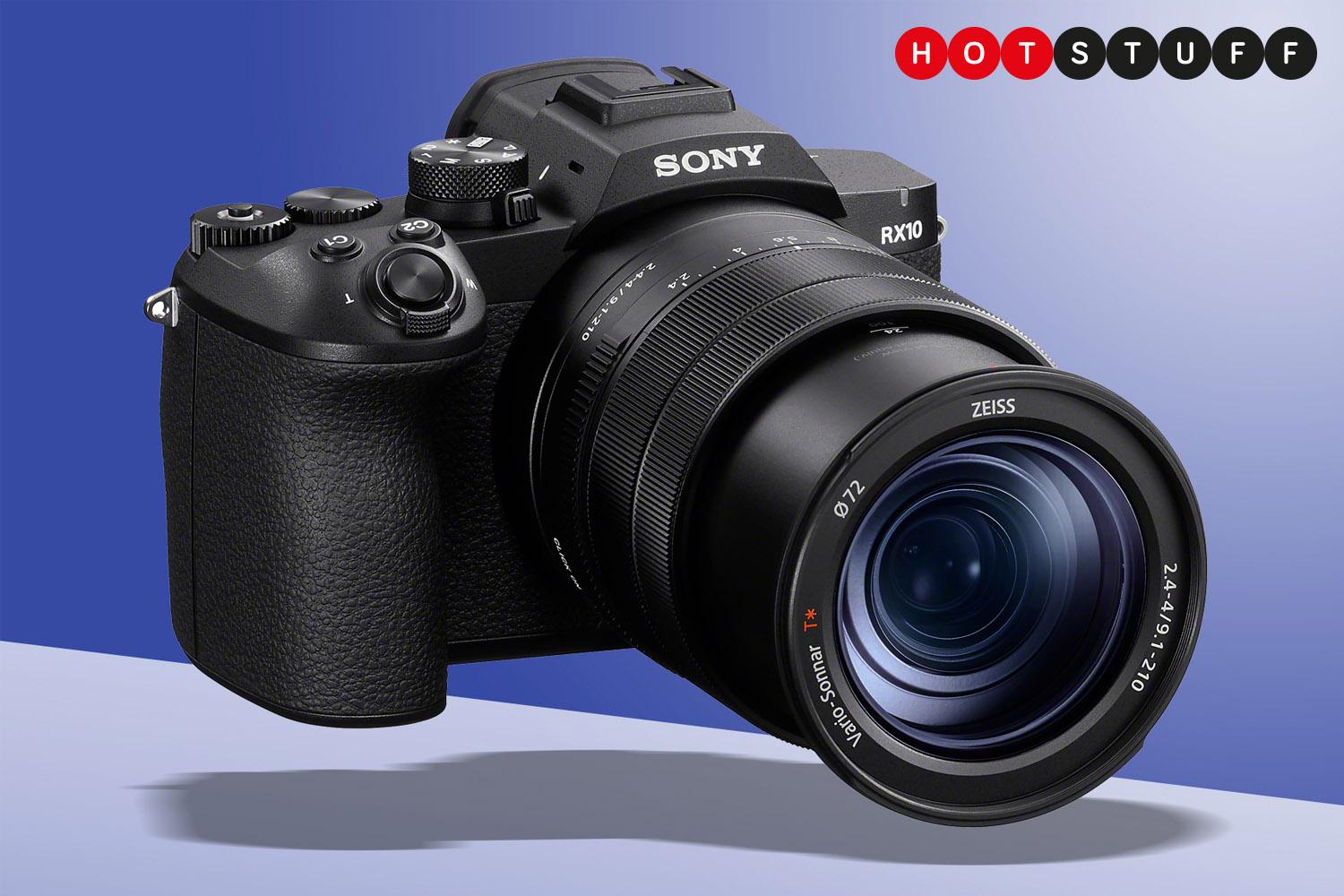
With pocket-sized compact cameras being all the rage and their interchangeable lens bigger brothers aiming more at professional creators, I thought the bridge camera’s days were numbered. Yet Sony is bringing it back from beyond the grave with the RX10 IV – a fixed-lens superzoom that has learned a few lessons from the firm’s Alpha division between generations.
The last-gen Sony RX10 IV is now nine years old, making this successor model almost a decade in the making. It’s had both a visual and mechanical overhaul: the more modern styling and rearranged top plate more closely match Sony’s mirrorless line-up, while the uprated autofocus is smarter than ever.
It’s the Zeiss Vario-Sonnar T* fixed lens that remains the star of the show, with a massive 24-600mm zoom and wide f/2.4-4.0 aperture range. Optical image stabilisation should keep your shots steady at extreme magnification, and there’s even digital zoom to boost reach up to a bonkers 2400mm. Close-ups are on the cards too, with a macro focus distance of just 3cm at the widest or 72cm at full tele.
The 20.1MP stacked Bionz XR CMOS sensor is newer but no bigger than the outgoing model’s, yet Sony is claiming improved colour reproduction and more effective noise reduction at medium to high ISO. There’s a dedicated AI processing unit that provides real-time and predictive subject recognition that can recognise eyes, faces, heads and bodies; animals, vehicles and insects are also detected, with an Auto mode able to do the whole lot without making you constantly change settings. The 575 focus points cover 70% of the sensor.
The RX10 V is a speedy thing, managing blackout-free continuous shooting with AF/AE at 30fps using an electronic shutter. You have the choice of shooting in HEIF as well as JPEG now, and lossless comp compressed RAW is supported for the first time. Other additions include creative looks that try to emulate analogue photographs, getting in on the trend kickstarted by Fujifilm’s film simulations.
Unsurprisingly for a Sony camera the RX10 V sounds adept at video too, being able to film at 4K/120p and apply MLUT/LUT colour profiles. 4K live streaming is supported over USB-C, which can also transfer files at 10Gbps USB 3.2 Gen2 speeds.
From the outside, the new grip is similar to the ones found on the A9 III and A1 II. The top plate sees the old model’s LCD display ditched in favour of a multi-selector dial that toggles between stills, movie and Slow and Quick (S&Q), as well as shooting modes. The electronic viewfinder is larger, has a higher resolution and adds an optional 120fps high frame rate mode, while the LCD display adds new tilting abilities. The user interface finally rotates into a vertical mode when portrait shooting too.
Sony reckons the battery is good for 570 and 630 shots depending on if you favour the EVF or LCD display.
The RX10 V is up for pre-order right now, directly from Sony and all the usual camera retailers. It won’t be a pocket change purchase, though: expect to payt £2200 in the UK and €2500 in Europe. US pricing and availability was still TBC at the time of writing.




