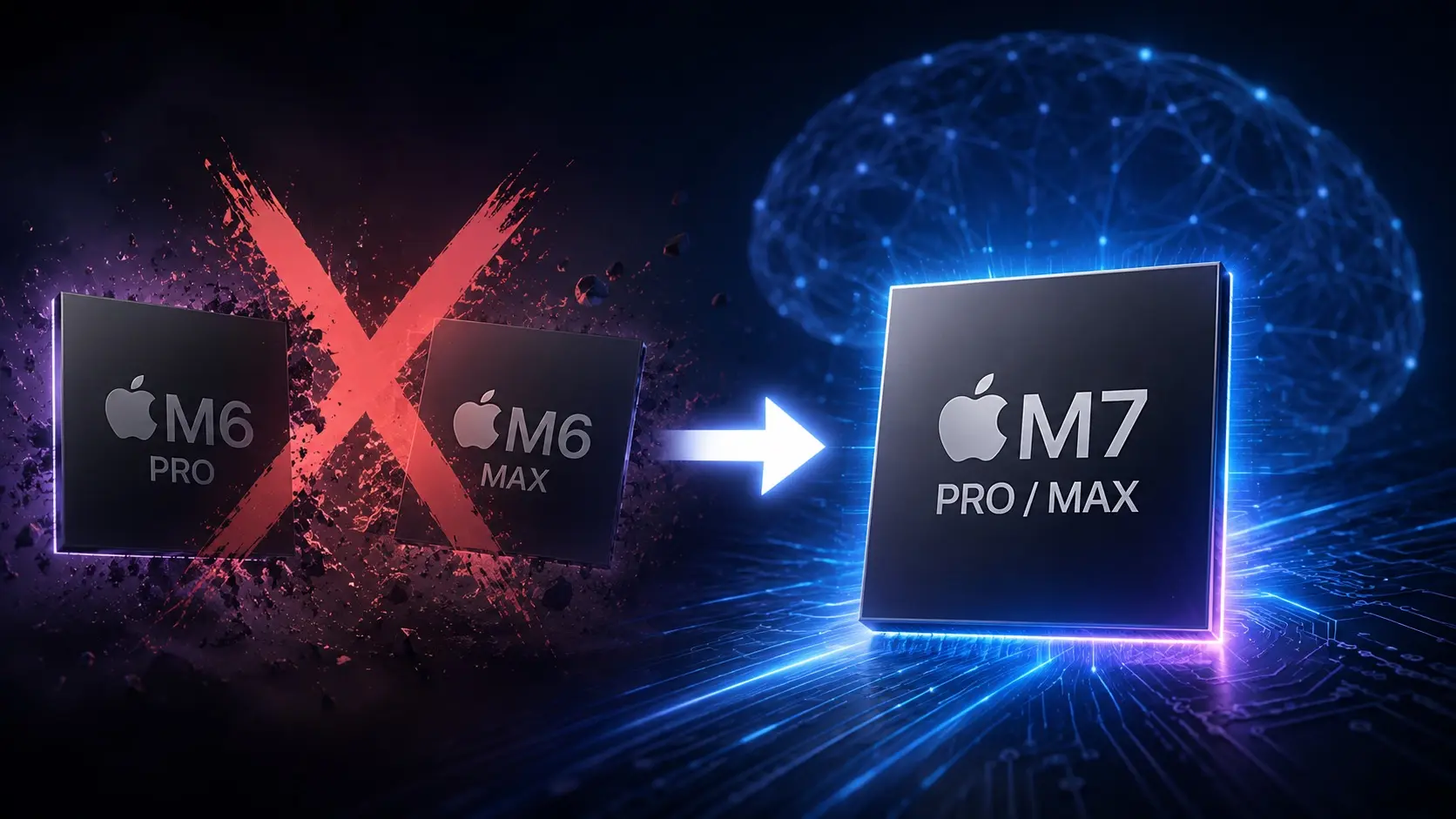
The next leap in Apple silicon may skip a step.
AI image: ChatGPT
Apple will supposedly skip launching the M6 Pro and M6 Max chips due to AI. Instead, it will launch an M6-powered MacBook Pro and then directly jump to the M7 Pro and Max chips in 2027.
This move would mark a notable shift from Apple’s long-established Apple silicon release strategy. Since the M1 debuted, every generation expanded from the base chip to Pro and Max variants.
M7 chips will focus on AI performance
In late June 2026, a Bloomberg report suggested that Apple would skip M6 Pro and Max chips for its redesigned MacBook Pros. Instead, these Macs would use the existing M5 Pro and M5 Max SoCs. As part of the rejig, Apple also apparently fast-tracked the M7 Pro and M7 Max launch.
In the latest edition of his Power On newsletter, Mark Gurman provided more insight into the change in Apple’s chip strategy. Apparently, Apple planned major Neural Engine upgrades for the M7 family. Because the Neural Engine is critical to AI performance—and with AI becoming an increasingly important focus—Apple reportedly decided to accelerate the launch of its M7 chips.
While there are no details about the rumored performance improvements, they seem significant. In particular, the M7 Ultra will “dramatically” improve AI performance. The jump would be so big that Apple may even use the M7 Ultra to power Apple Intelligence servers starting in 2029.
M7 Ultra may ship with 1.5TB RAM!
Gurman reveals another interesting tidbit about Apple’s next-gen high-end Apple silicon chips. He says the M7 Ultra can support up to 1.5TB of RAM, twice as much as the upcoming M5 Ultra. That’s also the same amount of RAM the 2019 Mac Pro supports.
However, there’s no guarantee that Apple will offer M7 Ultra-equipped Mac Studios with 1.5TB of RAM. The DRAM and NAND flash shortage and memory prices may force the company to limit the maximum RAM.
While the M3 Ultra supports up to 512GB of RAM, you can now configure it with only 96 GB. Apple discontinued the higher-end RAM options due to DRAM shortages.

Rajesh has been writing about consumer technology for over a decade, with a strong focus on iPhones, Macs and Apple’s ecosystem. He enjoys digging into Apple software updates, hardware changes, and discovering new Mac apps that make work faster and more enjoyable.
You can reach out to him at mail[at]rajeshpandey.me.



