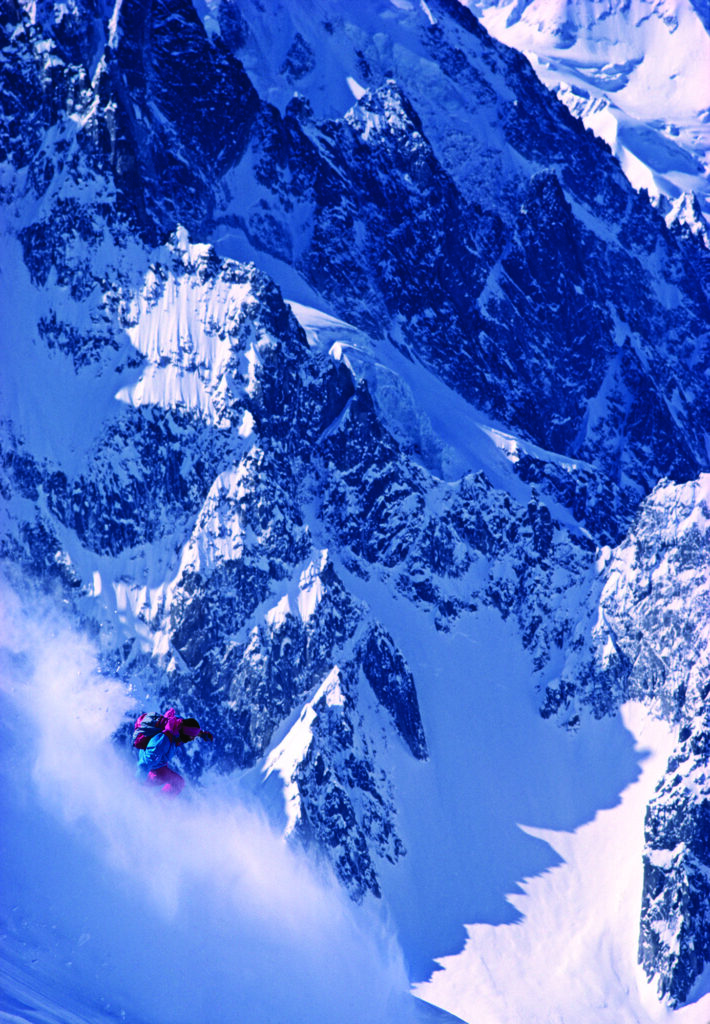
In the late 1980s, photographer and writer Chris Noble was spending time in Chamonix, France, ground zero for extreme sports, where people like Jean-Marc Boivin, Bruno Gouvy, and Patrick Vallençant were pushing the outer edge of snow performance. After one of those stays he brought a word back to the States that seemed to capture this high-angle energy, and he shared it with me: glisse.
Glisser, as Noble explained, meant to glide, and the French had adopted glisse, the act of gliding, as an umbrella for what Americans came to call action sports. To my young ears, new to the alpine scene, it was the right word at the right time—foreign, cool, suggestive of what North Americans were doing but not American. Glisse was slippery, slidey, Gallically insouciant and impish, connected in delightful sibilance to the movements it suggested. In a bit of wishful synesthesia, I associated the word with the plums and purples and pinks of Degré 7, Vallençant’s flamboyant clothing line, and I loved the way the “ss” could be drawn out until you ran out of breath, an onomatopoeic echo of a ski carving past you on snow, or flakes sweeping across your parka.
The origins of glisser date to the 13th century, when two Old French words, glacier (to slip or slide) and gliier (to slip, slide, or glide), were combined as one. In August 1786, when Jacques Balmat and Michel-Gabriel Paccard made the first ascent of 15,781-foot Mont Blanc, considered to be the launching point of alpinism, glisser was mostly used to describe unwanted slips. Around 1830, it shape-shifted into glissade, the act of sliding down snow in your boots. In the 1840s, glissade also became a ballet term, and in the 1870s it hooked up with Italian and became glissando, gliding notes of music. In little more than a century, accidental had become intentional, with the joy of motion as its root.
These cognates served the French well until the mid-1970s, when word came to France of a new type of ski competition in America—hot-dogging. More than just bump skiing, hot-dogging also incorporated ballet and aerials and, even more important, a hedonistic, rock-star attitude. Hot-doggers thumbed their nose at tradition, flipped off the establishment, and seemed to be having the most fun.
French kids like Bruno Bertrand liked the look of that.
Bertrand, who was born in 1967, came up through the ranks of traditional ski hierarchy, ultimately competing in moguls on the World Cup and in the Olympics, but as a teen was drawn to the liberating promise his countrymen were beginning to create.
“France was strongly influenced by American culture,” said Bertrand, who now works for Salomon. “But of course, the French people were speaking French with French words. We are proud of being French and being different, and some of the French don’t accept English language. We are pretty bad about that.”
“Glisse” adopted American ideas, made them French, and then went beyond mere description to create an imperative break from the past, rejecting the old and sparking the new.
“Glisse means to glide or slide or ride—it’s a little bit of everything altogether—and everybody has a different story about the first time they experienced glisse, and how they understood it,” said Bertrand. “For me, glisse was a little about skiing, but it was mostly about surfing the west coast of France. That was the coolest place when we were young, and for me glisse started there.
“It wasn’t your father or grandfather’s skiing. What it was was glisse. It was revolution.”
Glisse created, popularized, or amplified off-piste skiing, extreme skiing, paragliding, speed-flying, enchainments, hydrospeeding, skate, inline skating, surfing, windsurfing, and more. It became the inspiration for a movie series, Nuit de la Glisse (Night of the Glide), which was equally as influential as Greg Stump’s films in America. Glisse inspired generations of French youth to pull up roots—to move to the mountains, beaches, and rivers, to adapt old sports or invent new ones, to wear pink and purple, question authority, and let France’s freak flag fly.
Revolutions fade. Alternative sports became mainstream, mainstream became commercial, and the impossible became everyday. Surfing is in the Olympics. As the internet eroded French opposition to English, glisse lost its countercultural oomph. The word settled back into its traditional place in the dictionary. It still means to slide, though, and to some of us that will always mean freedom.


