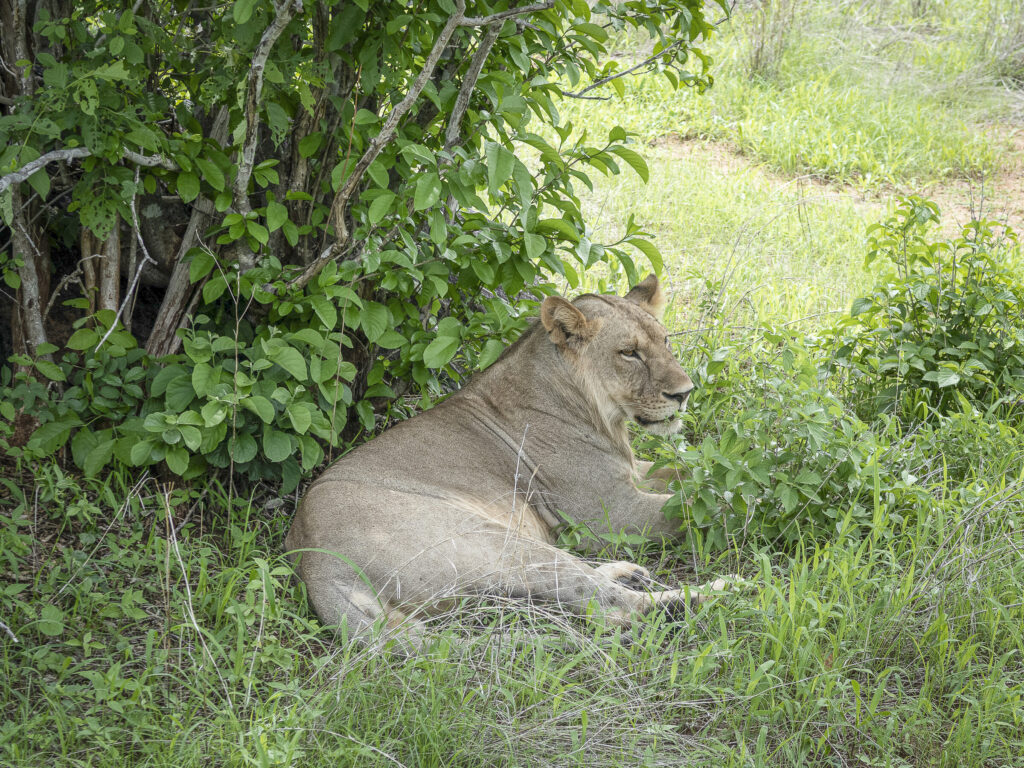
I woke at two in the morning, bladder bursting, and strained to hear sounds of critters over the snores of my seven-year-old daughter. Nothing. Relieved, I unzipped the tent and cautiously scanned the African night with my headlamp before peeing. No elephants. No cape buffalo. No hyenas. And most importantly: no lions.
Mere moments after my family had climbed into the rooftop tent above our rented 4×4 earlier that evening, we’d heard a menacing rumble. It turned my stomach to liquid.
“What was that?” asked Talon, our eleven-year-old son.
“Sounded like a motorcycle,” my husband Rob answered. I assumed he was half-truthing so the kids wouldn’t freak out. Because every cell in my body knew without a doubt that it was a lion—and it was close.
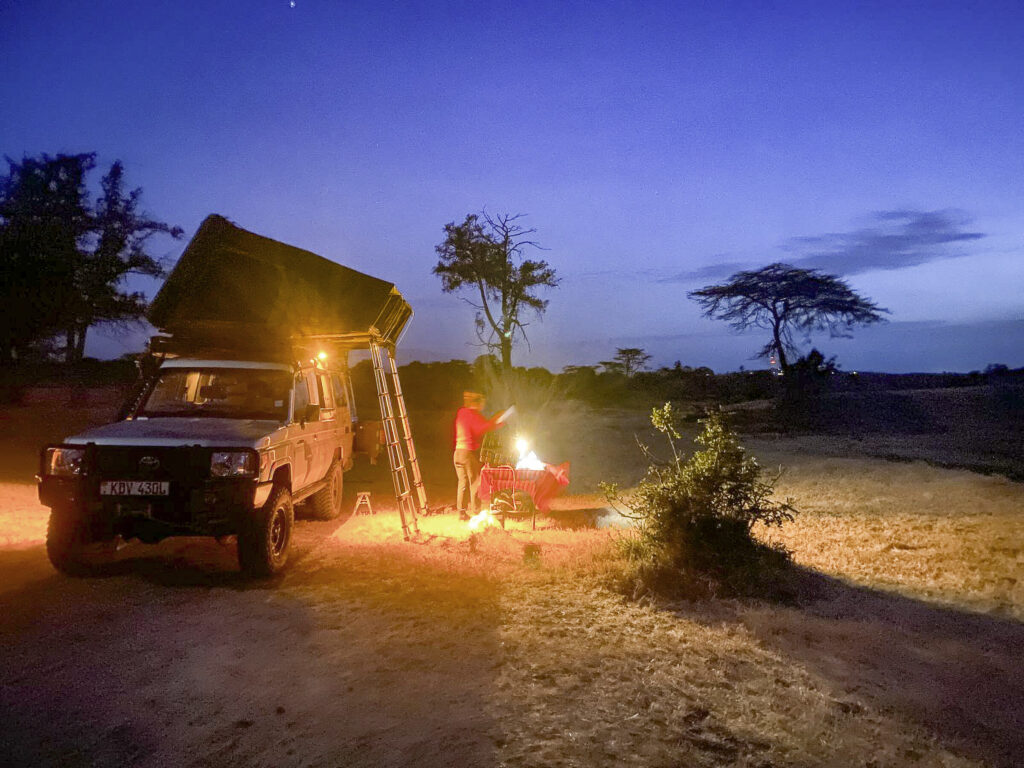
We were alone in Lolldaiga Hills Conservancy, a forty-nine-thousand-acre wildlife reserve in northern Kenya, on the tail end of a DIY safari. There was no lodge for miles. No guide or guard in sight. And definitely no grrring motorcycles tooling around the rutted two-tracks in the pitch black.
The next growl was louder, closer, and answered by two more. A whole pride of lions commenced roaring, right from where we’d recently sat around the campfire. I could feel the vibrations in my chest.
“Don’t get down to pee tonight, Bri,” Rob advised. “Just go off the ladder.”
I eyed the top rung, which seemed easily in range of an ambitious lion. “I’ll just hold it.”
Eventually, I drifted off to sleep amidst the lions’ unsettling conversation, dreaming fitfully of feasting beasts. Then woke with a start hours later, dreading the fact that I had to pee. I levered out over the ladder like it was a portaledge on El Cap. Squeezing my eyes shut, I envisioned fangs sinking into my butt and pulling me into the bush with my pants around my ankles. Job done, heart thudding, I scrambled back inside.
The lions resumed growling before I finished zipping up the tent.
Why, you might be wondering, were we and our kids all alone with predators in the African wilderness? I was wondering that myself.
It was Rob’s idea. Three months previously, while lounging on our comfy fang-free couch in Montana, he announced, “I think we should head to Kenya for the last week of our trip in Africa. Let’s rent a rig and drive around by ourselves.”
I agreed. After guided tours around Tanzania, a self-guided road trip seemed like a good idea. Glamping in swanky lodges and being chauffeured between sundowners wasn’t my style. Indeed, the scheduled Tanzanian safari would be the first guided trip of my life—Rob and I preferred rambling around in our twenty-year-old Tundra, sleeping in patched-up tents, and letting the kids roll around in the mud. A DIY safari in Kenya would be a welcome reset back to our dirtbag values.
I knew it wouldn’t be easy to camp by ourselves in Kenya—especially coming from a five-star lodge where our every need was met. Plus, neither Rob nor I had ever traveled in mainland Africa. I anticipated hardship: slim food pickings. Few toilets. Rioting children who wanted out of the backseat. But I could handle those inconveniences. My bigger fears were animal-related: venomous snakes. Malaria-filled mosquitoes. Charging elephants.
I never considered the fact that driving would be the most likely thing to kill us in Kenya.
“The highway heading northwest is the most dangerous road in East Africa,” warned Joseph, the employee from the rental company who walked us meticulously through each butter knife, traction board, and charging port in our vehicle, which was nicknamed the Black Mamba. Joseph informed us that our rental contract forbade us from driving past dusk. And they’d know if we did, because there was a tracker in the Black Mamba. “You should leave immediately if you want to make it to Lake Naivasha tonight,” he added.
Rob and I exchanged a harried “we’ve-been-traveling-with-kids-for-twelve-hours-across-international-borders-and-still-have-three-hours-to-go” look, then hopped in the rig to get out of dodge.
Only to narrowly avoid colliding with a semi-truck that drifted into our lane. Rob swerved onto the red dirt shoulder. I gripped the oh-shit handle. The kids screamed. A herd of goats scattered, inches from becoming stew on our grill. Their brightly wrapped Maasai owner glared at us. I waved a weak apology.
Back on the blacktop, Rob started to get the hang of dodging semis through Nairobi’s chaotic roundabouts while driving on the left-hand side of the road from the right-hand side of the car. He didn’t seem nearly as concerned as I was by the lack of lane markers, road signs, or traffic lights. I relaxed a smidge.
Until Talon yelled, “Dad! Speed bump!” Our camping supplies launched skyward as we hit the bump at forty miles per hour. My head whipped within inches of the dashboard. Now it was my turn to glare.
“Who the hell puts speed bumps on a highway?” Rob grumbled defensively.
Only two and three-quarters hours to go until our first campsite. Were we having fun yet? Well, we were hungry, at least.

Between death-trap roundabouts, we’d managed a cursory run into a gas station mini-mart for some supplies. Our groceries consisted of rice, peanut butter, crackers, and cookies. I planned to stop for more food on the commute north. But the only “stores” we found were wooden crates selling mangoes.
By the time we pulled into a small private conservancy on Lake Naivasha, my blood sugar level was critical and family morale was at rock bottom. Luckily, a herd of zebras was grazing a stone’s throw from the fenced campsite (whose highlight was flush toilets). The kids cheered and darted off to get closer. I, meanwhile, stared hopelessly at the tangle of unfamiliar camping gear jigsawed into the back of our rig, trying to locate the propane and cookstove. Taking pity on me, Rob whipped up some rice cooked in coconut milk, which we paired with mango slices for dinner. We’d find protein another day. Probably.
The sun dropped like a rock at seven, along with the temperature. Although we were right on the equator, we had gained sixty-five hundred feet in elevation while rounding the southern flank of Mount Kenya. We layered up and dove into sleeping bags.
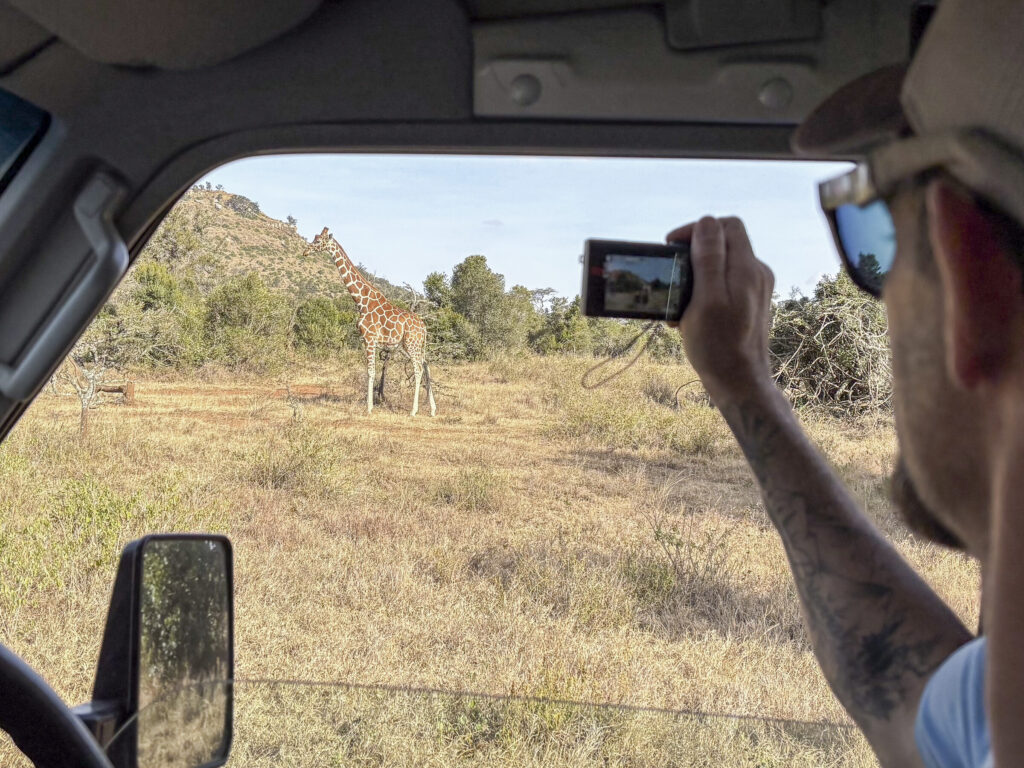
The next morning, I woke to my daughter’s excited voice ringing through the chilly air. “Look, everyone! Giraffes!” Lyra pointed through the tent mesh at a pair silhouetted against the rising sun. Inspired, we grabbed a handful of cookies and set off on a walking safari. Talon spotted a trio of bat-eared foxes, which we followed to their den. Lyra identified kingfishers, herons, and fish eagles on the lakeshore, already an expert wildlife watcher after two weeks in Tanzania. Impala bounded off as we meandered through knee-high grass. Perhaps most exciting of all, we stumbled upon a cafe that served breakfast. With protein.
When we hit the road again, I started Googling options for our next campground. It turns out, unplanned road trips are less fun in a foreign country, particularly one that’s not set up for self-drive safaris. That’s why most international travelers who want to rent their own 4×4 head to Namibia or South Africa, where there are smooth roads and excellent camping infrastructure.
We, of course, shunned the easy option. Harder is so much more memorable, after all. Driving in Kenya isn’t for the faint of heart. Signage is sparse. Ruts are deep. And the camping is either outrageously expensive, impossible to find, or a parking lot at a 1970s-era Boy Scout-esque compound. Entry into national parks like Samburu or Amboseli runs upwards of five hundred dollars per day for a car full of non-residents. It’s double that if you add in overnight camping fees. Large private conservancies cost almost the same amount.
Fortunately, a handful of community-run campsites have cropped up to capitalize on self-drive safari-goers looking for a patch of dirt to call home. These cost around fifty dollars per night and don’t need to be booked ahead of time. Using the Overlander app, I found one a few hours’ drive north that looked perfect.
If we could find it. Following sketched arrows on tiny cardboard signs stapled to trees, we navigated a maze of bone-jarring roads to a camping “resort” with a view of Mount Kenya. The quotation marks were well-earned: Other than a pool hovering around fifty degrees, the amenities included acacia thorns embedded in our sandals and a sludgy pond populated by two half-sunk pedal boats. We were the only campers, though, so the solitude was special.
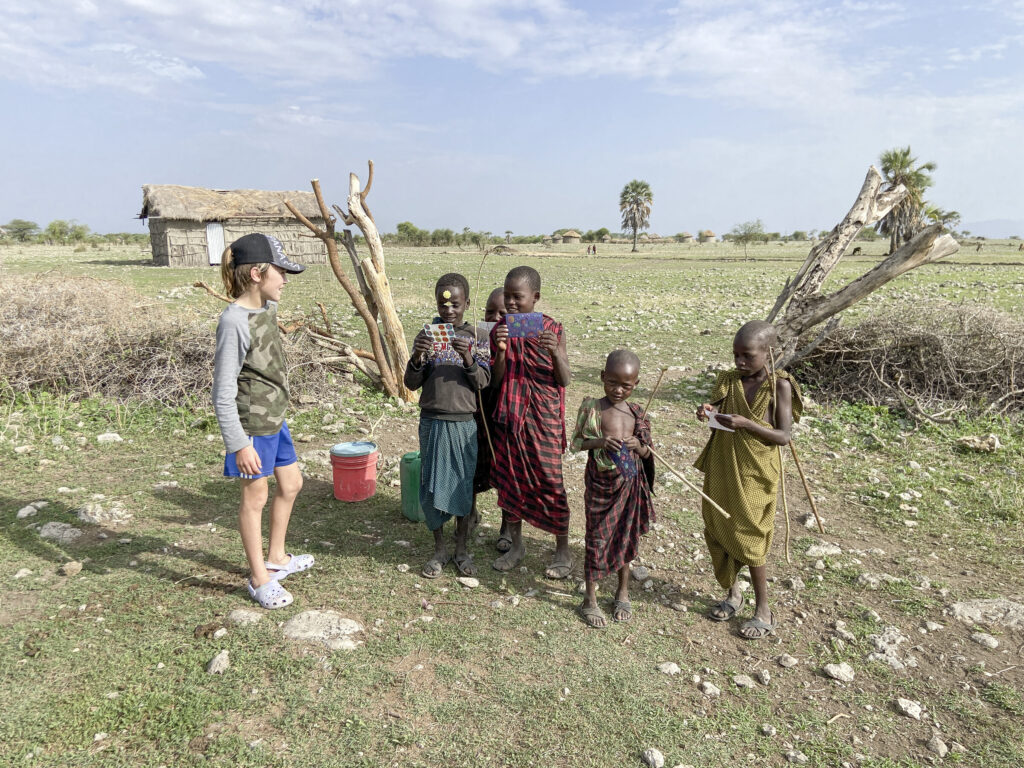
In the late afternoon, we set out to walk through the nearby village. Before long, we’d collected an entourage of locals who giggled and pointed at the four mzungu walking down the road. I wondered if this was how those giraffes and foxes felt when we gawked at them. After posing for a slew of pictures with our new fan club, we passed out stickers to the children and canned goods to the women. I wished we had more to give.
A couple of days later, Jasper, a very tall Kenyan guide, led us down a dusty trail, pointing out snake tracks and rhino poo. We were hiking through the Ngare Ndare Community Forest, which was managed in part by Jasper’s village and provided a much-needed corridor for animals to move between Mount Kenya National Park and protected private land. We encountered elephant bones, a few curious rock hyrax, and a pair of waterbuck resting in the shade.
As we crossed a narrow draw, Jasper nodded toward a muddy area twenty yards away. “Last fall, a cape buffalo charged us here while I was hiking with five British tourists. I had to shoot it five times.”
I gulped, glancing with newfound respect at the giant gun over his shoulder. Eyes saucer-wide, Talon asked, “What did the tourists do?”
“They ran away very fast.”
By now, I was used to hiking alongside a semi-automatic rifle. In both Kenya and Tanzania, armed rangers accompanied us anytime we walked into the bush. This was to protect us from the Big Five—elephant, rhino, cape buffalo, lion, and leopard—which account for dozens of human deaths per year. It’s worth noting, however, that snakes kill one hundred times more people each year than the Big Five combined, while mosquitoes murder upward of half a million humans annually on the continent.
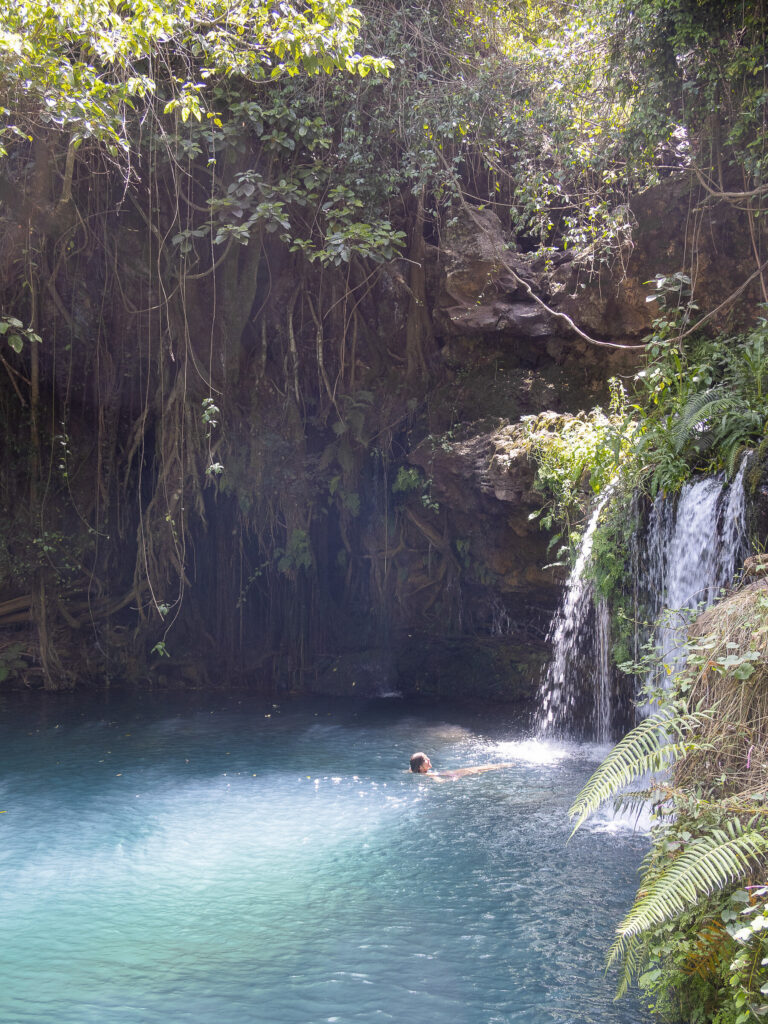
We made it to the promised waterfall without having to shoot anything, then took turns launching off cliffs into the icy turquoise pool to cool off. Back at the campground (an open, flat-ish patch among the trees that we had all to ourselves), we played cards in the shade of our Land Cruiser’s awning, honoring Jasper’s strict instructions not to venture into the bush.
He returned just before sunset to escort us to the canopy walk: a half-kilometer-long suspension bridge made of wire. We asked to venture across alone, figuring we would be safe from predators fifty feet above the ground. Jasper agreed. The kids moved stealthily, scanning for animals as the sky turned shades of sherbet. They were rewarded by an up-close encounter with a curious Hartlaub’s turaco—a blue-crested, parrot-sized bird with brilliant crimson wings. At the end of the bridge we emerged onto a wooden platform just in time to watch a troop of forty baboons splashing in the stream. I inhaled to capture the moment’s pure magic.
That night we sat around a cozy fire and shared our rice and beans with Jasper, who slept nearby all night to guard us from any charging buffalo.
The next day, we headed toward a cliffside campground in another community forest. First, though, we had to pick up two local guards at a random office in the middle of nowhere to accompany us. Both men balanced atop one small motorcycle, guns akimbo, as they led us through cornfields and cow pastures to the site. Our Land Cruiser soldiered intrepidly through an alarming number of scratches from the overhanging branches on the “road” (quotation marks once again well deserved), and I nursed a minor concussion from Rob’s unfortunate rendezvous with a hidden rock shelf.
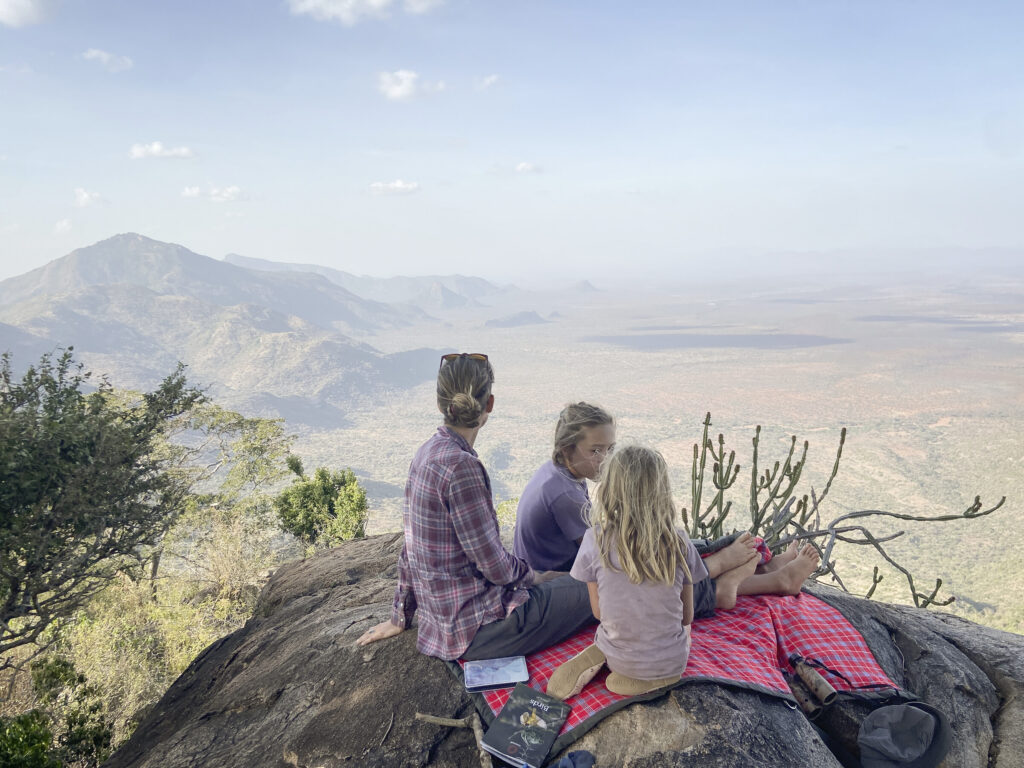
But the view from the campsite at the top of the track was worth the rough ride. Miles of forests, red buttes, and receding mountain ranges spread before us, a cornucopia of Great Rift topography framed in blue sky. Hawks soared by our rocky perch, riding the constant cool breeze. Bells tinkled in the distance as Maasai warriors herded goats over hillsides.
We whiled away the hottest part of the afternoon reading in the shade and enjoying the view. At one point, Lyra had to answer nature’s call, so Rob walked her into the forest to dig a hole. As she bounded back ahead of her dad, I heard her yell, “Oh my god! That is a huge snake!”
I sprang to my feet, panicked. “Don’t move!” I yelled, just as Rob ordered, “Stay still!”
The snake slithered off before either of us reached her.
“What did it look like?” her brother asked eagerly.
“Bright green and fatter than Daddy’s arm.”
Rob pulled out our guidebook and showed Lyra the page of snakes. “Do you think it was one of these?”
She pointed confidently at the green mamba. “It was that one.”
Rob and I exchanged a terrified glance: She’d nearly stepped on a highly venomous snake.
We hadn’t seen a single serpent during our weeks in Africa, which I thanked the gods for each night. Early on, when I quizzed guides in Tanzania about the chances of encountering a snake on safari, they told me it was unlikely. The vibrations from vehicles or footsteps send the shy creatures packing long before humans stumble upon them.
Unless, apparently, the footsteps are from a forty-pound sprite running full speed ahead. I shuddered with ex post facto adrenaline, clutching my youngest.
When we told one of the guards about the mamba encounter, he just smiled and declared, “Hakuna matata!”
I raised my eyebrows and begged to differ. While all was well now, I would be worrying plenty for the rest of the trip.
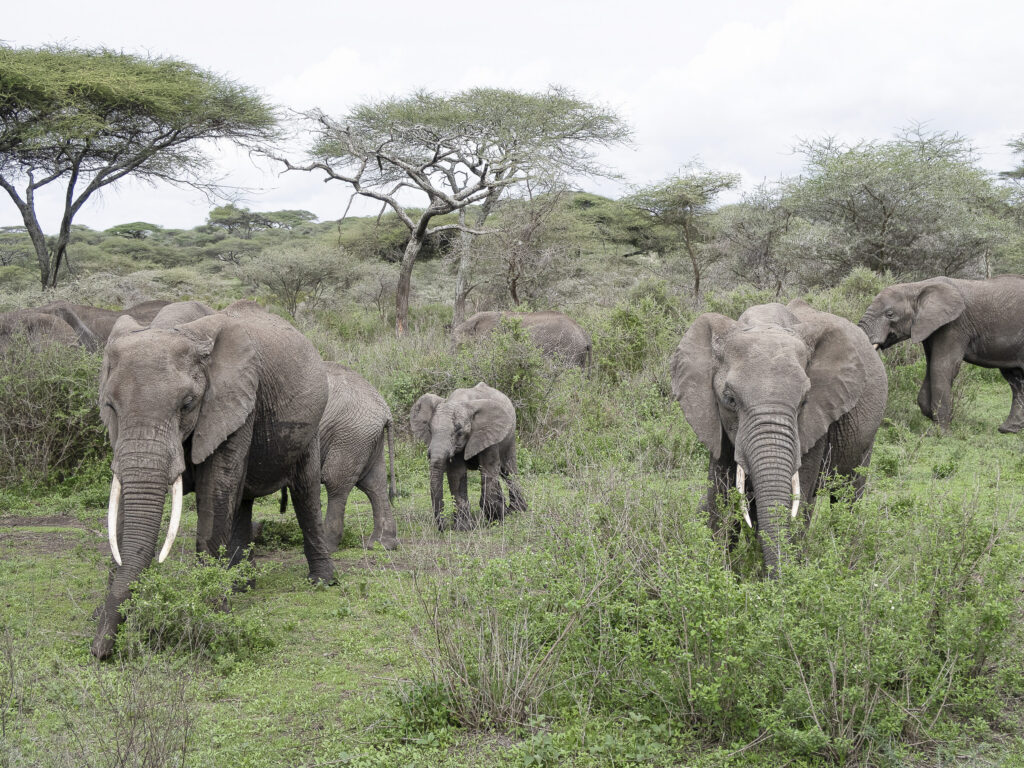
A trio of elephants lumbered into the bush as we parked beneath the shade of a baobab tree. Once the coast was clear, we hopped out of the rig. “Baby warthogs! Awww, they’re so cute,” Lyra exclaimed, binoculars trained on the shore of the watering hole. Talon counted gazelles and elands on the opposite shore while I set up the folding table and laid out salami and cheese for lunch.
We hadn’t seen a soul since we checked in with a ranger at the north gate of Lolldaiga Conservancy mid-morning, which suited us just fine. We had, however, seen gerenuks and duikers, new species for our list and Rob’s new nicknames for the kids. After lunch, we rolled into the conservancy’s campground, where we planned to spend our last two nights before returning to Nairobi.
Once again, we were all alone (save another sounder of warthogs). And once again, there were no toilets and many number twos to deal with. We assumed armed guards would show up. But none ever did.
Capitalizing on our unexpected independence, we decided to head out for a pre-sunset safari. Hyenas and foxes darted through the crepuscular light, while herds of buffalo and elephants grazed on abundant grass. Giraffes peeked at us from above treetops. We cooked ramen as the stars came out, then told stories around the campfire, sharing chocolate and bananas for dessert. The kids climbed into the tent to play Go Fish while Rob put out the fire and I cleaned up dinner.
Or tried to. I started toward the rusty water tank twice to fill the wash bin, only to turn back each time. I couldn’t make myself leave the small circle of lantern light by our truck. “I’ll do the dishes in the morning,” I told Rob, shoving the bin in the front seat and joining the kids in the tent. Five minutes later, we heard the first lion roar. It sounded like it was curled up right under the water tank.
I didn’t do the dishes the next morning either, since we could still hear the pride growling at dawn. Instead, we packed up lickety-split and headed to a quirky little cottage south of Nanyuki. We got to commune with colobus monkeys and chameleons on the deck. And then we got to close the doors of our cottage and pee in peace in the middle of the night.
After we returned the Land Cruiser, Rob and I high-fived. Not only did we provide our kids with an unfiltered, unguided glimpse into wild Africa, we managed to keep everyone alive for a week in the Kenyan bush. I was pretty proud of us.
Until Lyra pulled a tick out of her face in the Nairobi airport. “I think I got it from the warthogs,” she confessed.
“Better than from a lion,” Talon replied.
I couldn’t agree more.


