“The camp-fire is the living, life-giving, palpitating heart of the camp; without it all is dead and lifeless.”
— Daniel Carter Beard
More than the tent, the sleeping bag, or any other single piece of gear, the campfire functions as the place around which all other activities revolve. The outdoor educator and author David Wescott calls it “prince of entertainers, the king of hosts,” and no image or memory of camping is quite complete or suggestive without it. Anyone who has ever camped overnight and built a campfire from scratch knows that even the most severely charred hot dog or a can of plain reheated beans tastes far better than the most carefully prepared home-cooked meal. Some longtime campers might say that the dark and smoky patina that envelops camp food is the secret ingredient that no supermarket is able to supply.
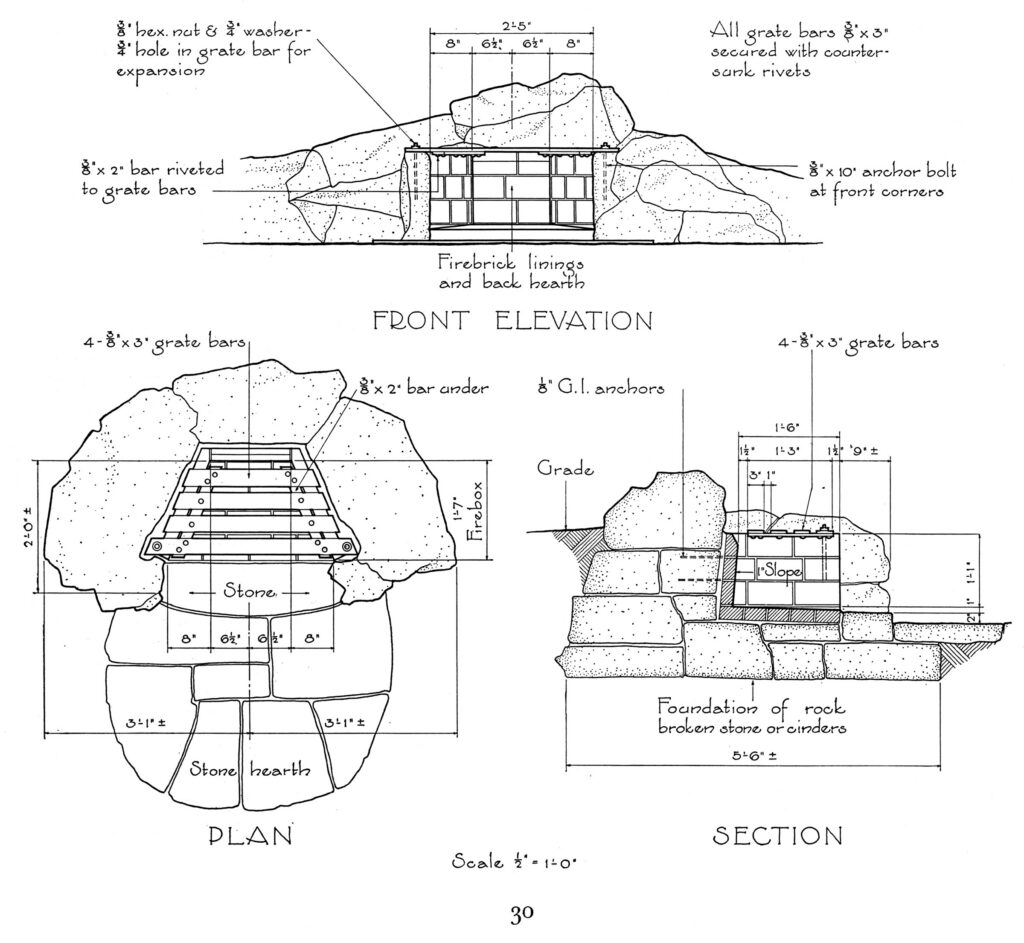
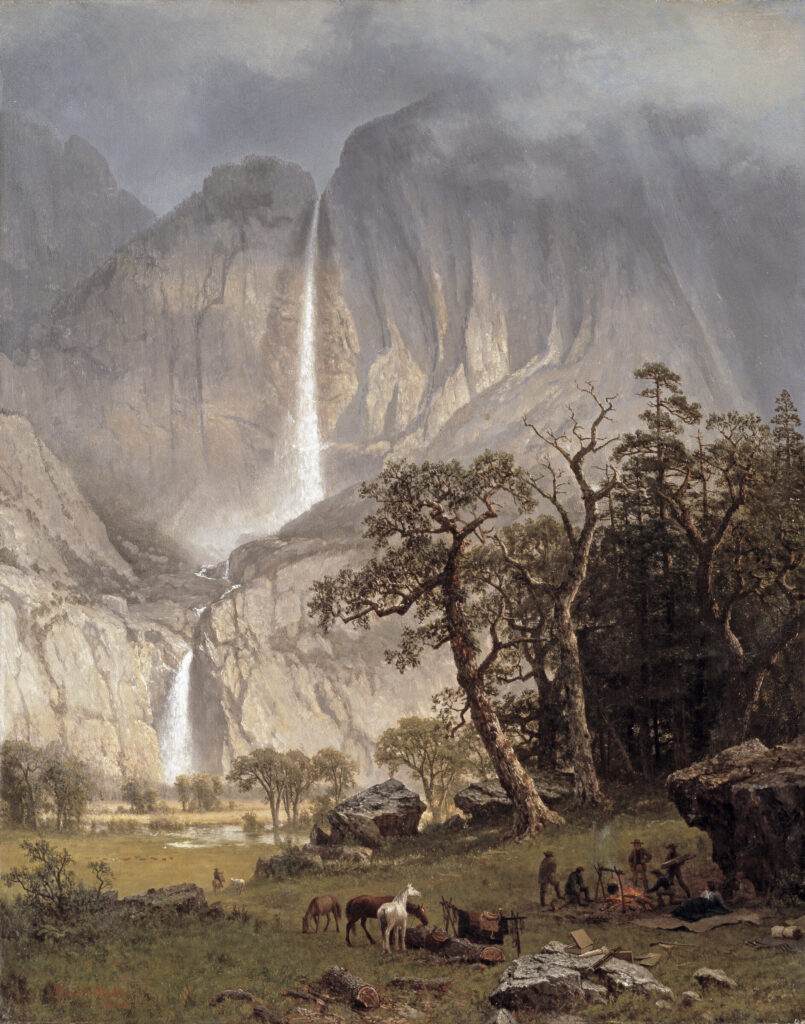
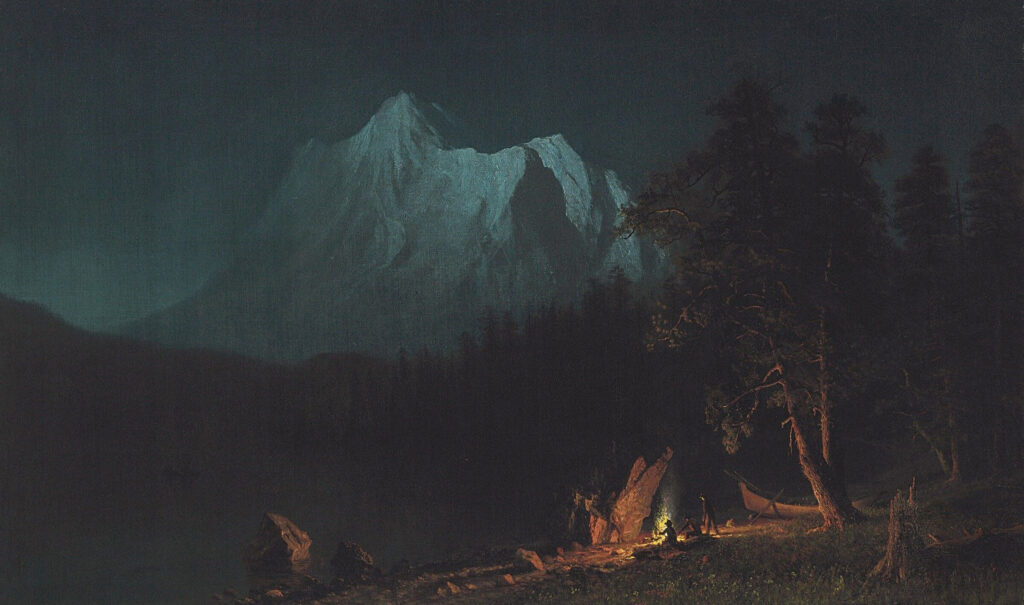
The celebrated American landscape painter Albert Bierstadt sought to evoke the primordial nature of fire when he and his companions reached Yosemite Valley in California in 1863, a scene which he later completed in his New York City studio and titled Cho-looke, The Yosemite Fall. Bracketed by a massive granite formation in the background and a modest campsite at the lower right of the canvas, Cho-looke tells a temporal story of times both far and near. The enthusiast building a wood fire at Upper Pines or Tuolumne Meadows may find little to distinguish the character of its live flame, its light, scent, and sounds, from the one Bierstadt and his companions erected at their own campsite one hundred fifty years ago, or those built by the Ahwahnechee hundreds or even thousands of years earlier on the very same spot.
Horace Kephart wrote that the cardinal rule of camping is to “never leave a fire, or even a spark, behind you. Put it out.” At nearly nine hundred pages, his most well-known book, Camping and Woodcraft, covers outfitting, clothing, provisions, cooking, tents, bivouacs, wayfinding, axemanship, even cave exploration. The decisiveness with which Kephart approached the end of the campfire’s life illustrates an interesting paradox: Poorly tended, a campfire may die, but poorly tended the very same fire may also survive or, worse, thrive dangerously far beyond its intended use. In the highly regulated environment of the modern campground, the lifespan of each campfire is finite, and often associated with morning or evening meals. Common sense and courtesy dictate that no campfire should endure past the moment when a camper departs their campsite for good.
To write a history of the campfire, then, is to perhaps follow a series of parallel tracks: first, the recognition of the singularity of each fire as a distinct installation of materials with a set interval of time and a display of practiced woodsmanship that is initiated and maintained under specific weather conditions; second is the story that continues once the blaze is put out and the infrastructure left behind is examined—such as the firepit and cooking grill that can help future campers locate the next campfire; finally, a history of the campfire would not be complete without a review of recent technologies that have emerged and supplanted its effects and altogether reorganized the camp, its space and atmosphere.
A Display of Woodsmanship
“A camper is known by his fire.”
— Horace Kephart
Naturalist and author A. Hyatt Verrill observed that “it may seem like a very simple matter to build a fire, and you may think that a description of how to do it is superfluous.” Issued at the height of the first recreational camping craze that gripped the US during the late nineteenth and early twentieth century, Verrill’s statement certainly rings true a hundred years later. Fire is such a familiar feature in human life that we now seem to possess the quasi-magical ability to summon it on command, under any circumstances: safely packaged and easily available in the form of matches, disposable lighters, fuel-dipped coals, and piezoelectric gas stoves, even those least experienced may succeed at safely resolving the old equation [wood]+[spark]=fire.
Verrill, like Kephart, authored some of the first instructional books on camping at a time when the practice still held many of its rustic charms. Because campfires cannot be purchased like a tent or a sleeping bag, both authors agree that building a campfire constitutes an important—perhaps the single most important—test of woodsmanship and resourcefulness. For them, the campfire constituted a rite of passage, the cost of membership in a burgeoning fraternity of campers: only after solving the equation [wood]+[spark]=fire could the camper call herself fully initiated. That this equation has lost much of its mystery, or that we should even conceive of the flame as more than a basic product, shows just how far we have come over the last one hundred fifty years since the birth of recreational camping.
It is nowadays both instructional and amusing to read through the weathered pages of those books. One common rhetorical trope of the period was to pit the wiser and more experienced camper against the novice. Verrill and his contemporaries couldn’t quite resist poking fun at those wannabe campers whose dollars and attention they sought, but whose lack of skill they also mocked, characterizing them with epithets like “shirk,” “tenderfeet,” and “blooming idiot.” Conservation activist G. O. Shields observed that “the great majority of men, when they undertake to make a camp-fire, proceed as if trying to put it out instead of to replenish.” Daniel Carter Beard, founder of the Sons of Daniel Boone (later to become the Boy Scouts of America), noted that “there is not one in a hundred who can do it successfully without a Sunday edition of the newspaper, a can of kerosene, and an armful of kindling wood.” Kephart expressed concern for the abundance of resources some deployed for such a modest task, describing a “higgledy-piggledy heap of smoking chunks that will warp iron and melt everything else.”
While the contemporary reader cannot help but marvel at the ways in which campfire building has morphed from an artful and highly technical undertaking to a mere commodity, one particular aspect of these descriptions still rings true today: the sense of being observed—even judged—by others is played out not in the private pages of an old book but on the very public stage of the modern campground, where rows of densely arranged campsites only serve to magnify technical difficulties into real and lasting shame.
More importantly, their words of advice helped place responsibility squarely into human hands. Pouring rain? Wet wood? Howling wind? Frank Cheley, founder in 1921 of Colorado’s Cheley Camps, offered that “if a fire won’t burn, nine times out of ten it is you rather than the fuel or the weather.” Beard suggested that “a man who can build one in the forest without the aid of matches and when everything is sodden and water-soaked, is entitled to wear fringe on his leggings and wamus, for he has earned for himself the title of the ‘real thing,’ the true Buckskin Man.” For Beard, the equation [wood]+[spark]=fire might be rewritten to account for site and circumstance: [green wood]+[wet wood]–[ax]+[wind]+[rain]+[darkness]–[matches]=fire (and buckskin).
For the truly desperate, Verrill offered bow-and-drill instructions so mind-boggling and complex as to deter any but the most determined. Cheley suggested that “a fire may be kindled by focusing the sun’s rays through the crystal of your watch (or even your eye glasses) onto a pile of fine lint, scrapings from a cotton garment, or fine bits of inner bark. If a live coal is secured, wrap the feeble spark in a bit of lint placed in your handkerchief and gently blow until it breaks into flame.” For those without matches, watches, or glasses, he even suggested firing a gun into a rag.
Even for the most skilled, there was a lot to think about. Not all lumber burned in the same manner, and every wood has its own peculiarities. Kephart’s observations about firewood, seen from the point of view of the fire builder, are a true wonder to behold. Under his gaze, lumber is no longer just wood, and even before it has been cut, dried, or lit, it takes on alchemical properties informed by a lifetime’s worth of experience. He reserved his greatest praise for hardwoods like beech, white oak, and sugar maple, “because it ignites easily, burns with a clear, steady flame, and leaves good coals.” Best of all in Kephart’s opinion was hickory—”a distinctly American tree”—which, green or dry, “make[s] a hot fire, but lasts a long time, burning down to a bed of hard coals that keep up an even, generous heat for hours.” He cautioned that hickory “must be watched for a time after the fire is started, because the embers that they shoot out are long-lived, and hence more dangerous than those of softwoods.”
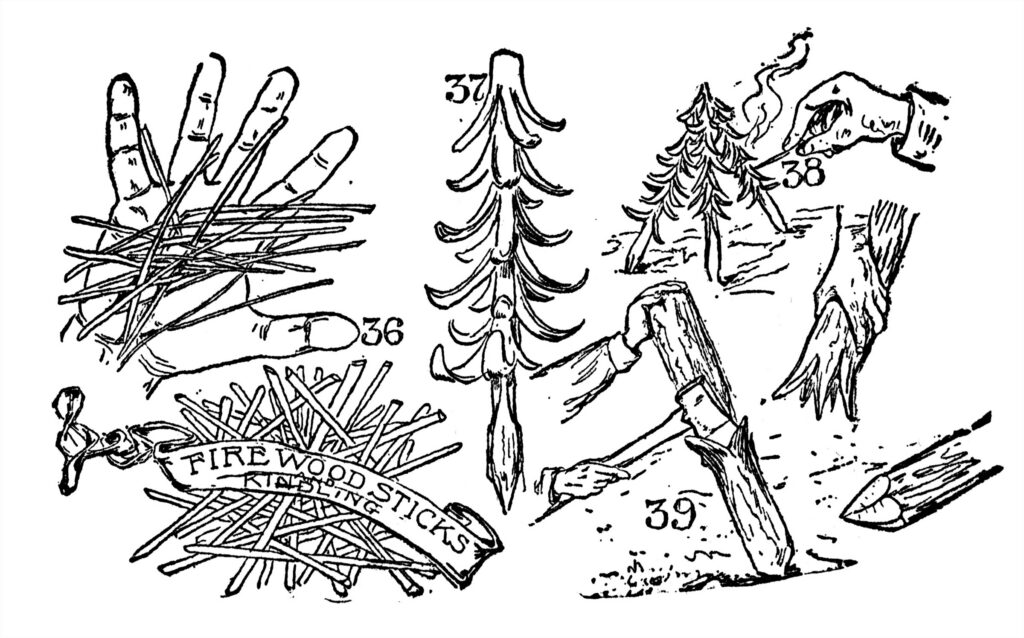
Once fallen, the desired wood then had to be transported to camp on foot and dried for long periods before it could be fed into the fire. Cheley described the sacredness of the ax above all other tools on the trail, an instrument so crucial that it should never be shared with others. Under its sharp blade, wood could be managed into pieces of various sizes—from logs to kindling—to facilitate different stages in the process. Beard, a prodigious and skilled illustrator, drew careful sketches of various forms of fires and the ways in which wood should be stacked to meet desired expectations.
But even such a fundamental part of the camping experience as selecting and chopping wood could in time be eliminated, and even monetized. The now-familiar sight of small packets of pre-cut and dried firewood at roadside stands or the local grocery store reflects the increasing parcelization of the campground. Buying wood meant that the tree-identification and fire-building skills promoted by Kephart and his compatriots were no longer essential, and therefore would no longer need to be passed down from one generation of campers to the next. As camping became increasingly popular during the 1920s, campground planners recommended permanent wood-supply areas that could provision individual campsites—limiting both the careless removal of trees from the campground and the spread of harmful pests between forests.
Traces, Permanence
“Burn everything that will burn—bury the rest.”
— Frank Cheley
Once ignited, the campfire becomes the least mobile point in camp, a geographic reference around which all other elements are positioned to maximize its impacts. As the architect Charlie Hailey noted, “the campfire is an originary and centralizing feature from which the camping practice proceeds and from which the practice’s operational modes radiate.” English architectural critic Reyner Banham described its effects in terms of concentric rings, “brightest and hottest close to the fire, coolest and darkest away from it.” The firepit—a permanent installation made from nonflammable materials, often partially embedded below the ground—helps contain the spread of the wood fire while designating the location where the next fire should be initiated.
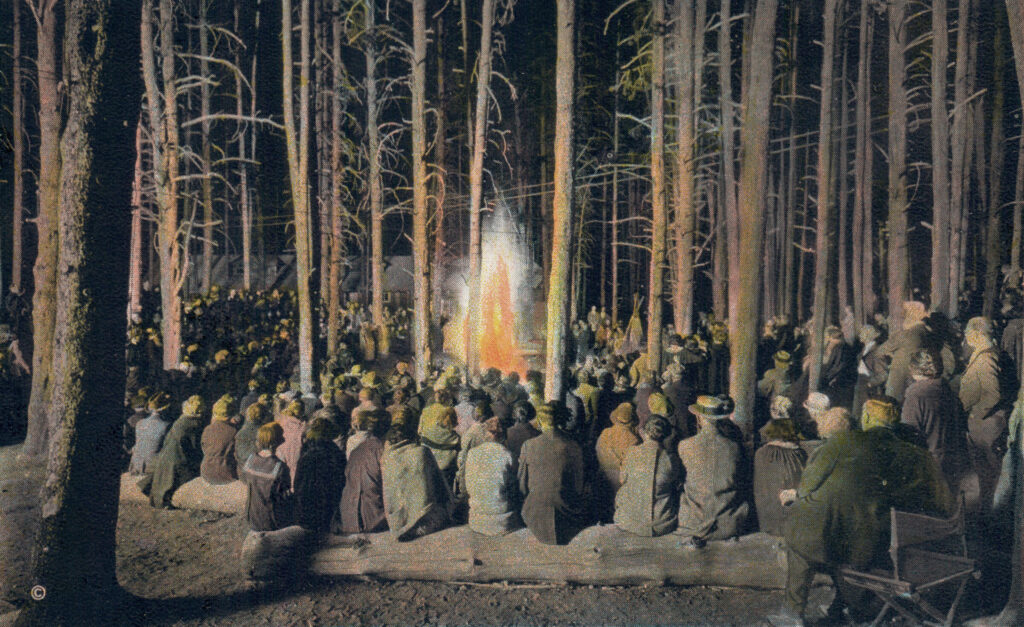
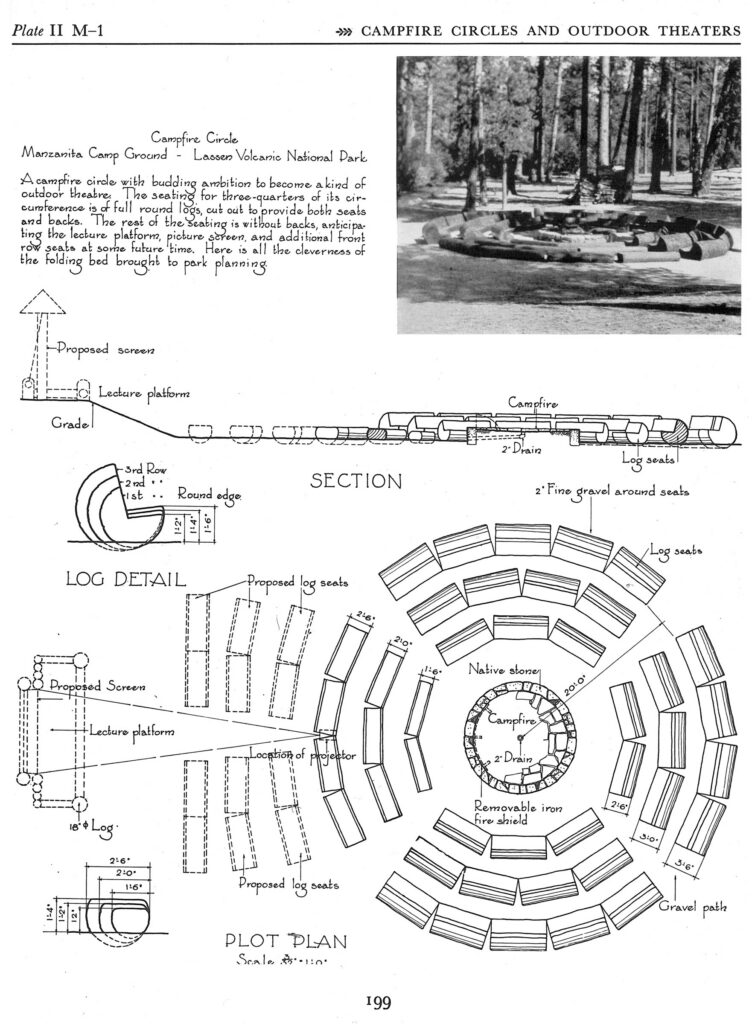
Early campground planners were equally concerned with the aesthetic impacts of such traces as they were with the inadvertent spread of fire. Writing in 1932, the plant pathologist Emilio Meinecke conceived of the modern campsite as a patch of open space outfitted with a permanent fireplace and a picnic table at its center, lying in wait of its next occupant. Albert Good, an architectural consultant for the National Park Service, devoted two full chapters of his 1935 Park Structures and Facilities to the subject. He took care to distinguish large communal campfire circles—with heavy log benches arranged in concentric rings around a large bonfire, places not meant for cooking but for the kind of social gathering that the Reverend W. H. Waggoner of Cincinnati described as a major event, where arriving visitors met and mingled with veterans of the camp—from the utilitarian firepits and stoves meant for individual campsites.
Good was ambivalent about codifying the individual firepit too precisely. He hailed “the pioneers, the plainsmen, who frequently cooked out of doors on the most primitive of contrivances,” and argued for “the subordination of the fireplace to its surroundings,” even “at some sacrifice of convenience in use.”
What he deplored were the overbuilt stone firepits that had begun cluttering campgrounds: “chimney yard eruptions that assume the monumental proportions, and even the appearance, of a dismal mortuary art.” His hunches proved largely true. By and large, those soaring piles of masonry have become a thing of the past. Among the structures that replaced them was an ingenious open-ended steel drum topped by a sturdy steel grille, first introduced by the National Park Service in the 1970s—heavy enough to stay put, fabricated en masse in a metal shop, and movable around the campsite like a picnic table.
Disappearance / Displacement
“The open fire is more picturesque. Granted. But so is the tallow dip more picturesque than the incandescent bulb. But we might as well face the fact that this is the age of electricity and motor cars.”
— Frank E. Brimmer
By the time these drums were introduced, the campfire had completed a long historical arc. No longer a display of skill and experience, the flame and its many benefits had been turned into pieces of gear that could be compacted and made highly portable in the form of lightweight cooking stoves and lamps; generated with safe, high-yield sources of fuel such as propane gas, denatured alcohol, and kerosene; and summoned in an instant with the push of a button. The equation [wood]+[spark]=fire, in any of its forms, had by this time been elegantly rewritten: fire=now, fire=anywhere.
Daniel Carter Beard traced the origins of this transformation to a single point in history. The British apothecary John Walker is largely credited with the commercialization of the friction match in 1826—pinewood sticks dipped in a phosphorus solution that could be ignited when struck against a hard surface. By the time Verrill published The Book of Camping nearly a century later, safety friction matches—and a pouch to keep them dry—had become de rigueur in any serious camper’s equipment. Appearing in Elon Jessup’s The Motor Camping Book is a table-grille hybrid perched on four folding legs set above a live flame, forming a flat surface over which cooking implements were placed. Having displaced the pot holder and other cooking implements that Beard had improvised from green branches, the clever design paved the way for still more gear: kettles, pots, and skillets, plates, cups, and silverware. Gone indeed were the days when the camper simply lopped off a chunk of meat from the roasting spit with a pocket knife.
In Forever Wild, the author Philip G. Terrie argued that the nineteenth-century sportsman “never really felt at home in the wilderness, he depended on an insulating barrier of technology, civilized comforts, and psychological buffers to keep himself from being overwhelmed by the vastness of nature.” Later, camping writers like Kephart, Beard, and Verrill sought to change the narrative by placing the emphasis on firsthand expertise. As camping became increasingly popular during the 1920s, the campfire and its attendant uses—cooking, heating, lighting—became perhaps the single most active area of experimentation with respect to camping gear. The selling point was no longer skill, experience, or resourcefulness, but the ease with which anyone, even the luckless newcomer, could summon the campfire’s magical powers.
There may be no single implement more emblematic of this change than the Coleman portable cooking stove, and no American purveyor of gear better known than Coleman, a company whose name has become synonymous with camping. William Coffin Coleman founded the Hydro-Carbon Light Company in 1900 with the initial purpose of selling hanging gasoline pressure lamps. Following a long period of testing during which many early prototypes failed, Coleman shipped his first portable lamp in 1910. Coleman then began developing a line of gasoline-pressured portable ranges, which it introduced in the early 1920s.
The Coleman Company hired Frank E. Brimmer to write a guidebook promoting its products. Modest in size, The Coleman Motor Campers Manual is a sixty-three-page pamphlet that offered a twist on a time-honored formula of the age. Like many books of the period, it featured equipment lists, rations, recipes, practical tips, and suggestions. Unlike other similar titles, however, it also came richly illustrated with camping scenes, inside which Coleman products had been carefully arranged. Populated with men, women, and happy children busying themselves around their equipment, these photographs suggested that camping could be easy, fun, safe, and accessible to all. Coleman coined the slogan “the smooth way to rough it,” a statement that foregrounded inherent contradictions inside the field that continue to define camping to this day: Enthusiasts often fashion a rustic image of themselves in the woods, braving the elements, and the like. At the same time, many of them like to be surrounded by modern domestic comforts—so campers embrace the many gadgets that will get them there. In this regard, camping gear seems to embody the perfect marriage between a problem and its resolution—even if one has to invent a fictional need wholesale. Brimmer knew that cooking posed a gender bias that might prove a tricky sell to the male-oriented camping audience of the time, but he also knew that no piece of equipment was immune to the mysterious gear-envy that seems to possess most campers. Sensing an opportunity, he embraced fuzzy rhetoric when he suggested that “many husbands would surprise their wives with their adeptness in cookery. Give them a few staples to work with, a rabbit for a stew, and a Coleman, and they can concoct dishes which would cause a French chef to turn green with envy.”
It is no accident that motor vehicles appeared in the background of most of the scenes in Brimmer’s pamphlet, for they constituted by far the most important technological innovation at the campsite. Using similar sources of fuel, the Coleman No. 2 stove had more to do with the car than it did with the traditional wood fire. Both embraced mobility and speed as central selling features. The July 1924 cover illustration from Motor Camper & Tourist shows a woman preparing a meal over the heat generated by the automobile engine. Similarly, the Coleman was not only light and portable, it also short-circuited the traditional timeline for gathering, cutting, and drying wood, and for building, igniting, and maintaining the campfire until the flame was primed for cooking. The camper in possession of a Coleman stove could “banish all old time cooking troubles and satisfy his cravings whenever Old Man Appetite says: ‘Let’s eat now.’”
Much of the uncertainty in delivering and maintaining a steady fire had now vanished. With the introduction of disposable, prepackaged gas cans that were screwed directly into the stove assembly, even fuel became a complete abstraction. A piezoelectric ignition system delivered an electric spark into a stream of pressurized gas, lighting the flame with the push of a button. The formula fire=now, fire=anywhere had been elegantly achieved.
In the twenty-first-century digital age, marked by instant gratification, the camping stove is experiencing a (very) quiet, if somewhat counterintuitive, revolution of its own. In The Revenge of Analog, the author David Sax celebrates the return of analog tools enjoyed by those resisting the digital world—notebooks, vinyl records, film, and board games. And if they’re not quite ready to abandon their iPhones and iPads at the campsite, many campers are embracing a similar worldview, sacrificing the immediacy of gas burners and piezoelectric ignition for a certain degree of environmental consciousness. Does this mean a return to the traditional virtues of the wood fire? Not quite: GoSun offers efficient portable solar ovens for off-grid use. A single burner stove, the Sierra Zip, employs a battery-operated fan to aerate a small chamber in which twigs, pine cones, and bark are fed. Residual matter that only a few decades ago would have been used to start a campfire now constitutes its main source of combustible fuel.
Conclusions
“Mankind on the trail cannot get along without external heat. Cold food may yield sustenance and allow him to continue a little longer, but to really restore his vigor he needs external heat, hot food cooked over the camp-fire, warm heat-rays to penetrate his body and relax the tired muscles, drive out the cold and rheumatic aches, and put him in a state of comfort that enables mind and body to recuperate.”
— Warren H. Miller
For the historical geographer Terence Young, the campfire constitutes “the means and emblem of light, warmth, protection, friendly gathering, council.” There is growing evidence that the traditional wood campfire is slowly being displaced as the primary source of these effects. The historian Warren James Belasco noted the introduction of electrical lighting in public campgrounds during the 1920s, an innovation which, in effect, stretched the day, allowing campers to stay on the road longer without the worry of setting up camp in darkness. During the 1990s, KOAs tested a new model of outdoor kitchen, the Kamper Kitchen—a shared facility equipped with domestic electric stoves and sinks—suggesting that cooking might no longer be an activity that defines the individual campsite, but one that could be delegated to a shared outdoor area.
On a 2017 camping trip to Maine’s Acadia National Park, I noticed campers eating fast food at their campsite; it is now completely reasonable to think that food consumed at the picnic table may be prepared well outside campground limits, and by different hands. In 2018, Domino’s announced one hundred fifty thousand public hotspots that don’t have traditional street addresses, including parks and campgrounds, where their products could be picked up.
The photographer Bruce Davidson’s wonderfully ironic 1966 shot of campers at Yosemite National Park, with its lone box of Ritz Crackers as the only source of food, illustrates the extent of a radical physical transformation of many campsite components, including the campfire: The entire site has been reduced to a glorified pantry, where imported goods are not made, but consumed. Even Davidson himself could not have envisioned how quaint his own vision would become only a few decades later. After picking up the evening meal at a local Domino’s Hotspot, the camper can get their evening campfire experience by taking in a local ranger’s PowerPoint presentation at the campfire circle talk—with no live flame in sight. In the era of climate change, some campgrounds formally forbid campfires altogether. For Charlie Hailey, these modern experiences of the campfire as a mere “televisual flicker” come as further evidence that the distance separating campsite and domicile is growing shorter still.
Adapted from Making Camp.


