
New research from BSR and GlobeScan suggests that from the perspective of sustainability professionals at companies with more than $1 billion in annual revenue, corporate sustainability is entering a more constrained and selective phase. A clear majority of respondents report that one or more of their company’s sustainability commitments are at risk of being scaled back. These findings offer a lens on how sustainability strategies are evolving inside large organizations.
As regulatory pressure has increased and traditional business drivers of sustainability efforts have weakened relative to a decade ago, companies appear to be reassessing not only why they pursue sustainability but how much they can realistically accomplish. The result is a tightening of scope, with 71 percent of sustainability professionals saying that one or more sustainability commitments at their companies could be scaled back. By contrast, less than a quarter of respondents expect all current commitments to be maintained. Sustainability professionals most often point to DEI-related commitments as being at risk of rollback (44 percent), followed by public advocacy on sustainability policy (23 percent). Supply chain requirements and climate transition investments are flagged less frequently — along with nature and biodiversity commitments and human rights due diligence — as areas at risk.
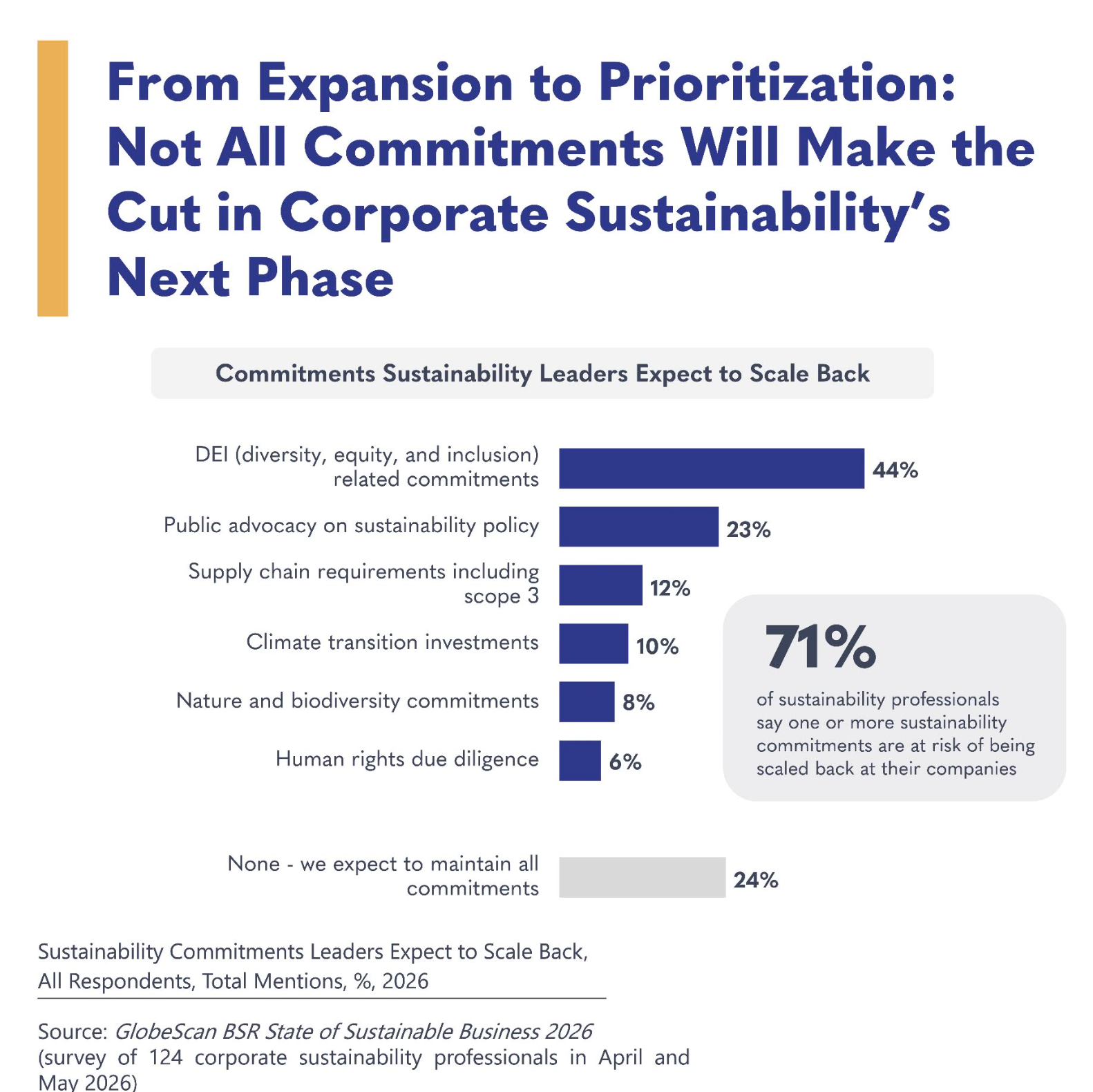
What this means
The findings suggest that many companies are moving from expanding sustainability agendas to prioritizing a smaller set of commitments. Faced with tighter resources, increasing regulatory demands and growing pressure to demonstrate business value, sustainability teams are growing more selective in where they invest time and effort.
As the profession enters this more pragmatic phase, success will increasingly depend on integrating these priorities deeply into core business strategy and operations. Organizations will need to clearly demonstrate how sustainability contributes to performance, resilience and growth, while delivering measurable outcomes that build internal and external confidence. Companies that embed sustainability into core decision-making and translate commitments into tangible results will be best positioned to maintain momentum, secure ongoing investment and strengthen stakeholder support.
Based on an online survey of 124 corporate sustainability professionals in April and May 2026.


