AWS Glue Data Catalog view is a multi-dialect view that supports querying from multiple SQL query engines, such as Amazon Athena, Amazon Redshift Spectrum, Apache Spark in Amazon EMR and AWS Glue. You can create a Data Catalog view in one account, using an AWS Identity and Access Management (IAM) definer role in the same or different account and use AWS Lake Formation to share the view across multiple accounts. The definer role has the required full SELECT on the base tables to create the view and share it with other users for querying. The Data Catalog assumes the definer role and manages access of the base tables when the view is queried, thus allowing to share a subset of data without sharing the underlying base tables.
AWS Glue now adds AWS SDK support for creating and updating the ATHENA dialect of Glue views. With this addition, you can now create ATHENA and SPARK dialects of Glue views simultaneously, using a cross account IAM definer role. This feature enhances the automation to create and update Glue views, like that of Data Catalog tables. In our earlier blog Create AWS Glue Data Catalog views using cross-account definer roles, we had introduced IAM definer roles in a cross-account use case to create Data Catalog views with SPARK dialects using the APIs – CreateTable() and UpdateTable() – while creating and adding ATHENA dialects using Athena query editor. As a continuation to it, this post shows you how to use the Catalog objects API CreateTable() to programmatically create ATHENA and SPARK dialects using cross-account IAM definer roles, and how to add the ATHENA dialect programmatically for the views that were created earlier with only SPARK dialect.
Cross account definer roles enable enterprise data mesh architectures where multiple accounts are interconnected in a central governance and multiple producers and consumers. The central governance account hosts the database, tables and permissions, while the producer accounts maintain CI/CD pipelines to create and manage those data assets. Having the definer role in producer accounts allows those CI/CD pipelines to be fully managed by IAM roles in the individual accounts.
Key points on creating multi-dialect views using cross-account definer roles
ATHENAdialects are validated and asynchronously created. Hence, a cross-account Glue connection is required for validation for every producer account-central governance account pair. This is a one-time setup.SPARKdialects are not validated. HenceSPARKdialect’s create syntax requires SubObjects list of the base tables and StorageDescriptor fields for the columns of the view.- Though queries on cross account views can be run using database resource link names, the view definition SQL query for creating the view requires the original database and base table names from the central governance account.
- If a view has
SPARKandATHENAdialects available, we recommend updating both the dialects of the view simultaneously usingupdate_table()API/SDK, for any changes in the SQL definition of the view or the base table. This will keep both the dialects queryable. - Creating and updating both
SPARKandATHENAdialects using cross account definer role is supported using AWS CloudFormation. - The Data Catalog view that can be created using cross account IAM definer roles are available in
SPARKandATHENAdialects and currently not supported for Redshift Spectrum dialect.
Prerequisites
We use the same setup used in Create AWS Glue Data Catalog views using cross-account definer roles for the sample database, tables, definer role, resource link, IAM and Lake Formation permissions on those resources and principals between the two AWS accounts. Summarizing the requirements as below.
- The setup includes a central governance account with Data Catalog database
bankdata_icebergdband two tablestransaction_table1andtransaction_table2, a producer account with a Data-Analyst role used as view definer role. - Lake Formation permissions on the central account’s database and tables are granted to the producer account Data-Analyst role as per the earlier blog. The definer role in producer account should have database
DESCRIBEandCREATE_TABLEpermissions, tableSELECTandDESCRIBEpermission on all columns and rows of the base tables. The IAM permissions required on the definer role are detailed in Prerequisites for creating views. Similarly, follow the earlier blog to create resource link for the shared database and grant Lake Formation permissions on the resource link to the Data-Analyst - An Athena data source named
centraladminin the producer account, pointing to the Data Catalog of the central governance account.
Creating ATHENA and SPARK dialects at the same time
Creating both ATHENA and SPARK dialects of a Glue catalog view simultaneously is now supported by the AWS SDK. In the producer account, create a new Glue connection, required for the Athena dialect validation. This is a prerequisite for creating the ATHENA dialect of the Glue catalog view using cross account definer role. Then we create a Glue view with both dialects.
- Sign in to the producer account as the Lake Formation admin role, or any role with permission to create AWS Glue connections.
- Using an AWS Command Line Interface (AWS CLI) environment, such as AWS CloudShell, create an AWS Glue connection as follows.
The content of
athena-validation-connection.jsonis as follows.Note: If you are using Athena for the first time in your account or using Primary workgroup, setup the query results location bucket using Specify a query result location.
- Sign out as the Lake Formation admin and sign back in to the producer account as the definer IAM role,
Data-Analyst. - Create an AWS Glue view using the create-table CLI command and JSON file, or using the AWS SDK for Python (Boto3) script.
The content of
create_multipledialects.jsonis as follows.Notes about fields in the above CLI input JSON (applies to all SDK):
- The definer is by default the API caller, but a
Definerfield can be set to explicitly specify a different IAM role. - In the
ViewDefinition, database qualifiers are required forSPARKdialect. That is, the SQL definition provided forViewOriginalTextandViewExpandedTextshould be in<source_database_name>.<source_table_name>format.
- The definer is by default the API caller, but a
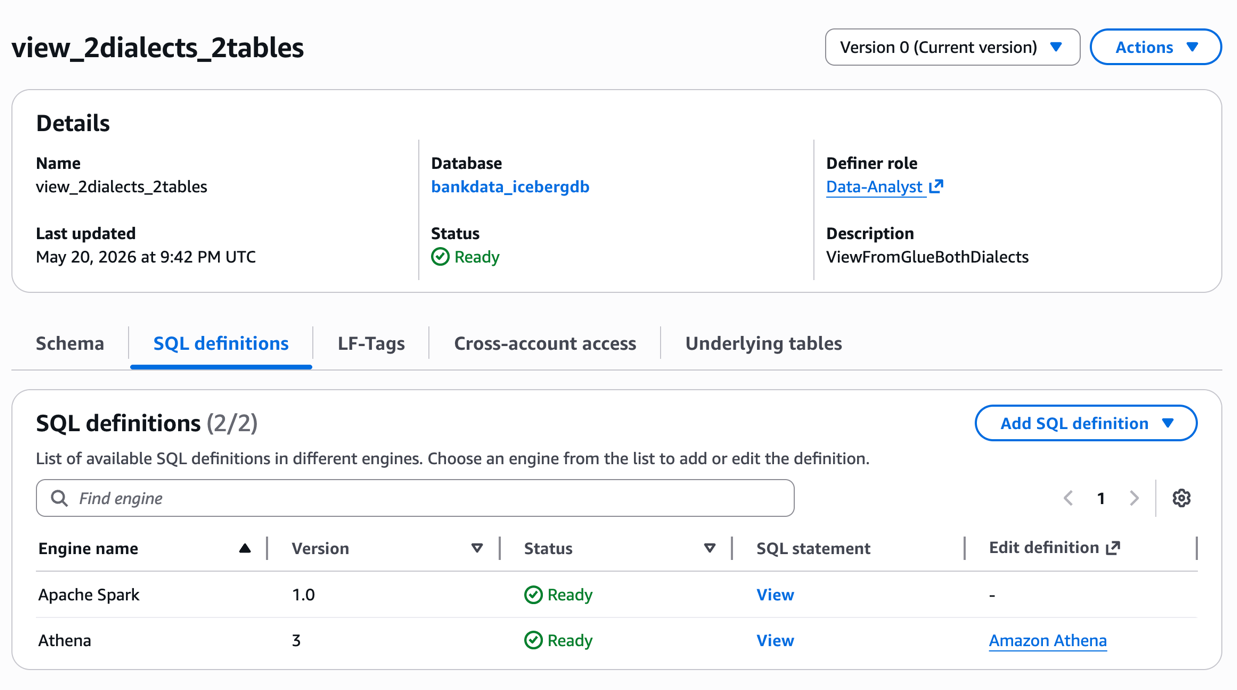
- After the view is created, you can inspect the details on the Lake Formation console. The SQL definitions show both
ATHENAandSPARKas shown in the following screenshot.
If your view creation fails for any of the dialects, you can use the AWS Glue get-table CLI command with --include-status-details to see what the error is and rectify it.
Glue PySpark script
The PySpark script for creating a view with ATHENA and SPARK dialects are provided below. Download and edit the Pyspark script with your bucket name, producer and central account ids, region and relevant Glue resource names: bdb_5773_createview_bothdialects.py
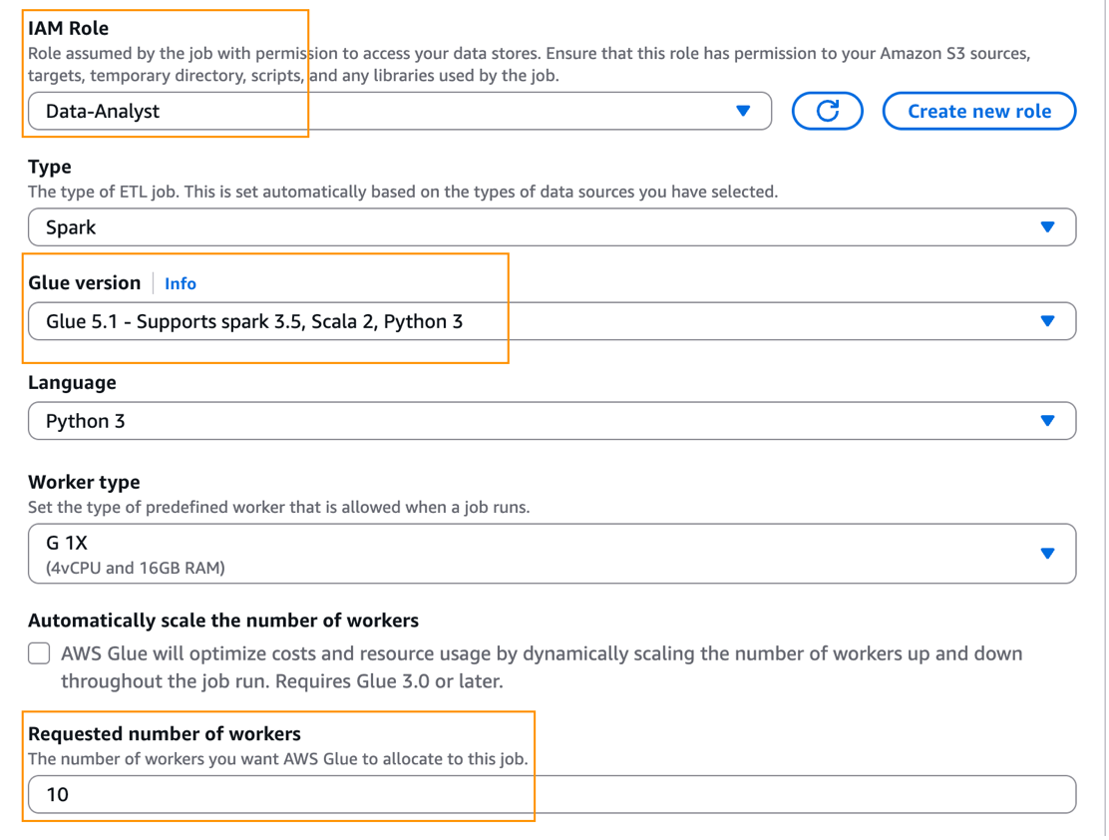
Provide the following settings to run the script in your Glue Studio. For details on running a Spark job in Glue, refer Working with Spark jobs in AWS Glue.
- Choose Data-Analyst as the job execution IAM role.
- Choose Glue 5.1 for Glue version.
- For the Requested number of workers, provide >=4. This is an FGAC Spark driver requirement, which is needed for Glue catalog views. Below screenshot shows these settings.

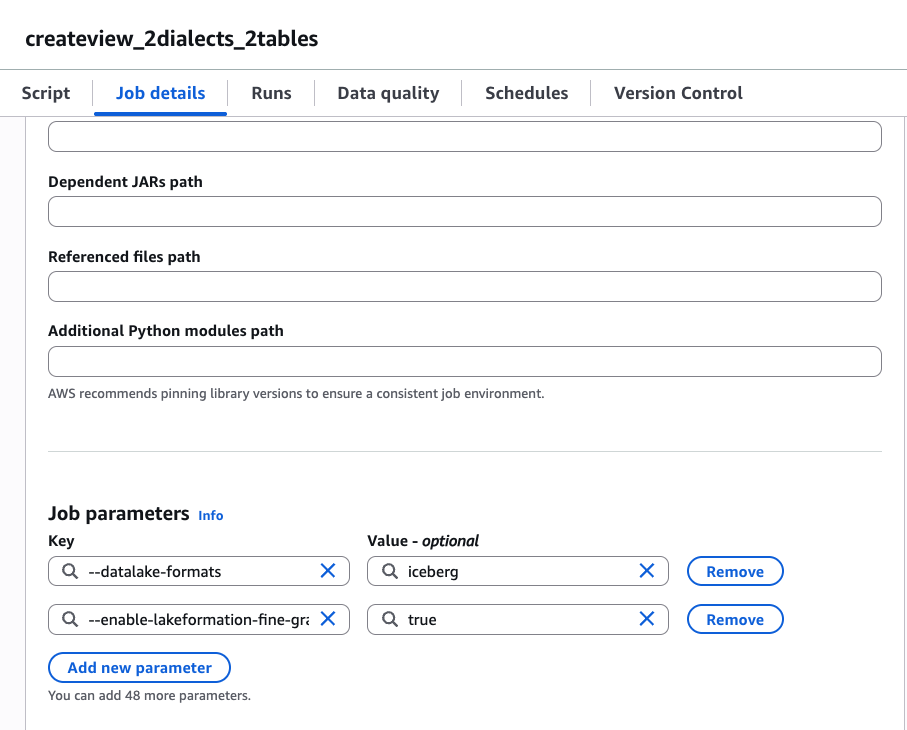
- Add the following 2 properties as additional job parameters. A screenshot is shown for reference.

- Save and run the Glue job. Check the
stdoutlogs to review the query on the newly created view.
A sample update_table script is also provided below, to illustrate changing the view definition with additional columns. Note the REPLACE keyword:
bdb_5773_updateview_bothdialects.py
Adding ATHENA dialect using SDK to an existing AWS Glue view
You can update an existing AWS Glue view that was created with the SPARK dialect and add the ATHENA dialect using the SDK. The following example uses the update-table CLI command.
The content of add-athena-dialect.json is as follows.
Verify the added dialect on the view by reviewing the SQL definitions of the view in Lake Formation console or using GetTable(). If you want to edit the SQL definition or change the base tables of an existing view that has both SPARK and ATHENA dialects, you can do so using the update_table API (using SDK or CLI), with "ViewUpdateAction": “REPLACE” and provide both the dialect definition under ViewDefinition.
You can run queries on the view from the producer account as Data-Analyst. The view can be shared using Lake Formation Tags or named method, just like sharing tables, to additional consumer accounts from the central governance account. The consumer accounts will create a resource link and query the views.
Cleanup
To avoid incurring ongoing costs, clean up the resources you used for this post:
- Revoke the Lake Formation permissions granted to the
Data-Analystrole and the producer account from the central governance account. - Drop the Data Catalog tables, views, and the database.
- Delete the Athena query results from your Amazon Simple Storage Service (Amazon S3) bucket.
- Delete the
Data-Analystrole from IAM. - Delete the AWS Glue connection and the Athena data source.
- Delete the AWS Glue job, if you tried the Python script as an AWS Glue job.
Conclusion
In this post, I demonstrated how to use cross-account IAM definer roles with AWS Glue Data Catalog views, how to create and update ATHENA and SPARK dialects using the Data Catalog CreateTable() and UpdateTable() APIs. The multi-dialect Data Catalog views allow sharing a subset of data from different tables using Lake Formation permissions, including LF-Tags based access control. The cross-account definer roles support multi-account data mesh architectures so that the producer IAM roles can run the CI/CD pipelines in its account. We encourage you to try the feature and share your feedback in the comments.
Acknowledgements: I would like to thank all the team members who worked to add AWS SDK support for creating ATHENA and SPARK dialects together for AWS Glue views – Daniil Arushanov, Wyatt Hawes, Yuxi Wu, Santhosh Padmanabhan and Karthik Devaraj.
About the author


