


Best for…
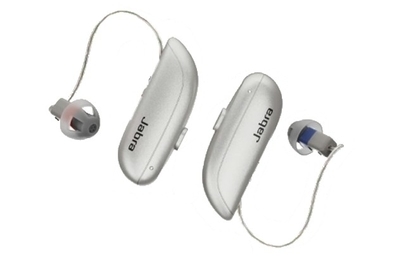
These hearing aids offer multiple sound modes, Bluetooth streaming capabilities, and an intuitive app.
If you’ve never used a hearing aid before, and you want a device that’s easy to set up and packed with useful features, the Jabra Enhance Select 300 is an excellent choice. The Enhance Select pair is ideal for the first-time hearing-aid user, due to the combination of thorough, extended customer service and a generous 100-day trial period when the device is purchased through Jabra directly. Otherwise, the return policy follows that of the retailer.
With a traditional, behind-the-ear design, these hearing aids stay in place comfortably and are water- and dust-resistant. Each Enhance Select hearing aid consists of three elements: the body (which houses the electronics and sits behind the ear), the hearing element or dome (which sits in the ear canal), and the wire connecting them. The 300 pair comes with several different wire lengths and receiver dome sizes. During your initial appointment, Jabra’s audiologist will help you select the right options.
This pair has an IP68 water-resistance rating, so you can remain submerged a few meters under (fresh) water for up to 30 minutes with no damaging effects.
Our tester Fiona — who has small ear canals and usually experiences pretty intense discomfort with the receiver-in-the-ear style of hearing aid — was very happy with how this pair fit. This particular receiver’s materials and form factor didn’t irritate her ear canals, and she said the receiver dome size options were more comprehensive than she’s used to.
Rachel also liked the Jabra set’s fit, and she said when she was looking in the mirror, she couldn’t tell she was wearing these hearing aids. However, due to the shape of her ear, she preferred a more oval-shaped dome. So we bought her some third-party domes, which she said made the Enhance Select pair a perfect fit.
Panelist Tom was happy with his final fit, though he pointed out that the delicate wire connecting the receiver to the body of the hearing aid “can be a touch trickier to manipulate than the more rigid material of a sound tube, specifically for folks with dexterity concerns.” With practice, however, he was able to get the hang of the Enhance Select 300’s design.
Even though this hearing aid’s body rests behind the ears, our panelists were able to wear their glasses comfortably.
Our panelists loved how simple it was to set up, customize, and use this pair. Jabra’s service package includes a video orientation with an audio professional, the ability to upload an existing audiogram, three years of follow-up care and professional adjustments, and three years of warranty and loss/damage protection (there’s a $195 deductible for loss or catastrophic damage).
If you order directly from Jabra, the Enhance Select 300 hearing aids are preset to your hearing profile based on an online hearing test. If you purchase from a retailer, you’ll need to complete the test at home. You can also upload an audiogram, then Jabra’s hearing professionals can fine-tune the sound during your remote appointment. Or you can adjust the sound yourself on the go using Jabra’s intuitive app. Changes to the sound profile upload to the hearing aids wirelessly.
The service team received consistent praise from our panelists. We think this is crucial because having access to tech support and audiologists can be a factor that facilitates long-term use. Good tech support can also be helpful to people setting up the devices for loved ones who may be less technologically savvy.
This set’s sound quality is more adjustable than that of other sets. Our testers found it was simple to fine-tune the volume level and the balance of treble, midrange, and bass. They appreciated the inclusion of situational sound modes (such as restaurant and outdoor modes), which were helpful for reducing background noise while amplifying conversation. This feature was less helpful in many of the cheaper devices we tested.
Rachel said she initially found that the 300 pair sounded a little tinny. However, she said as her ears adjusted and she tested other hearing aids, this set sounded the most natural and performed the best for use at her job, which involves a lot of face-to-face conversations.
Via Bluetooth, the 300 set can also play back sound from devices, like smartphones and tablets, and it can transmit your voice for full headset-style capabilities. (Some OTC hearing aids require you to use the microphone in your phone.)
The 300 set runs on rechargeable (rather than disposable) batteries that last all day. The amount of battery life you get using your Jabra hearing aids will vary based on how many calls you take, how long you stream music, and so on. All of our panelists were able to get a full day’s use on a single charge, and the in-case charging made it easy for them to get some extra battery power while they were out and about. Jabra claims that one hour of in-case charging will provide 15 hours of use. Our panelists said this sounded about right, though they never actually ran out of battery power by the end of the day.
The charging case is on the larger side. It’s bigger than a deck of cards, so it isn’t something you can pop into a pocket and forget about. Because our panelists were able to use the 300 set for a full day without recharging, the charging case’s size wasn’t a dealbreaker for us.
How the Jabra Enhance Select 300 hearing aids have held up
Our original testers still love the Enhance Select 300 hearing aids after a year of use. Fiona told us that she still uses her Jabra pair three to four times as much as she did her old prescription hearing aids, specifically in situations where she anticipates difficulty, “like travel or conferences.” Tom, who initially doubted the need for call connectivity, found over time that he increasingly appreciated being able to use these hearing aids with his iPhone.
A small number of readers have mentioned that the initial appointment to set up the device may be scheduled for a week or so after the day you call, especially if you have limited availability. Although you can still use the hearing aids prior to optimization, this wait can be a bummer if you’re hoping to get them set up and perfected on the same day.
Flaws but not dealbreakers
With this set, you need to use a mobile device to change the sound profiles and update the firmware. This requirement could be a dealbreaker for folks on a budget or who are anti-smartphone. If that describes you, we recommend the less-app-dependent Tweak Enhance.
Another flaw is the lack of bass reproduction for music. The Enhance Select 300 set can stream music from your phone, but all of our panelists noted that the bass notes lacked the oomph that would come from a good set of headphones or earbuds. Rachel said for music, she prefers to use her AirPods Pro 2 and then switch back to the Jabra set when she’s ready to reengage with the world.
Also, because the Jabra hearing aids support streaming via Bluetooth, you have to connect each one to your mobile device separately, so they can be a little annoying to set up. Additionally, if you take too long to remove both hearing aids from the charging case, they may not pair as a set; that means you’ll need to reinsert them in the case and take them back out again to reconnect. This is a Bluetooth issue. Our panelists ultimately found that the easiest way to avoid connection issues was to remove both hearing aids from the case first and then put them in their ears.
Like most OTC hearing aids, this Jabra pair doesn’t have telecoil capabilities. Telecoil, T-coil, or induction loop systems essentially offer a way for hearing aids to receive a signal from a local broadcasting device, such as a theater’s audio, a public-transit PA system, or a specially equipped telephone.
Our panel also wished that the Enhance Select 300 was compatible with more non-mobile devices for videoconferencing. Currently, MFi (Made for iPhone/iPad) hearing aids like this set can pair only with select Mac computers that use the M1 chip and all Mac computers with the M2 chip or later; that means folks with older Apple devices or Windows machines are out of luck. You can scroll to the bottom of the page to check this list of MFi compatibility to see if your set meets the requirements.


