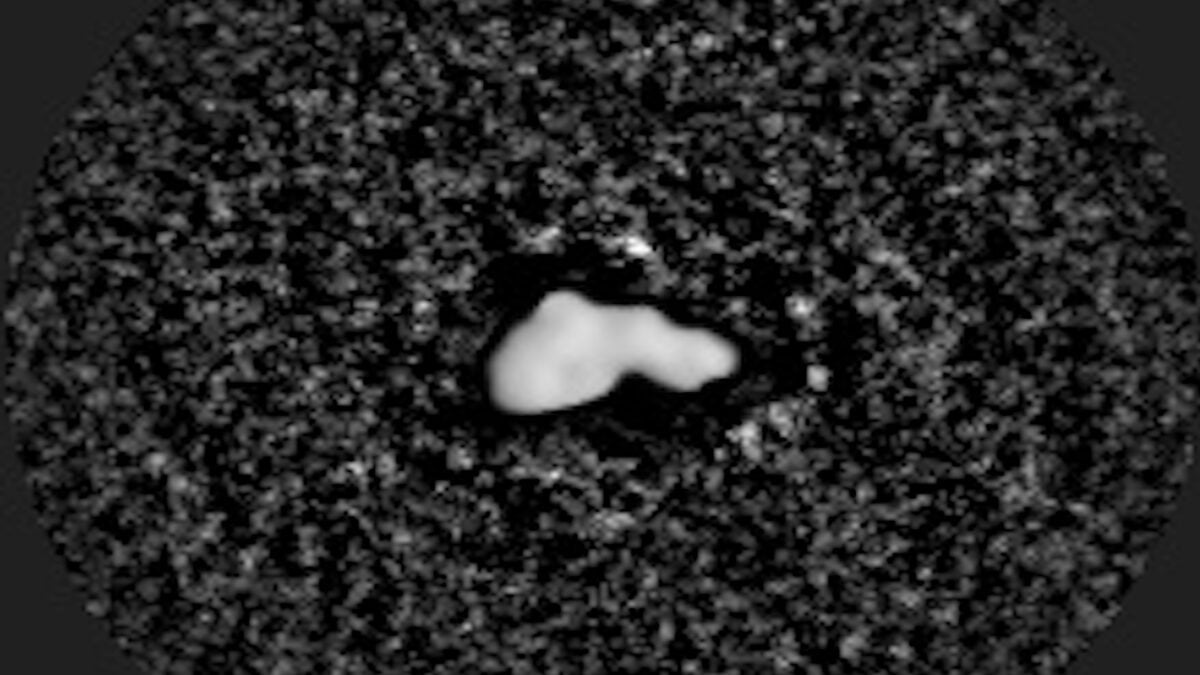
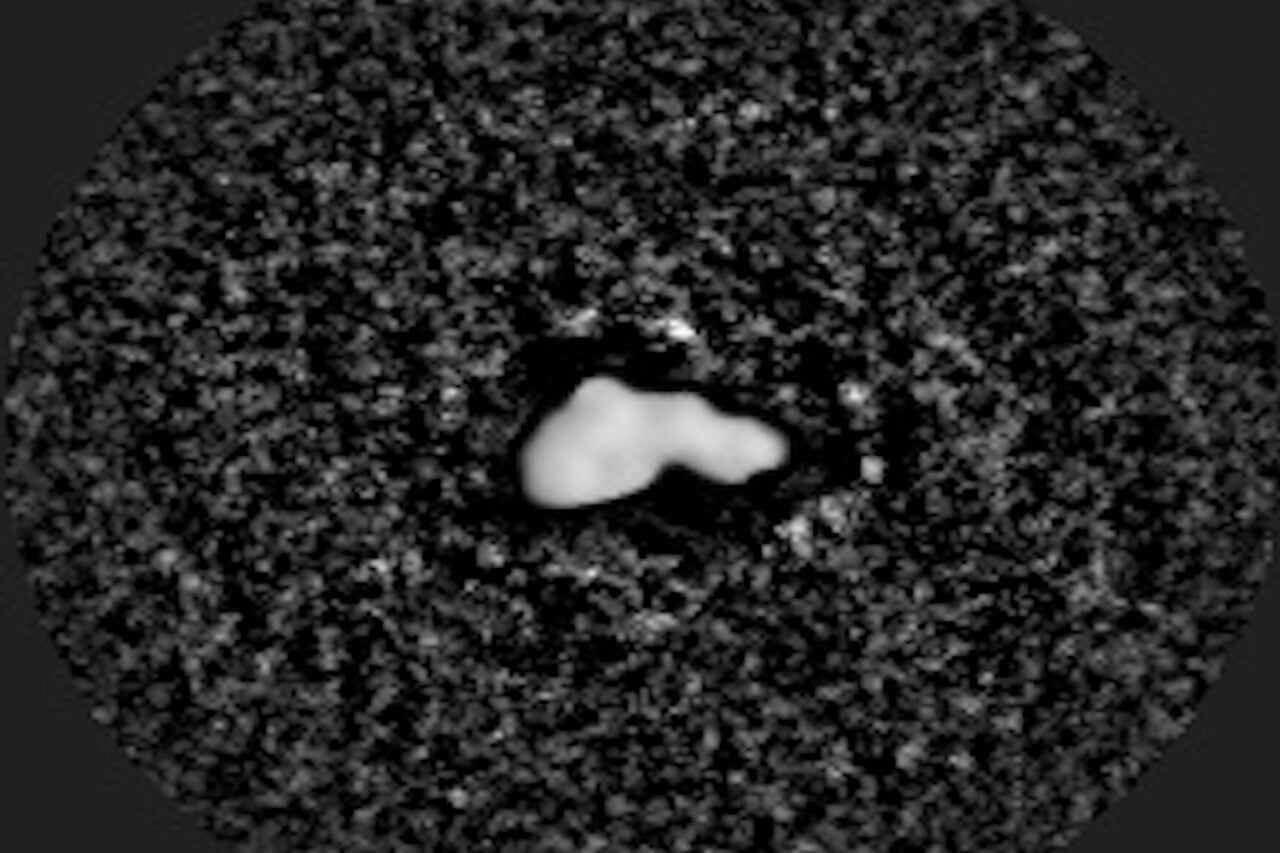
Astronomers got a closer look at one of the largest known asteroids in the main belt, revealing a world like no other accompanied by its own moon.
The asteroid (44) Nysa was first discovered in 1857, circling the Sun between the orbits of Mars and Jupiter. Using high-resolution images from the Large Binocular Telescope in Arizona and the Very Large Telescope in Chile, a team of scientists built a three-dimensional model of the asteroid and found that it was unlike any they have ever seen.
Nysa appears to have three lobes, which are connected together through a thin neck that’s holding the space rock together. The recent observations also found a tiny moon orbiting the asteroid at a distance of around 100 miles (170 kilometers).
The new findings help shed light on ancient collisions that took place during the early history of the solar system and how they helped shape the asteroids that orbit the Sun today.
Counting lobes
Since its discovery, Nysa has gained plenty of attention for its unusual brightness and composition. Astronomers have been studying the asteroid for over a century, with earlier observations suggesting that it possessed an elongated or bilobate shape.
Nysa is an E-type asteroid, a somewhat rare space rock rich in an iron-free mineral called enstatite, which has a light-reflecting signature that makes the asteroid’s surface appear bright. E-type asteroids share similar chemical traits to the building blocks of Earth, and their composition suggests they formed closer to the Sun; that means they may hold clues to the formation process of the solar system.
To learn more about the asteroid, the team of astronomers behind the new study obtained the highest-resolution images ever acquired of Nysa and combined them with specially developed image processing techniques. The images revealed multiple large surface features, including two prominent valleys that appear to wrap around the asteroid’s circumference and may act as a neck connecting the asteroid’s lobes.
“The images reveal a remarkably unusual object,” Kate Minker, an astronomer at the Lowell Observatory in Flagstaff, Arizona, and lead author of the paper, said in a statement. “The most likely explanation is that Nysa is either a contact trinary, consisting of three connected components, or an extremely irregular coherent body unlike anything we’ve previously observed.”
Two-lobed asteroids are fairly common throughout the universe, but the new images hint at the first discovery of a three-lobed asteroid.
And it’s got a moon
Astronomers also detected a previously unknown moon orbiting the asteroid. The small moon measures at just over half a mile (1 kilometer) wide, circling its 47-mile-wide (75-kilometer) companion.
The team used a high-contrast imaging technique to be able to detect the faint light from the small moon, which was overwhelmed by Nysa’s intense brightness. Future observations of the tiny satellite will help the team of astronomers better determine Nysa’s mass and density.
“Our technique is a bit like figuring out Christmas presents while they’re wrapped,” Al Conrad, associate staff scientist at the Large Binocular Telescope Observatory and a co-author on the paper, said in a statement. “You may be wondering whether the box you’re eyeing contains a clock radio or a bag of socks, so to get a clue of which it is, you pick it up and get a feel for the weight. In a way, you intuitively are measuring density to find out the composition.”
Once the astronomers can gather more data on the asteroid, they will be able to confirm whether Nysa is indeed the three-lobed freak they think it is.
“These new images appear consistent with several earlier clues that Nysa is really a unique object,” Conrad said. “For the first time, we can directly investigate whether those clues point to a deeply indented body or to a true multi-lobed structure.”


