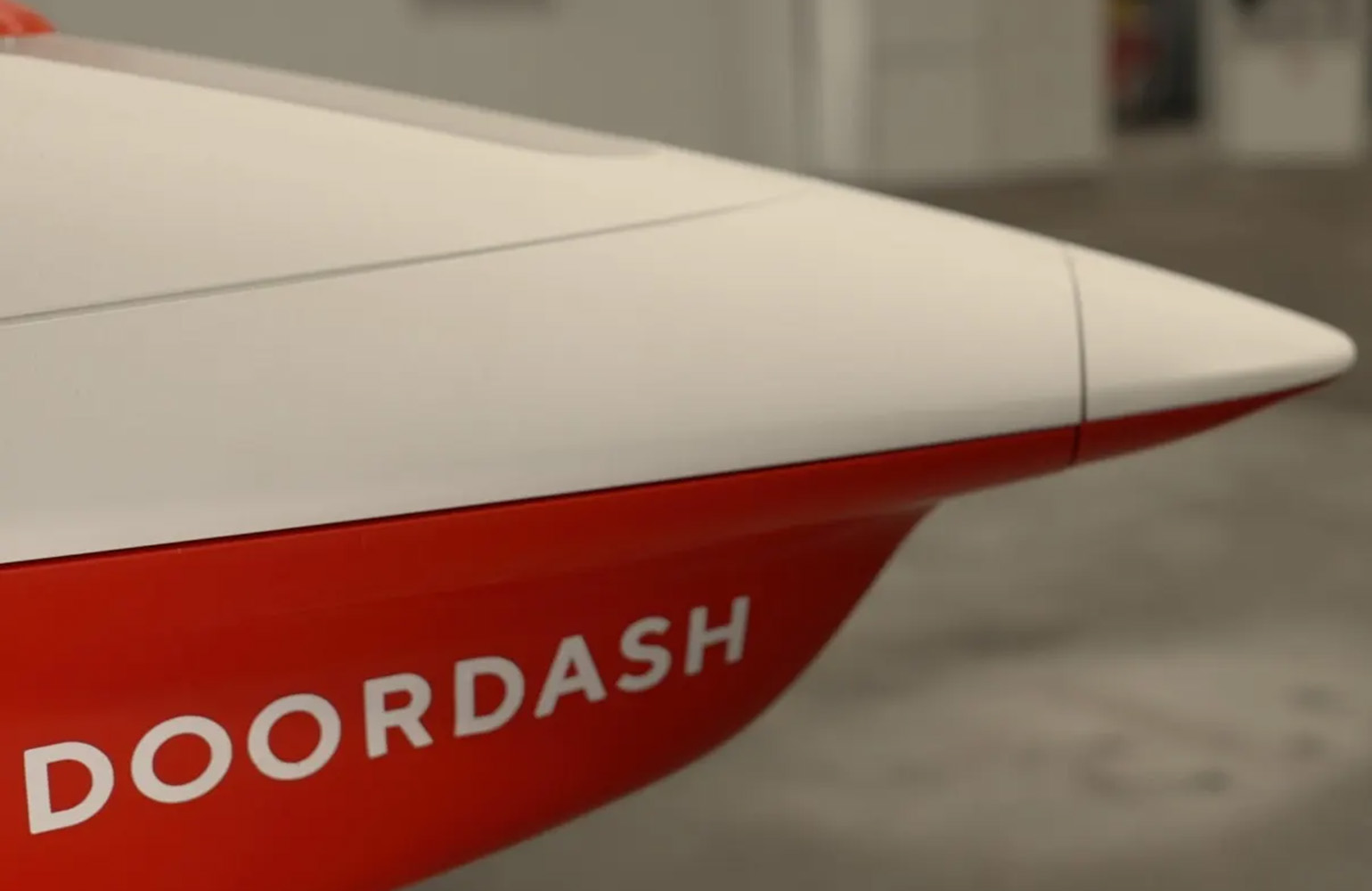
DoorDash said its drone network may handle midrange deliveries, which are less attractive to Dashers. | Source: DoorDash
More drone deliveries are taking to the skies. DoorDash yesterday said it has earned Part 135 air carrier certification from the Federal Aviation Administration. With that approval, the food delivery giant is launching DoorDash Air, its in-house drone program.
In recent years, DoorDash has increasingly invested in automation, and the company is interested in building much of its delivery automation in-house. Last year, it unveiled Dot, its first autonomous delivery robot. The company said it built Dot to travel on bike lanes, roads, sidewalks, and driveways to perform local deliveries.
Now, the FAA’s certification means that San Francisco-based DoorDash can operate as an air carrier.
“We want drone delivery to work for any merchant, anywhere,” said Harrison Shih, the head of DoorDash Air. “We’re building the full stack to make that possible from the ground infrastructure to the drone itself, and the handoff systems that make it work together seamlessly.”
“Advances in hardware, compute, and AI are creating extraordinary new capabilities for local commerce, and becoming a certified air carrier accelerates everything we’re building,” he added.
DoorDash passes the FAA’s rigorous certification process
DoorDash noted that FAA Part 135 certification involves a rigorous testing process with high standards. Operators must pass a robust five-stage evaluation process verifying aircraft airworthiness, maintenance programs, and safety procedures.
“This certification is the product of years of engagement with the FAA,” a DoorDash spokesperson told The Robot Report. “The process is a rigorous multi-stage safety review that authorizes us to perform commercial operations as a licensed air carrier.”
“It required us to clear a five-stage federal process: airworthiness testing, detailed flight operations and maintenance documentation reviewed by the FAA, an FAA-accepted safety management system, a hazardous materials program, and more,” said the spokesperson. “We’re proud to be one of only eight drone operators in the country to have cleared the process.”
Why is DoorDash building its drone network in-house?
DoorDash already works with Wing for drone deliveries. However, the company is building its drone program inside DoorDash Labs, its in-house robotics and autonomy team.
“Our program is built on three things: first, our Autonomous Delivery Platform, which is the software layer that routes each order to the most efficient delivery mode, whether that’s a Dasher, Dot, drone, AV, or sidewalk robot across our third-party partners,” said the spokesperson. “We believe the best way to help local businesses scale with growing consumer demand is through a multimodal delivery network powered by more operators, not fewer.”
“Second, the ground infrastructure we’re building that handles the merchant handoff is designed to be interoperable across drone providers,” DoorDash said. “Our ambition is to develop a merchant handoff solution that supports the entire industry.”
“Third, this Part 135 certification lets us operate, fly, and maintain our own drones,” said the spokesperson. “Together, those are what makes drone delivery actually work at scale for local commerce, not only for our own aircraft, but [also] with drones built by others.”
DoorDash said it is designing its uncrewed aerial vehicles (UAVs) to fill the gaps it sees in local commerce. The company also plans to design and build its drone in the U.S. using mostly American-made components.
Delivery systems get tested in select areas
DoorDash has already tested its drone delivery with its pilot partners. The company did not disclose which cities it has tested in.
In 2025, DoorDash estimated that its drones completed deliveries in just 25 minutes on average. In fact, some locations participating in its drone partner pilots saw DoorDash order volume grow by roughly 30%, with the lift sustained for nine weeks following the pilot launch.
The company said it hopes drones can fill in some of the gaps in its wider delivery network. More than 20% of orders on the DoorDash platform in 2025 traveled three to five miles. Those orders took on average nearly 25% longer than shorter deliveries, largely because finding the right ground-based Dasher takes longer for midrange trips, it said.
Routing mid-range deliveries to drones lets Dashers focus on shorter deliveries that can be done quickly, it explained. These allow the Dasher to stay near a high concentration of merchants for optimal routing.
DoorDash did not share details about where it would be rolling out DoorDash Air, or when we can expect to see DoorDash drones zipping through the sky. However, the company did say it plans to divulge more details in its Dash Forward event this September.
 Save the date for RoboBusiness 2026
The post DoorDash gains FAA certification to operate its own drone delivery program appeared first on The Robot Report.


