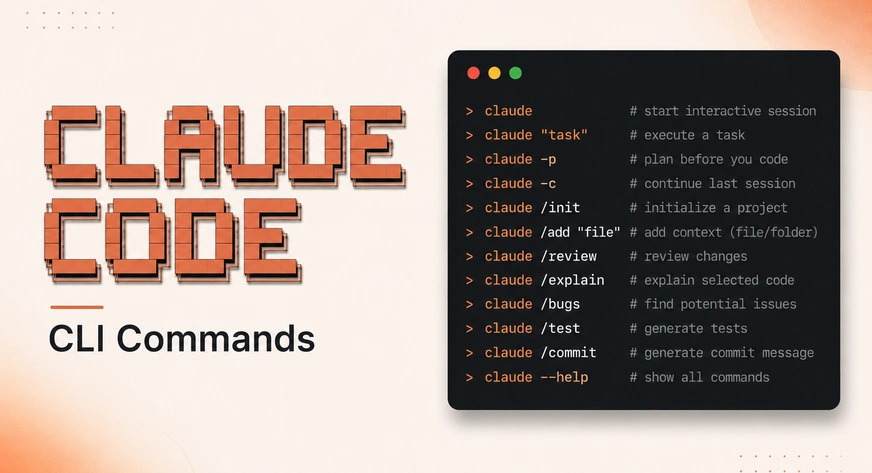
I used Claude Code daily for months before realizing that claude --help hides many of its most useful capabilities. I kept restarting fresh sessions, repeatedly explaining the same project structure, simply because I did not know a better workflow existed.
While debugging an unrelated issue, I discovered the full CLI reference: dozens of commands and flags that completely changed how I use the tool. In this article, I walk through the hidden features that mattered most in practice and how they can make Claude Code significantly more productive.
Note: This article skips installation and beginner setup. If you are new to Claude Code, start with Getting Started with Claude Code for installation and first-run setup, and Claude Code: Master it in 20 Minutes for a quick overview of the tool. Everything below focuses on the less obvious CLI features and is verified against Claude Code v2.1.209 and later; version-specific flags are noted where relevant.
1. The First Thing That Changed: I Stopped Losing My Sessions
Claude Code saves every session automatically. It always has. I just never knew how to get back into one. Three flags fix the entire problem:
# Continue the most recent session in this directory
claude -c

# Name a session when you start it
claude -n "auth-refactor"

# Come back to it by name, days later
claude -r "auth-refactor" "finish the PR description"
The naming part is what makes this actually usable. Without a name you get an auto-generated ID like 7c5dcf5d, which works fine but is impossible to remember. With a name, resuming a piece of work three days later takes one command and Claude already knows everything about it.
There is a fourth flag here worth knowing. If you want to pick up an old session but you are about to try something risky, –fork-session branches it so the original transcript stays untouched:
claude -r auth-refactor --fork-session| Flag | What it actually does for you |
|---|---|
claude -c |
Picks up your last session in this folder. Full context, no re-explaining. |
claude -n "name" |
Names the session so you can find it later without hunting for an ID. |
claude -r "name" |
Resumes a specific session by name or ID. |
claude --fork-session |
Resumes but branches, so the original session stays as it was. |
claude --from-pr 123 |
Opens the session picker filtered to sessions tied to a specific pull request. |
Try this now: Open a project you were working on yesterday and run claude -c. If you have ever used Claude Code in that folder, it will pick up exactly where you left off. This one command is the difference between a tool you restart every day and one that remembers your project.
2. The One That Changed My Whole Working Day: Background Agents
If you take one thing from this article, take this one.
Adding --bg to any command starts the task as a background agent and hands your terminal straight back to you. Claude keeps working. You keep working. You check on it when you feel like it.
$ claude --bg "investigate why payments.test.js is flaky"
Session started: 7c5dcf5d
To attach:    claude attach 7c5dcf5d
To view logs: claude logs 7c5dcf5d
To stop:      claude stop 7c5dcf5d
The moment this clicked for me was a Monday morning. I kicked off a background agent to audit an unfamiliar codebase for security issues, then spent the next forty minutes doing my actual planned work in a second terminal. When I came back, it had a full report waiting. I had not been sitting there watching a spinner.
You can run several at once. My usual pattern now looks like this:
# Fire off two long jobs
claude --bg "audit the API surface for missing auth checks"
claude --bg "find every TODO comment older than six months"

# Get on with your own work, then check in
claude agents
Managing them
| Command | What it does |
|---|---|
claude agents |
Live view of every session, running and finished. |
claude agents --json |
Same thing as JSON, so you can parse it in a script. |
claude attach <id> |
Pull a background session into your current terminal. |
claude logs <id> |
Print recent output without attaching. |
claude stop <id> |
Stop a running session. |
claude rm <id> |
Remove it from the list. The transcript stays on disk. |
claude respawn <id> |
Restart a session with its conversation intact. |
claude respawn --all |
Restart everything. Useful right after a Claude Code update. |
One more that took me a while to notice. The –exec flag runs a plain shell command as a background job instead of a Claude session, which is surprisingly handy for long test runs:
claude --bg --exec 'pytest -x tests/'If parallel agents interest you at a bigger scale, Anthropic pushed this much further with Dynamic Workflows, which can coordinate hundreds of parallel subagents in a single session. We covered that in our Claude Opus 4.8 article.
3. The Flag I Should Have Learned on Day One
-p, short for --print. It runs your query, prints the answer, and exits. No interactive session, no waiting for follow-up.
On its own that sounds boring. What makes it interesting is that it turns Claude Code from a thing you sit inside into a thing you can pipe into:
# Ask one question, get one answer, back to your shell
claude -p "what does auth.js actually do"

# Pipe a file straight in instead of asking Claude to find it
cat error.log | claude -p "summarise these errors by root cause"
cat changes.diff | claude -p "review this diff for security issues"

# Continue your last session but just get one answer
claude -c -p "any type errors left?"
The piping is the part I lean on most now. Feeding a log file or a diff directly into Claude is faster than describing where the file is and waiting for it to read from disk, and it works on files outside your project folder.
Try this now: Find any log file on your machine and run: cat thatfile.log | claude -p “what is going wrong here”. It takes about ten seconds and it is the fastest way to understand what -p is for.
Output formats, once you start scripting
Once -p is in your toolkit, output formats become relevant. Text is the default. JSON gives you something parseable. Stream JSON gives you an event stream for real-time pipelines:
claude -p "list all API routes" --output-format json
claude -p "query" --output-format stream-json --verbose
And if you are calling Claude Code from a script a lot, --bare is worth knowing. It skips auto-discovery of hooks, skills, plugins, MCP servers, and CLAUDE.md so the call starts faster. Claude still has Bash and file tools, nothing else loads:
claude --bare -p "quick question about this one file"4. Where I Was Quietly Burning Money
This section exists because of a bill I did not enjoy looking at.
Claude Code has an effort setting that controls how much reasoning it applies to a task. I had never touched it, which meant every trivial task got the same deep-thinking treatment as a hard architecture problem.
claude --effort low       # small edits, quick questions
claude --effort medium    # standard day-to-day coding
claude --effort high      # complex refactors, architecture work
claude --effort ultracode # xhigh effort with ultracode on (v2.1.203+)
Matching effort to the task is the single easiest cost lever in the tool. A one-line fix does not need max effort.
Hard limits for anything automated
For scripted or automated runs, two flags stop things getting out of hand. I now treat both as mandatory in any pipeline:
# Stop once API spend hits two dollars
claude -p --max-budget-usd 2.00 "large refactor task"

# Stop after five agentic turns
claude -p --max-turns 5 "investigate this bug"
As of v2.1.217, spend from subagents counts toward –max-budget-usd, and once the cap is hit Claude Code stops background subagents that are still running. Before that version, subagent spend could quietly overshoot the cap.
There is a lot more depth on cost control than I can fit here. If this is your concern, 23 Tips for Claude Code Token Saving goes properly deep on model choice, effort tuning, and reusable subagents, and it is where I picked up most of my own habits.
5. The Setting I Had Wrong for Months
Permission modes control how much Claude Code does without checking with you first. I ran on the default for a long time, approving every single file edit by hand, and assumed that was the only safe option.
It is not. There are six modes, and picking the right one for the task removes a lot of friction without giving up control where it matters:
| Mode | What it allows | When I use it |
|---|---|---|
default |
Prompts before every edit and tool use | Unfamiliar codebases |
acceptEdits |
Auto-accepts file edits, still asks before Bash | Most of my actual work |
plan |
Plans only. Writes nothing, runs nothing. | Understanding a change before allowing it |
auto |
Decides for itself what is safe to allow | Projects I know well |
dontAsk |
Suppresses prompts but keeps safety checks | Longer trusted tasks |
bypassPermissions |
Skips all permission prompts | CI only, in a sandbox |
claude --permission-mode plan
claude --permission-mode acceptEdits

# Same as bypassPermissions, deliberately verbose so you notice it
claude --dangerously-skip-permissions
Plan mode was the real find for me. When I am about to let Claude touch something I do not fully understand yet, I start in plan mode, read what it intends to do, then switch modes and let it run. It costs one extra step and has caught flat-out wrong assumptions more than once.
Restricting tools instead of modes
Separately from permission modes, you can limit which tools Claude has at all:
| Flag | Effect |
|---|---|
--tools "Bash,Edit,Read" |
Only these built-in tools are available this session. |
--tools "" |
No tools. Claude can only produce text. |
--allowedTools "Bash(git log *)" |
Auto-allow matching calls without prompting. |
--disallowedTools "Bash(rm *)" |
Always deny matching calls, tool stays otherwise usable. |
--disallowedTools "mcp__*" |
Deny every MCP tool for this session. |
6. MCP From the Terminal
MCP is what lets Claude reach into your database, GitHub, Slack, and anything else you connect. I am not going to re-explain the setup here because we have a full walkthrough in How to Connect MCP Servers with Claude, covering both Claude Desktop and Claude Code. What I do want to flag are the CLI commands that are easy to miss.
The three I actually use
# Check what is connected and what is broken
claude mcp list

# Authenticate a server showing 'needs authentication'
claude mcp login sentry

# Bring over everything already set up in Claude Desktop
claude mcp add-from-claude-desktop
That last one saved me a tedious afternoon. I had five servers configured in Claude Desktop and was halfway through adding them to Claude Code by hand before I found out one command copies the lot across, on macOS and WSL.
The mcp login and mcp logout commands are newer, from v2.1.186. Before them you had to open the interactive /mcp panel to run an OAuth flow, which was awkward over SSH. Now you can do it from the shell, and --no-browser prints the URL for you to paste instead of trying to open a browser on a remote box:
claude mcp login sentry --no-browserReading the status output
When claude mcp list shows something other than connected, the status tells you what to do next:
| Status | What it means and how to fix it |
|---|---|
connected |
Working. Nothing to do. |
needs authentication |
Reachable but not authorised. Run claude mcp login <name>. |
connected, tools fetch failed |
Connected but could not list tools. Run claude mcp get <name> for the error. |
failed to connect |
Did not start. Run the install command in your own terminal to see the real error. |
pending approval |
A project-scoped server you have not approved in this session yet. |
7. System Prompts: Append or Replace, and Why It Matters
There are four flags for changing the system prompt. Two replace it entirely, two add to it. I got this wrong the first time and it took me a while to work out why the results felt off.
| Flag | Behaviour |
|---|---|
--append-system-prompt "text" |
Adds your text after the default prompt. |
--append-system-prompt-file f.txt |
Adds file contents after the default prompt. |
--system-prompt "text" |
Replaces the entire default prompt. |
--system-prompt-file f.txt |
Replaces the default prompt with file contents. |
Here is the rule I now follow. Use append when Claude should still behave like a coding assistant but also follow an extra rule of yours. Use replace only when the task is not coding at all, like a data extraction step in a pipeline nobody is watching.
Replacing drops everything in the default prompt, including tool guidance and safety instructions. That is the part I had not appreciated. My replaced prompt was shorter, so the model had less to work with, and I could not understand why it had stopped following conventions it had followed all week.
# Extend without changing what Claude is
claude --append-system-prompt "Always write a test for any new function"

# Replace, for a non-coding pipeline step
claude --system-prompt "You are a JSON extraction agent. Output only valid JSON."
For rules you want on every session in a project, do not pass flags every time. Put them in CLAUDE.md, which loads automatically. And if you find yourself repeating a whole workflow rather than a rule, that is what Skills are for: Claude Skills Explained covers building them, and there is a good collection of ready-made ones in these GitHub repositories.
8. When Something Breaks
These are the commands I reach for when Claude Code is behaving strangely, in the order I try them.
Start here
# Read-only diagnostic: install health, settings errors, auth state
claude doctor
claude doctor runs without starting a session and tells you whether your install is healthy, whether your settings files have validation errors, and whether you are authenticated. It has caught a malformed settings.json for me twice, which is not something you would ever guess from the symptoms.
If a customisation is the problem
# Start with every customisation disabled
claude --safe-mode
Safe mode disables CLAUDE.md, skills, plugins, hooks, MCP servers, custom commands, output styles, keybindings, and auto-memory. Authentication, model selection, and built-in tools all still work. If the problem disappears in safe mode, you know it is something you configured rather than the tool itself.
Note: Safe mode and bare mode are not the same thing. Bare mode skips auto-discovery for speed in scripts. Safe mode disables customisations for troubleshooting, and goes further, covering output styles and keybindings that bare mode would still load.
If a background session is stuck
claude daemon status

# Stop the supervisor but leave the sessions running
claude daemon stop --any --keep-workers
Updating
claude update

# Or pin a specific version
claude install 2.1.195

# Restart background sessions so they pick up the new binary
claude respawn --all
That last line is easy to forget. Background sessions keep running on the old binary until you respawn them, which produces some very confusing behaviour where a new flag works in a fresh terminal but not in a session you started before updating.
A small quality-of-life thing: if you mistype a subcommand, Claude Code suggests the closest match rather than failing oddly. claude udpate prints ‘Did you mean claude update?’ and exits.
Quick Reference
Everything above in one place, for when you know what you want and just need the syntax.
Sessions
| Command | Description |
|---|---|
claude |
Start interactive session |
claude "query" |
Start with an initial prompt |
claude -p "query" |
One answer, then exit |
claude -c |
Continue most recent session here |
claude -n "name" |
Start and name the session |
claude -r "name" |
Resume by name or ID |
claude --fork-session |
Resume into a new branch |
Background agents
| Command | Description |
|---|---|
claude --bg "task" |
Run as a background agent |
claude agents |
View all sessions |
claude attach <id> |
Attach to a session |
claude logs <id> |
Print session output |
claude stop <id> |
Stop a session |
claude respawn --all |
Restart all running sessions |
claude --bg --exec 'cmd' |
Run a shell command as a background job |
Cost and limits
| Command | Description |
|---|---|
claude --effort low|high |
Set reasoning depth |
claude -p --max-budget-usd 2.00 |
Cap API spend |
claude -p --max-turns 5 |
Cap agentic turns |
claude --bare -p |
Skip auto-discovery for faster scripted calls |
Permissions
| Command | Description |
|---|---|
claude --permission-mode plan |
Plan only, change nothing |
claude --permission-mode acceptEdits |
Auto-accept edits |
claude --dangerously-skip-permissions |
Skip all prompts (CI only) |
claude --tools "Bash,Edit,Read" |
Restrict available tools |
MCP
| Command | Description |
|---|---|
claude mcp list |
List servers and status |
claude mcp login <name> |
Run OAuth for a server |
claude mcp add-from-claude-desktop |
Import servers from Claude Desktop |
claude mcp remove <name> |
Remove a server |
Diagnostics
| Command | Description |
|---|---|
claude doctor |
Install and settings diagnostic |
claude --safe-mode |
Start with all customisations off |
claude daemon status |
Background supervisor state |
claude update |
Update to latest |
claude project purge --dry-run |
Preview deleting project state |
What I Would Tell Myself Six Months Ago
Three things, in order of how much time they would have saved me.
- name your sessions and resume them.
claude -non the way in,claude -ron the way back. This alone removes the daily re-explaining tax. - use
--bgfor anything that will take more than a couple of minutes. There is no reason to sit and watch a long task finish when you could be doing something else in another terminal. - set
--effortto match the task, and put--max-budget-usdon anything automated. Both take five seconds and both directly affect what you pay.
One last thing, and it is the reason this article exists. Run claude --help, then go and read the actual reference. The help output is not the full list, and the gap between the two is where most of the useful stuff lives.
Frequently Asked Questions
A. The documentation says it directly: –help does not list every flag, so a flag’s absence from help output does not mean it is unavailable. Always check the official reference if you are looking for something specific.
A. -c continues the most recent session in your current directory without asking. -r resumes a specific session by name or ID, or shows an interactive picker if you do not pass one. Use -c when you just want the last thing you were doing, -r when you have several pieces of work going and need a particular one.
A. Yes. Combine -p for non-interactive mode, --dangerously-skip-permissions to skip approvals, and a token from claude setup-token for auth. Add --max-budget-usd and --max-turns so a bad run cannot spiral. claude -p –dangerously-skip-permissions --max-budget-usd 5.00 "run the test suite and report failures"
Login to continue reading and enjoy expert-curated content.


