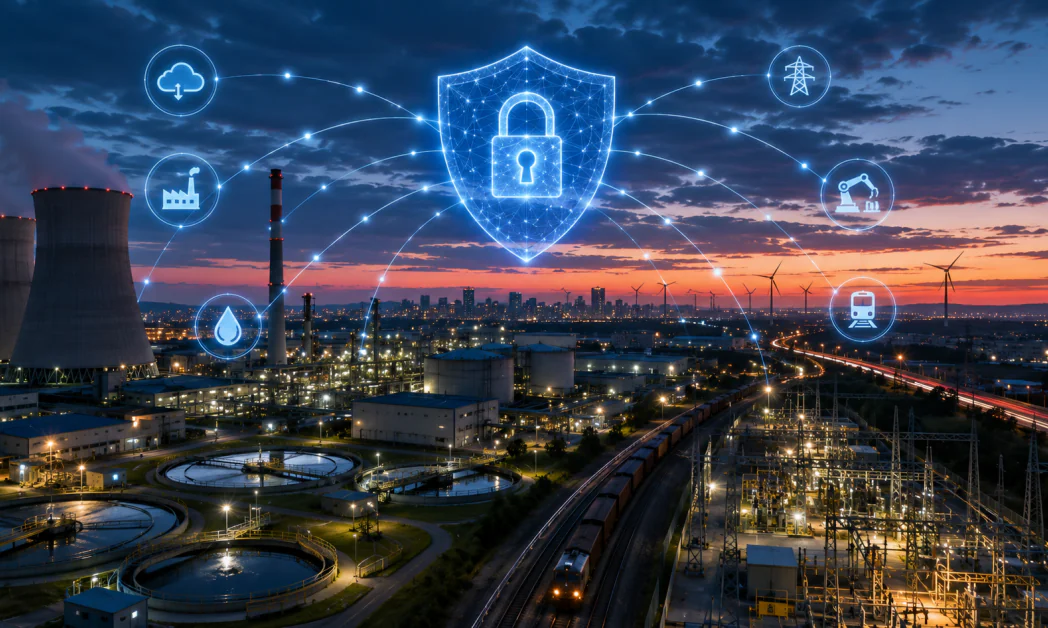
AI is rapidly becoming a foundational layer of modern infrastructure. Organizations are investing heavily in AI-powered systems, expanding data center capacity, integrating cloud platforms, and deploying automation across industrial environments. These advances are creating new opportunities for efficiency and innovation, but they are also introducing new cybersecurity challenges.
The growing intersection between AI infrastructure, operational technology (OT), and critical infrastructure has created a more complex cyber-physical systems (CPS) environment. Systems that once operated independently are increasingly connected through cloud services, remote access technologies, enterprise identity platforms, and industrial data networks.
At the same time, U.S. policy around advanced AI is evolving. The recent White House Executive Order on AI innovation and security reflects growing recognition that frontier AI capabilities have national security implications. While the order focuses on encouraging innovation while improving safeguards, it also highlights a broader challenge: cybersecurity strategies must adapt to a world where AI can accelerate both defensive capabilities and offensive threats.
As geopolitical competition around advanced AI intensifies, critical infrastructure operators face a changing threat environment. The challenge is not only defending against increasingly capable adversaries, but also securing a growing ecosystem of connected systems where everyday exposures can create opportunities for disruption.
AI Adoption Is Accelerating IT and OT Convergence
AI infrastructure expansion is changing how organizations operate. Industries such as energy, manufacturing, transportation, and water are adopting AI to improve forecasting, automate processes, optimize maintenance, and analyze operational data.
However, AI-driven transformation depends on connectivity. Industrial environments increasingly rely on connections between traditional IT systems, cloud platforms, edge devices, and operational technology.
Historically, many industrial systems were designed around reliability and availability rather than cybersecurity. Some environments were isolated from enterprise networks and operated on long technology lifecycles. Digital transformation has changed that model.
Remote monitoring, cloud-based analytics, and centralized management platforms have improved efficiency but have also expanded the number of systems that must be protected.
For critical infrastructure operators, cybersecurity is no longer limited to corporate networks. Security teams must understand and manage relationships between business systems, industrial processes, connected devices, and external services.
Exposure Remains the Primary Path Into Critical Infrastructure
While advanced AI-enabled attacks are receiving significant attention, most compromises of cyber-physical environments continue to rely on familiar weaknesses.
Attackers frequently exploit exposed systems, insecure remote access services, weak authentication practices, and poor visibility into connected assets. These weaknesses are especially challenging in industrial environments because operational systems often cannot be easily updated or replaced without affecting production.
Unlike traditional IT systems, OT environments prioritize continuous operation. A manufacturing line, power system, or water treatment facility cannot always tolerate frequent changes or immediate security upgrades.
As AI expands the number of connected systems, reducing unnecessary exposure becomes one of the most effective ways to improve resilience. Security programs must focus on understanding what is exposed, how systems are connected, and where unnecessary access pathways exist.
Frontier AI Is Changing the Speed of Cyber Operations
One of the most significant cybersecurity implications of advanced AI models is the acceleration of offensive activity.
Frontier AI systems are increasingly capable of assisting with software analysis, vulnerability discovery, code generation, and security research. These capabilities may reduce the time required for attackers to identify weaknesses and develop exploitation techniques.
For defenders, this changes the traditional relationship between vulnerability discovery and remediation. Organizations have historically relied on a window of time between identifying vulnerabilities and seeing widespread exploitation. AI-assisted capabilities may continue to shrink that window.
This challenge is particularly significant for cyber-physical environments, where patching vulnerabilities is often more complex than in traditional IT systems. Many OT systems support essential operations and cannot always be taken offline for updates without affecting safety, reliability, or production. As AI accelerates the pace at which vulnerabilities are identified and potentially exploited, organizations will need to prioritize continuous exposure management, compensating controls, and risk-based remediation strategies alongside traditional patching processes.
The recent AI Executive Order reflects awareness of this challenge by emphasizing coordination around advanced AI capabilities and encouraging information sharing between developers and government stakeholders.
However, policy frameworks alone will not eliminate the risk. Organizations must prepare for a future where security teams have less time to respond after vulnerabilities become known.
Continuous monitoring, stronger identity controls, asset visibility, and exposure reduction will become increasingly important alongside traditional patch management.
Geopolitical Competition Is Expanding the Strategic Importance of Infrastructure
The development of advanced AI capabilities is no longer limited to competition among technology companies. It has become a strategic priority for governments and national security organizations as nations seek to protect critical infrastructure, strengthen technological resilience, and maintain competitive advantage.
Advanced AI systems depend on critical resources, including semiconductor manufacturing, data centers, cloud infrastructure, and large-scale computing environments. These assets represent valuable targets for intelligence collection and disruption.
At the same time, cyber-physical infrastructure remains attractive because successful attacks can create consequences beyond the affected organization. Disrupting energy delivery, manufacturing operations, transportation systems, or municipal services can have economic and societal impacts.
Infrastructure operators must therefore defend against both financially motivated cybercrime and activity linked to geopolitical objectives. For cyber-physical systems, cybersecurity is increasingly about maintaining operational continuity.
Critical Infrastructure Security Must Reach Smaller Operators
One of the biggest challenges in cybersecurity is the gap between the importance of many critical infrastructure operators and the resources available to protect them.
Federal cybersecurity efforts have historically focused on large organizations with significant resources, including government agencies, defense contractors, major energy providers, and technology companies. However, many essential services are operated by smaller entities that face similar threats with fewer resources.
Municipal utilities, regional energy providers, rural healthcare organizations, local transportation systems, and smaller industrial operators often manage systems that are essential to communities but lack large security teams or extensive cybersecurity budgets.
This creates what many cybersecurity professionals describe as the cyber poverty line: organizations whose operational importance exceeds their ability to invest in advanced security capabilities.
National resilience depends on protecting the largest institutions while also strengthening the thousands of smaller organizations that support public safety and economic stability.
The Future of CPS Security Requires Continuous Exposure Management
The growth of AI-enabled infrastructure requires a different approach to cybersecurity.
Traditional security models often focused on periodic assessments, vulnerability scans, and compliance requirements. While these practices remain important, they are increasingly insufficient for environments that change constantly.
Organizations need continuous visibility into assets, connections, identities, and exposure points across IT, OT, and cloud environments.
Key priorities include:
- Reducing unnecessary internet exposure for operational systems.
- Strengthening authentication and identity management.
- Improving visibility across connected infrastructure.
- Segmenting networks to limit attacker movement.
- Monitoring changes in the external attack surface.
These practices represent a shift from reacting to incidents after they occur toward reducing the conditions that allow attacks to succeed.
Building Resilience in an AI-Driven Era
The future of critical infrastructure protection will depend on building resilience across interconnected ecosystems. Organizations best prepared for this shift will be those that understand their exposure, strengthen identity protections, improve visibility, and extend cybersecurity investments beyond traditional enterprise boundaries.
In an AI-driven world, security will not be defined solely by how quickly organizations respond to attacks. It will be defined by how effectively they reduce opportunities for those attacks to succeed in the first place.


