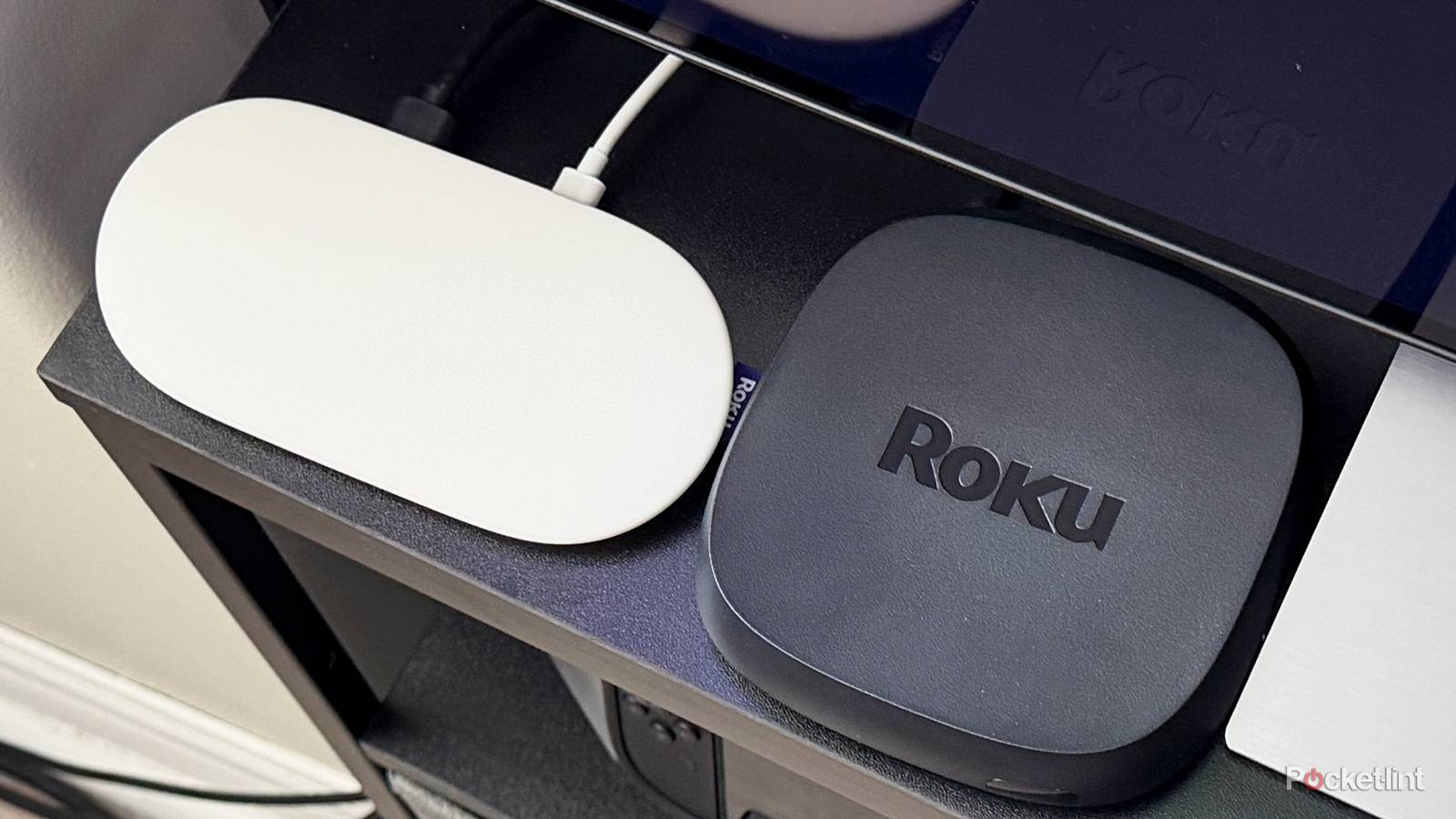
There’s a lot to like about the Roku Ultra. For one, since it’s a set-top streamer rather than a streaming stick, it has upgraded hardware and is inherently faster. There are also several benefits to using Roku OS, including streamlined access to The Roku Channel, which offers a vast library of free content. And while Roku’s interface does have plenty of ads, I find it pretty straightforward to navigate. I especially like how the home screen lays out all my apps in big tiles. I also really appreciate that the Roku Ultra has both a USB port and an Ethernet port, so I can use it to watch local media or hardwire it to my router for a more reliable connection.
That’s what brings me to the Google TV Streamer. I recently picked one up during Prime Day while it was on sale, and I’ve been using it over the past few weeks instead of my Roku Ultra. For the most part, I’ve had a solid experience with it, and I really love its Apps Only mode. I also appreciate that it has a Gigabit Ethernet port, which is 10 times faster than the Roku Ultra’s 10/100 Ethernet port. The Roku tops out at 100 Mbps, while the Google TV Streamer supports speeds of up to 1 Gbps.
But there’s one feature I’ve really come to miss on the Google TV Streamer, one that I used all the time on my Roku Ultra. And honestly, it’s a bit of a head-scratcher why Google left it out, especially when even cheaper Google TV streaming devices, like the Onn 4K Pro, have one.
The Google TV Streamer lacks an open USB port
An odd omission by Google

The key feature the Google TV Streamer is missing is an open USB port, one you can easily use to connect an external storage device or other USB accessories.
To be clear, the Google TV Streamer has a USB-C port, but it’s also the same port used to power the device. So, technically, it’s not a port you can use right out of the box to plug in something like a USB stick and start watching local media.
To connect external storage to the Google TV Streamer, you need to buy an additional adapter, such a USB-C Hub, that plugs into its USB-C port. The hub can still deliver power to the streamer while giving you more USB ports that can be used to connect storage devices the streamer can read.
On the flip side, the Roku Ultra has an open USB-A port that you can use to connect a hard drive and watch local media through Roku’s Media Player. I’ve used it plenty of times to watch old movies I have saved to a portable hard drive, including the Despecialized Edition of Star Wars. But because Roku OS isn’t Android-based, watching local media is really the only thing you can do with that USB port, since you can’t sideload apps.
That’s what makes it even more puzzling that the Google TV Streamer doesn’t have one. If anything, I’d argue that a USB port would be far more useful on a Google TV device than it is on the Roku Ultra. Because the Google TV Streamer is Android-based, there’s so much more you can do with an open USB port beyond just watching local media, such as sideloading apps and installing custom launchers that can totally transform the experience, such as Arc Launcher, which gives your device an Apple TV-like interface that is ad-free.
The Google TV Streamer still has the upper hand
Despite its USB shortcomings, it still comes out on top

While the Google TV Streamer frustratingly lacks a USB port and forces you to rely on an adapter instead, I still think it represents a much better value than the Roku Ultra.
For one, hardware-wise, it comes with 4GB of RAM compared to the Roku Ultra’s 3GB, and it has all the same key premium streaming features, including support for Dolby Vision, Dolby Atmos, and HDR10+. And as I mentioned earlier, it also has a Gigabit Ethernet port, which is 10 times faster than the Roku Ultra’s 10/100 Ethernet port.
Crucially, though, the biggest difference between the Google TV Streamer and the Roku Ultra right now is the price. Roku recently raised the prices of all its streaming hardware due to the ongoing global memory shortage, driven in part by demand for AI and rising component costs. The Roku Ultra got a $50 price increase, jumping from $100 to $150.
Google has yet to change the price of the Google TV Streamer, and it’s unclear if that will happen, but as it stands, it still costs $100. That means the Roku Ultra is now $50 more expensive, despite arguably having inferior hardware in some areas. Its open USB port is one of its biggest advantages, but even that isn’t necessarily a deal-breaker on the Google TV Streamer. You can pick up a USB-C Hub for relatively cheap, which effectively solves the problem, like the UGREEN Revodok Pro USB-C Hub.
So, while I still prefer the Roku Ultra in some ways and miss having an open USB port, the Google TV Streamer’s combination of better hardware, faster Ethernet, and a lower price makes it the better value right now.

- Dimensions
-
6.4 x 3 x 1-inch
- Connective Technology
-
Wi-Fi, Bluetooth
- Brand
-
Google
- What’s Included
-
Remote


