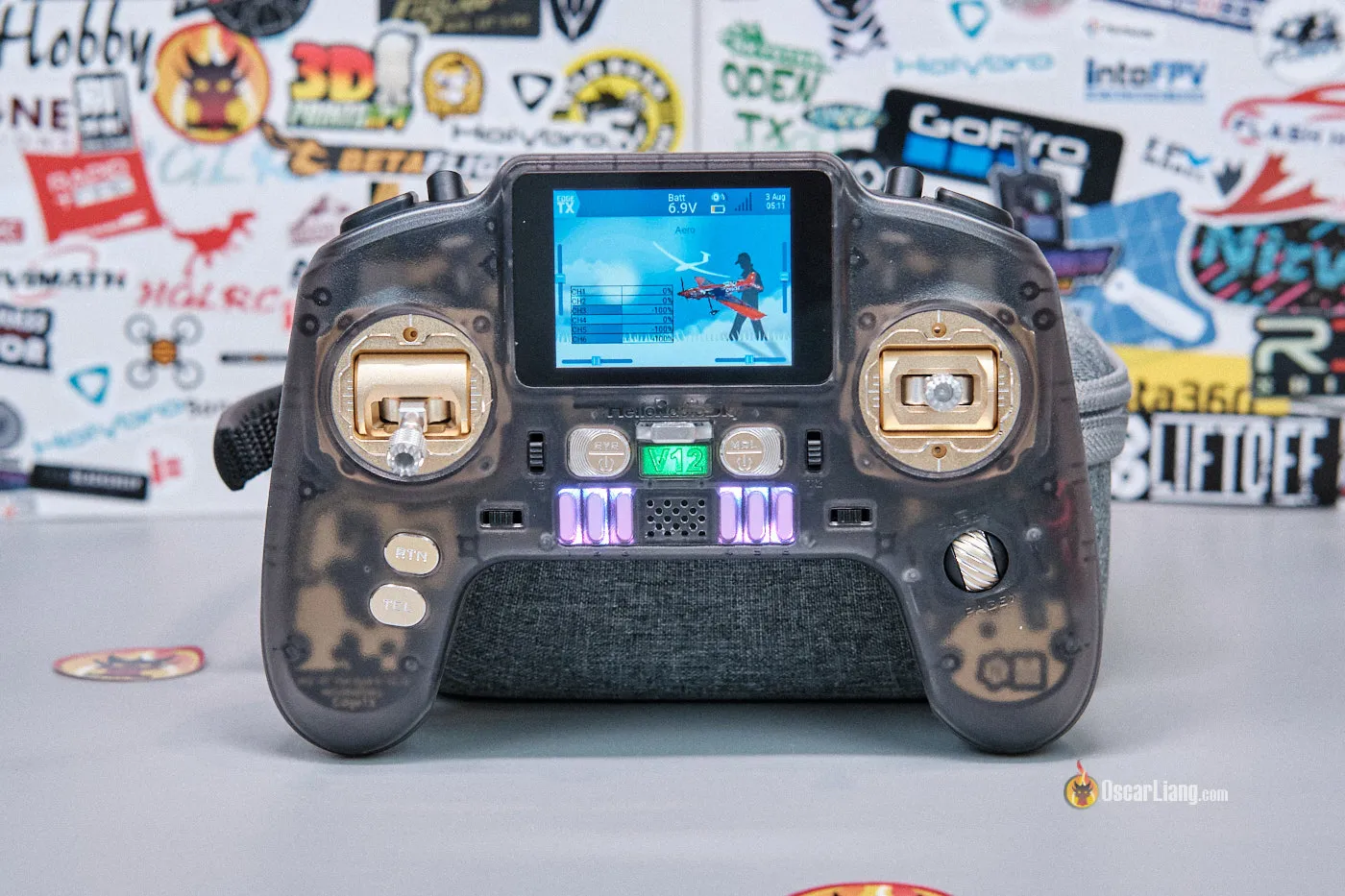
Compact gamepad-style radios are often positioned at the cheaper, budget end of the market. But finally, we have a compact radio with modern hardware, a colour display, better gimbals, strong ExpressLRS performance, and enough battery capacity for longer flying sessions. The HelloRadio V12 MAX is one of the first radios that genuinely feels designed to fill this gap. It is not perfect, but the overall package is impressive, especially its premium build quality, compact design, and extensive feature set.

New to FPV? Learn more about radio transmitters in our buyer’s guide: https://oscarliang.com/radio-transmitter/
Where to Buy
Get the HelloRadio V12 MAX from:

Specifications
- Main processor: STM32H750XBH6
- Transmitter module: Built-in dual-band ExpressLRS module
- ELRS RF chip: LR1121
- Transmission frequencies: 2.4GHz or 900MHz
- Number of channels: 12+ (depending on the receiver)
- Operating voltage: 6.6–8.4V DC
- Operating current: 260mA
- Operating system: EdgeTX
- Display: 2.4-inch TFT colour screen
- Cooling: Dual-channel fan
- Power supply: 2× 21700 batteries, not included
- Firmware update method: USB-C
- Dimensions: 179 × 125 × 55mm
- Weight without batteries: 360g
- Weight with two 21700 batteries: 528g
| Feature | V12 | V12 CNC MAX |
|---|---|---|
| Main Processor | H750 | H750 |
| Built-in ExpressLRS Module | Dual-band ELRS | Dual-band ELRS |
| Maximum RF Power | 1000mW | 1000mW |
| Antennas | Single internal antenna | Dual internal antennas and external antenna |
| Gimbal Sensor | Hall effect | Hall effect |
| Gimbal Material | Plastic | CNC aluminium |
| Button Material | Plastic | CNC aluminium |
| Shell | Grey | Multiple colour options |
| Display | 2.4-inch colour screen | 2.4-inch colour screen |

How It Compares with the RadioMaster Zorro
Let’s be honest: many gamepad-style radios feel cheap and basic – they are designed that way. The RadioMaster Zorro was one of the first genuinely capable gamepad-style transmitters for FPV. It offered EdgeTX, internal ExpressLRS transmitter module, and a familiar console-controller shape.
However, it also had several limitations, including relatively small batteries, modest gimbals, and an older monochrome display.
The V12 MAX improves on the Zorro in almost every major area:
- Faster processor
- Colour display
- Larger batteries
- More powerful internal RF hardware
- Dual-band ExpressLRS
- Better gimbals
- Higher-quality buttons and controls
- External antenna support
With that said, the V12 is not going to replace the Zorro for everyone. For many people the Zorro is a totally adequate controller, and is cheaper, so there’s no need to upgrade. But if you value some of these features, the V12 Max is worth considering.
Build Quality and Ergonomics
The V12 MAX feels very solid in the hands. It definitely feels higher-quality and heavier than most of the compact radios on the market. The weight actually contributes to its premium feel – it does not feel hollow or cheap, and the shell feels sturdy and well supported.
The gamepad-style shape works especially well for thumbers, but I also found it surprisingly comfortable for hybrid pinching. Pilots with small hands should have no problem reaching the full gimbal travel, while those with larger hands may want to use stick extensions.


The overall design feels more mature than some of HelloRadio’s earlier products. Those radios sometimes relied on gimmicky features, such as voice-command control, to stand out. The V12 MAX feels much more focused on actual usability and build quality.
Mini CNC Gimbals
The V12 MAX uses CNC aluminium gimbals, and they feel exceptionally smooth.

The default spring tension is quite light, which is how I normally prefer it. I can use it out of the box without any adjustments. You can also make adjustments if you are used to stiffer tensions.
The stick ends use a less common thread arrangement, with female-threaded stick ends. Stick extensions can still be fitted, but you may need the correct adapter or spacer.
Bear in mind, these are still mini gimbals, similar in size to those used in the Radiomaster Pocket or Zorro. They should be sufficient for most pilots, especially beginners, but I personally still prefer the full-size gimbals found in radios such as the Boxer, T20S, and TX16S.
Full-size gimbals provide more stick travel and potentially finer control, but the V12 is simply too compact to accommodate them.
Switches and Buttons
The biggest weakness of the V12 MAX is probably its limited switch selection.
Sure, most FPV drones pilots should find it adequate, but pilots flying complex fixed-wing models or more advanced setup may find it limiting. For a typical quad pilot, though, I think the available controls are sufficient.
The V12 uses compact, low profile button-style switches rather than traditional stick-style switches. For FPV drone pilots, this can be an advantage because it makes the radio easier to transport. However, the number of switches is quite limited.
The V12 MAX includes:
- Two 3-position shoulder switches
- One latching switch
- One momentary switch
- Two rotary controls (self centering)
- 6 front flight buttons
- A multi-directional scroll wheel
- Dedicated Model and System buttons

The front buttons are RGB illuminated and change colour when pressed. This is not essential, but it looks cool and can help you distinguish between assigned functions visually. When charging, the front buttons also act as charging indicators, which is genuinely useful.

The radio does not have a huge number of switches. For racing/freestyle quads, tiny whoops, and basic FPV aircraft, this is unlikely to be a problem. You have enough controls for:
- Arming
- Flight modes like Angle, Rescue, Position hold
- Turtle Mode
- Buzzer
- Pre-arm
For complex fixed-wing models with flaps, retractable landing gear, multiple flight modes, lights, and telemetry functions, etc, a full-size radio such as the TX16S or TX15 may be more appropriate.
Colour Display and Menu Navigation
The V12 MAX uses a colour display. It is easy to read indoors and appears usable outdoors, although it might struggle under strong direct sunlight.

For FPV flying, I rarely look at the screen during flight anyway, so I am not too fussed about a color screen, but for those who care, it’s certainly a bonus.
However, the major disappointment is that it is not a touchscreen. At this price, and on a radio with a modern colour interface, I expected touch input. Instead, navigation is handled entirely through a 5-directional scroll wheel.
Dual-Band ExpressLRS
The internal RF system is one of the V12 MAX’s strongest technical features.
It supports:
- 2.4GHz or 868/915MHz
- up to 1W output power
This gives you the flexibility to choose between high packet rates and compact antennas on 2.4GHz, or improved propagation and penetration on 900MHz.
Note that the V12 Max does not support Gemini-X, you can only select one frequency.
For most racing, freestyle, tiny whoop and cinewhoop pilots, 2.4GHz will be sufficient. Long-range pilots or those flying through demanding environments may appreciate having 900MHz built in without needing an external module.
The radio also includes an external module bay, so you can still add another protocol or more advanced RF module when required.

Internal and External Antennas
The MAX version includes internal antennas and an SMA connection for an external antenna, which is included. This antenna has both 2.4GHz and 900MHz element built-in, so you can use it for both frequencies.


For short range and ordinary flying, the external antenna is not necessary. The internal system should be sufficient for most whoop, freestyle, and park-flying applications.
The external antenna is intended for situations where you need:
- additional range
- improved penetration
- more reliable long-distance performance
HelloRadio states that the radio automatically detects the external antenna when it is installed, so no manual menu change should be necessary. However, some users have reported uncertainty about whether the automatic switching always behaves as expected. Until this is verified more thoroughly, I would perform a proper range test before relying on the external antenna for demanding long-range flights.
Battery and Charging
The V12 MAX takes two 21700 Li-ion cells, providing substantially more capacity than compact radios using smaller 18650 cells (or even 18350 cells in the Zorro).

The 2 cells are connected in series, so you need both cells inserted to work, battery hot swap is not possible.
A typical configuration would be two 5000mAh 21700 batteries.
The radio uses a single USB-C port for both battery charging and data, which simplifies setup. Also that means you can play FPV simulators without draining your battery.
Power Consumption and Battery Life
Here are my measurements of the V12 MAX’s current draw with a 7.4V input. Unless otherwise stated, the screen brightness was set to minimum.
- RF module off: 0.16A
- RF module off, maximum screen brightness: 0.21A
- 10mW: 0.32A
- 25mW: 0.35A
- 50mW: 0.37A
- 100mW: 0.40A
- 250mW: 0.51A
- 500mW: 0.58A
- 1000mW: 0.90A
- 1000mW, maximum screen brightness: 0.97A
Estimated Runtime with 5000mAh Batteries
- 10mW: Around 15 hours
- 250mW: Just under 9 hours
- 1000mW: Approximately 5.5 hours
These figures are estimates, but they show that the V12 MAX should offer excellent battery life at lower and moderate RF power levels.
Removable Sticks and Travel Storage
The stick ends can be removed for transport.

The radio also provides stick storage slots on the back of the radio, allowing you to keep the stick ends with the radio rather than carrying them loose in a bag.

This is an excellent feature for travellers. With the stick ends removed, the controller becomes flatter and much easier to pack safely.
FPV Simulator Support
The V12 MAX is compatible with major FPV simulators, including Liftoff and Tryp.
It is essentially plug-and-play, although you may need to calibrate the sticks the first time you connect it.
Because the USB-C connection supports data and power, you can use the radio with a simulator without unnecessarily draining the batteries.
Final Verdict: Who Is the V12 MAX For?
The V12 MAX makes the most sense for pilots who:
- Prefer gamepad-style radios
- Primarily fly FPV drones
- Want premium compact gimbals
- Travel frequently
- Fly tiny whoops or freestyle quads
- Want built-in dual-band ExpressLRS
- Need up to 1W RF output
- Want something more advanced than the RadioMaster Pocket
- Want a modern alternative to the Zorro or Tango 2
It is less suitable for pilots who:
- Need a touchscreen
- Use a large number of switches
- Fly complex fixed-wing models
- Want a budget radio
- Prefer a full-size “box-shape” transmitter
The HelloRadio V12 MAX is one of the best gamepad-style FPV radio transmitters I have tested.
Its biggest strength is not any single feature, but the way HelloRadio has managed to integrate all these features into such a compact radio. That is what makes the V12 MAX stand out.
Get the HelloRadio V12 MAX from:
It is not a budget option, and the lack of a touchscreen is slightly frustrating at this price point. The smaller gimbals may also be a downside for some pilots. However, for those who want a compact controller with premium hardware, strong ExpressLRS performance, excellent gimbals, and genuine everyday portability, the V12 MAX is extremely compelling.
For pilots who want a full size transmitter with more switches, larger gimbals, and a touchscreen, the RadioMaster TX15 or TX16S MK3 remains the better choice.


