As the cloud-focused, remote workforce leans into more flexible, automated, on-demand enterprise network solutions, dynamically provisioned network services, also known as Network-as-a-Service (NaaS), have become a differentiator among carriers.
These NaaS solutions enable customers to turn their network up and down within minutes and can offer visibility into service catalogs, inventory availability (including address discovery), quoting, circuit delivery, and circuit performance.
So how is NaaS evolving and how is it being incorporated into the WAN? This analysis—powered by TeleGeography’s NaaS pricing portion of our Network Pricing Database—dives into what NaaS is, the services being offered by NaaS providers, and examines trends in NaaS pricing around the world.
(If you want to learn more about how we collected this data, you can read about our WAN Manager Survey and the key takeaways.)
NaaS definition and overview
As with many new network products, there are multiple definitions for NaaS and standards are still being developed. Mplify (formerly MEF) defines NaaS as a standards-based automated ecosystem that combines on-demand connectivity, application assurance, cybersecurity, and multi-cloud-based services. Essentially, NaaS allows enterprises to consume network infrastructure through a subscription model (like cloud services) to meet their business needs and optimize network performance. Customers can quickly provision and consume network services on demand through a customer portal rather than through a long-term contractual agreement which may take weeks or months to spin up new locations.
Increasingly, carriers are using the term to refer to not just how enterprises might consume or order network services, but also how they manage the whole network lifecycle, from bandwidth provisioning, to monitoring, and fault reporting and management. In this analysis though, we’ll focus just on the consumption-based model of bandwidth provisioning for the two major NaaS products, Data Center Interconnects (DCIs) and Dedicated Cloud Connectivity.
NaaS adoption rates
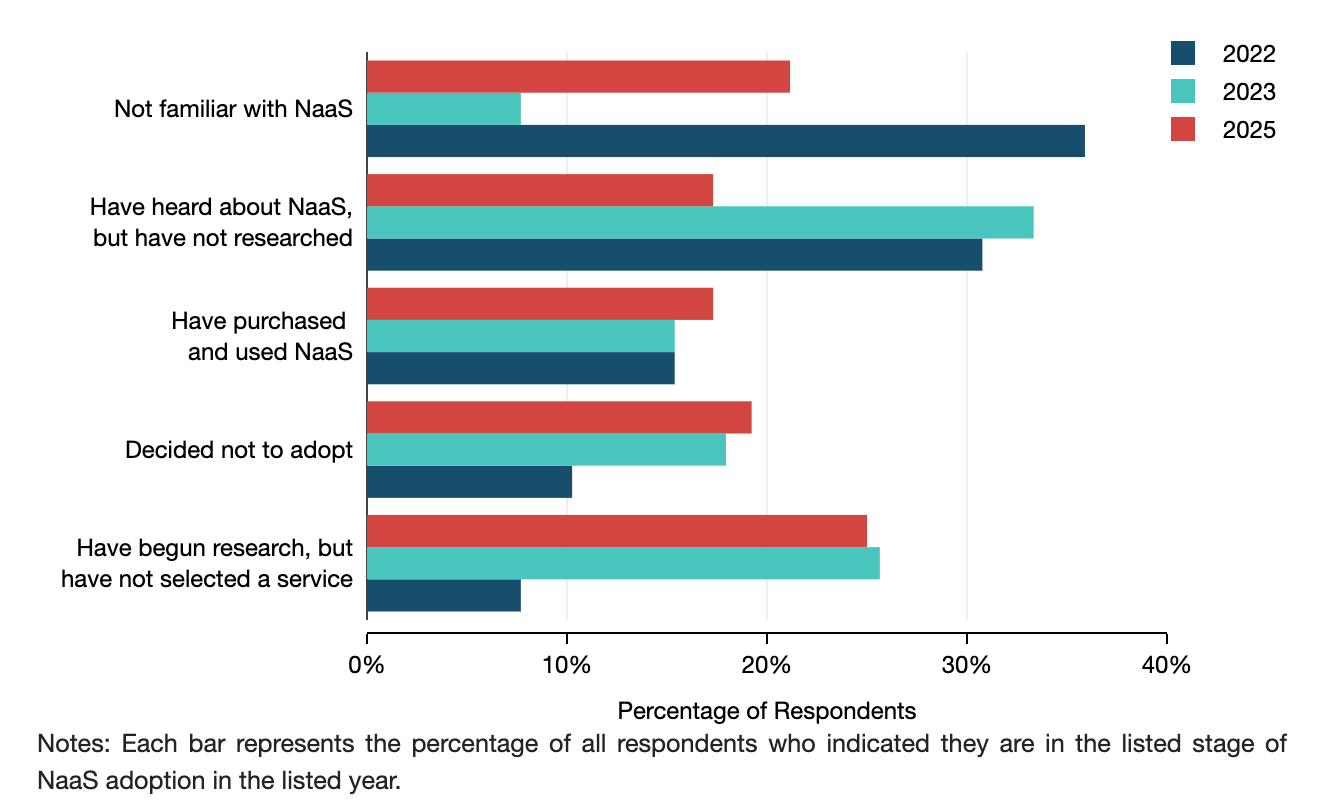
While NaaS products are now widely available and are a frequent topic of discussion at industry events, we’ve found that very few enterprises have already integrated them into the WAN. However, that doesn’t mean that awareness of the service isn’t growing or that interest is lacking. The figure below highlights responses to our WAN Manager Survey (renamed Enterprise Network Trends & Strategy: Insights from the WAN Manager Survey, located within our Cloud and WAN Research Service) in 2022 (dark blue), 2023 (turquoise), and 2025 (red).
NaaS Adoption Stage, 2022-2025
A few key takeaways:
- Adoption of NaaS services remains fairly stable. In 2025, 17% of WAN Manager Survey respondents had already purchased and used NaaS services. That’s compared to 15% in 2022 and 2023.
- Awareness of NaaS is growing, though, and interest is there. As you can see, the biggest change between 2022 and 2025 was the number of enterprise customers who were actively researching NaaS, but had not yet selected a service. In 2025, 25% of respondents were at this stage of adoption, up from 8% in 2022.
- Providers need to continue to work on raising awareness and selling the concept of NaaS. A sizable portion of WAN managers we surveyed (21%) were still not familiar with the service and a further 19% had decided not to adopt it.
When to use NaaS
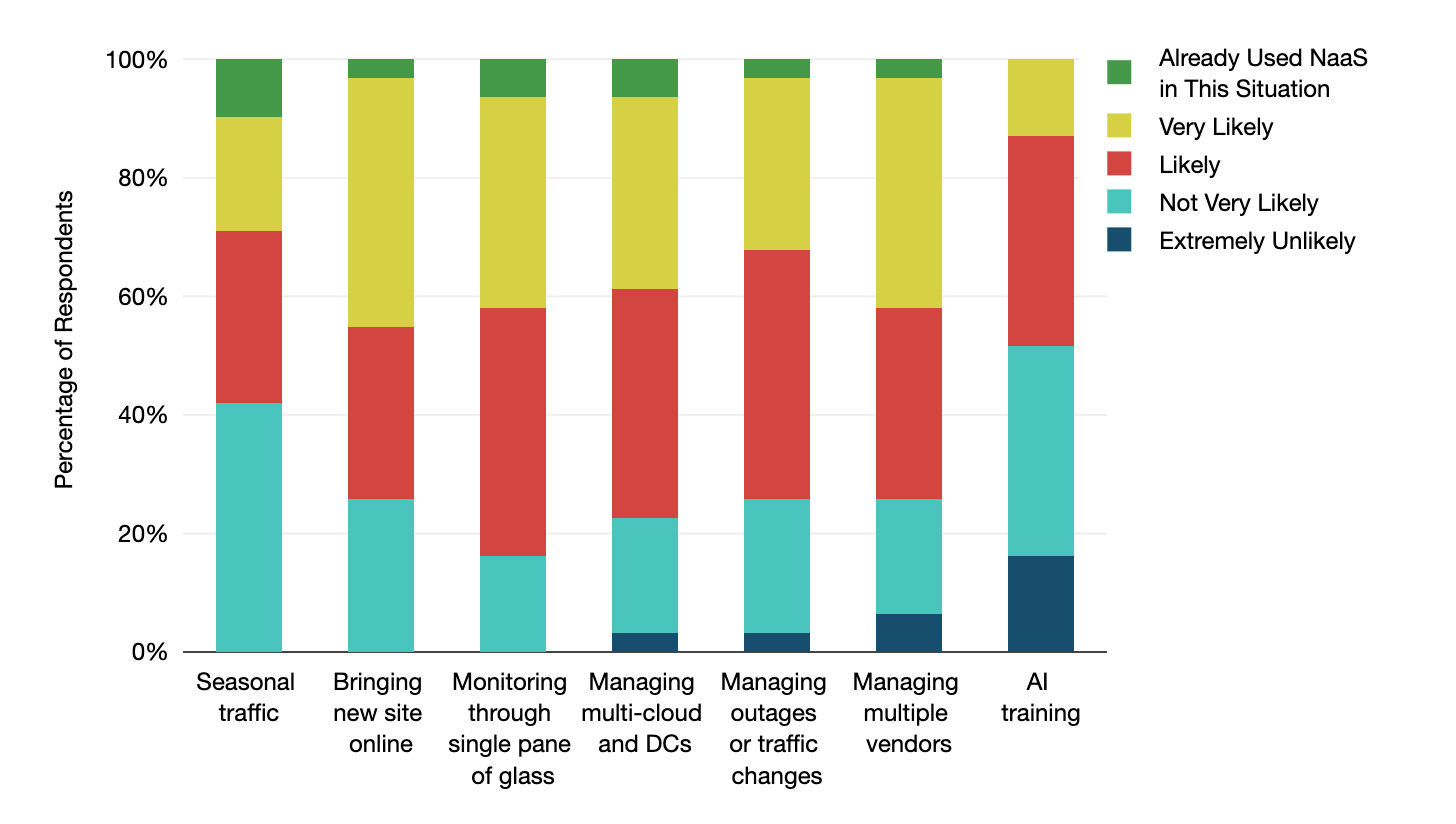
For those enterprise customers who have or are considering integrating NaaS, what are the potential use cases? Service providers have emphasized that the primary audience is companies that may need to boost bandwidth up and down between data centers (DCs) or to their cloud service providers (CSPs), and we see that play out in our data. The figure below details how likely our WAN Manager Survey respondents indicated they were to use NaaS for specific use cases. Bandwidth demand fluctuations from companies such as retail outlets with seasonal bursts or enterprises that specialize in live events were the most likely use case to have been implemented (10%). A further 48% indicated that this was a likely or very likely use case for NaaS. The next most popular use case was a tie between managed cloud connectivity across multiple hyperscalers and/or on premise DCs and monitoring network performance or security through a single pane of glass. For both situations, 6% of NaaS users had already utilized NaaS this way.
NaaS Use Cases
NaaS products and pricing
As we mentioned above, two of the main NaaS products are Data Center Interconnects (DCIs) and Dedicated Cloud Connectivity. But as with any new network technology, pricing models are still evolving. And it’s not as simple as dividing an annual lease price by 365 to calculate a daily rate. While some providers indicated no premium for shorter terms, others reported that opting for hourly, daily, or monthly usage over a 12-month contract carried a premium ranging from 10% to 35%.
So what does NaaS pricing look like? The following analysis includes the results from TeleGeography’s 2025 NaaS pricing update. Participants were asked to assume and provide the following:
Data Center Interconnect, or on-demand Layer 2 connectivity between any two data centers on the network.
- Port charges: the monthly recurring charge for a multi-service access port at each customer site. Please assume a one year term for each port.
- Connectivity charges: the Layer 2 connectivity between customer access ports for data center to data center connectivity.
Dedicated Cloud Connectivity, or scalable dedicated connections from the enterprise network in the data center to cloud service provider’s (CSP’s) network.
- Port charges: the monthly recurring charge for a multi-service access port at each customer site. Please assume a one year term for each port.
- Connectivity charges: the Layer 2 connectivity between a customer access port and CSP network.
For both services, respondents were asked to provide connectivity charges by the day, or the smallest increment of time they allowed customers to provision. A majority of providers indicated they allowed customers to provision connectivity by the day, while others maintained a monthly connection as the smallest unit of connectivity. In order to compare apples to apples across providers, we have divided the reported monthly prices by 31 to calculate a daily rate.
Data center interconnects
Data center interconnect pricing contains two main pieces–two multi-service access ports, one in each of the customer’s DCs, and the Layer 2 connectivity between them.
Let’s first take a look at multi-service port pricing. These access ports in a DC can be ordered via a provider’s customer portal and are usually offered for a one year term. Charges include a non-recurring charge and then a monthly recurring charge. As you can see in the figure below, what you can expect to pay for a 1 Gbps port varies around the world. In 2025, median 1 Gbps port prices ranged from $150 per month in Europe, Latin America, Oceania, and the U.S. & Canada, to $200 per month in Africa and Asia. While one provider increased prices over the past year, a majority kept prices the same in 2024 and 2025.
Median Monthly Access Port Prices by Capacity in Europe
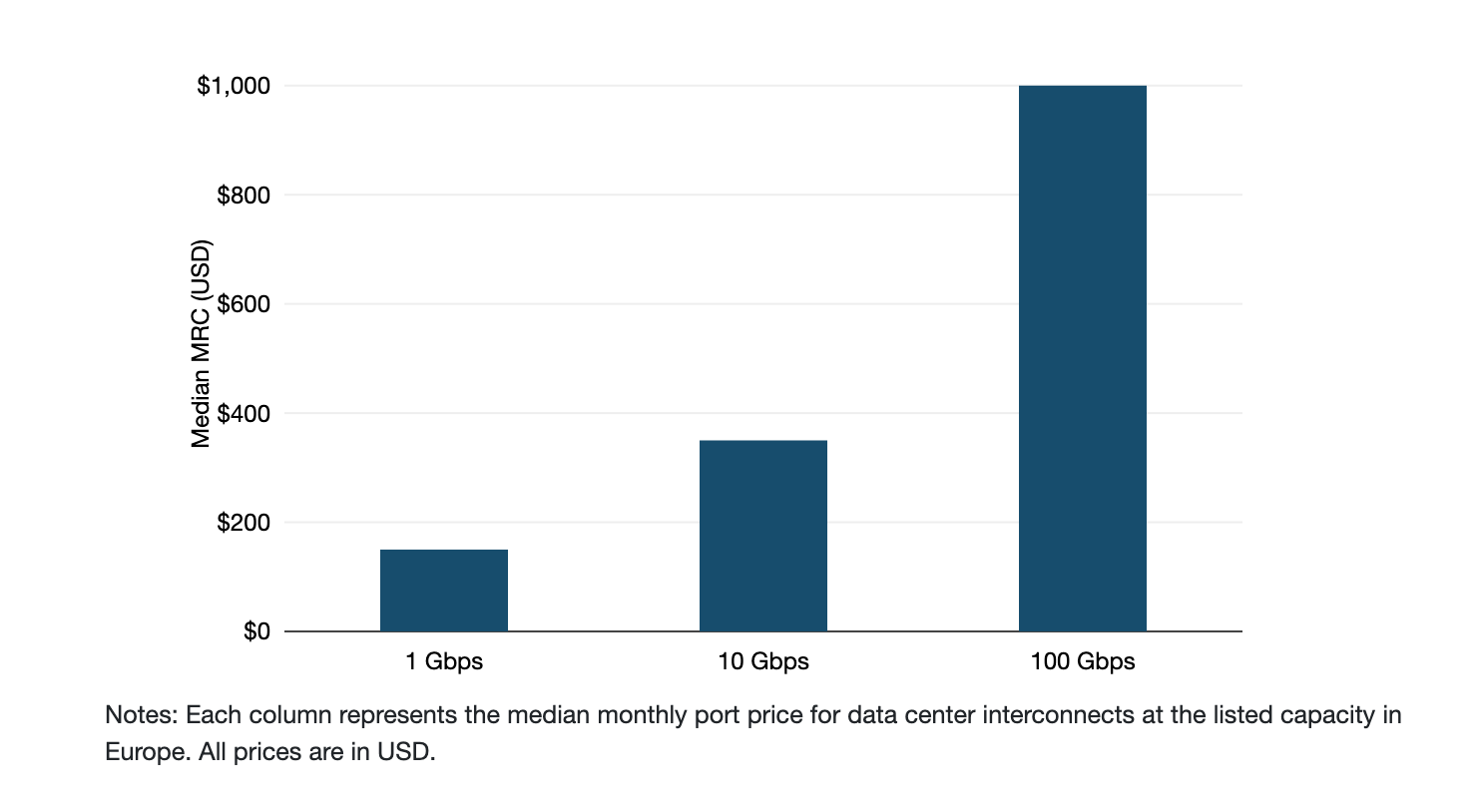
Across capacities, port prices in Europe ranged from $150 per month for 1 Gbps to $350 for 10 Gbps. That’s 2.3 times the price for ten times the capacity. Upgrading to a 100 Gbps port was slightly more expensive, at 2.9 times the price of a 10 Gbps access port. Enterprise customer requirements at 100 Gbps are low and the number of providers who offer 100 Gbps NaaS services is limited, contributing to the higher price multiple.
Get more pricing data and analysis
You can get even more of this intelligence in TeleGeography’s Network-as-a-Service Pricing platform, which delivers pricing data and analysis on consumption-based, subscription-based NaaS services around the world. Get the industry’s most comprehensive, unbiased pricing data from TeleGeography’s Network Pricing Database. Subscribe to all or choose the pricing modules you need: