
ChatGPT is already showing ads on roughly one in four commercial prompts, but new research suggests its conversational ad targeting still has some growing pains including ads appearing alongside unrelated topics.
A study from SE Ranking analyzed more than 50,000 commercial prompts across 20 niches to understand how frequently ChatGPT serves ads, where they appear and how relevant they are.
Ads are already relatively common. SE Ranking found sponsored placements on 25.94% of commercial prompts, putting ChatGPT surprisingly close to Google’s AI Mode, where the company’s previous research found ads on 29.45% of commercial queries.

For now, the ChatGPT ad experience is relatively uncluttered. Every ad observed appeared below the generated response and contained a single sponsored offer without another advertiser competing alongside it.
Relevance remains a problem. Around 14.35% of ChatGPT ads were effectively unrelated to the prompt they appeared alongside, according to SE Ranking’s semantic analysis, roughly one in seven placements.
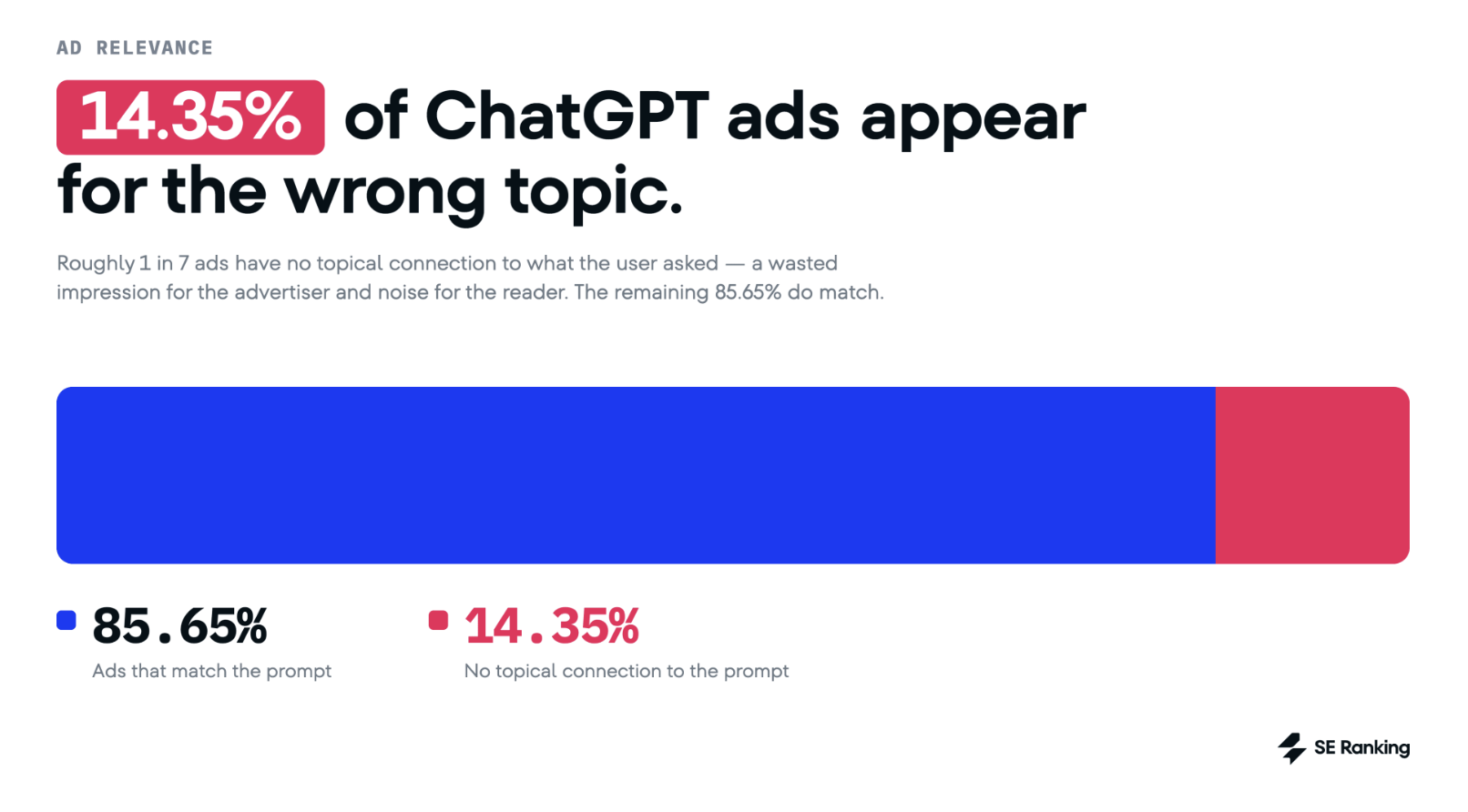
The problem varied considerably by category. Just 2.6% of ads in Pets were classified as mismatched, compared with more than half in Relationships and News & Politics.
One example saw a prompt about dating apps accompanied by an ad for a clothing and lifestyle retailer, while a newspaper subscription query triggered an electricity provider ad.
Why is this happening? ChatGPT Ads doesn’t rely on conventional keyword targeting. Advertisers instead provide natural-language “context hints” describing the conversations where they want their ads to appear, alongside keyword-style phrases.
Those signals guide the matching system rather than acting as strict targeting rules. Advertisers also don’t currently get visibility into the individual queries or conversations that triggered their ads, making it harder to diagnose irrelevant placements.
Paid visibility doesn’t mean AI visibility. One of the more interesting findings is how separated ChatGPT’s advertising and generated answers appear to be.
Only 3.63% of advertisers were also cited as a source in the answer above their ad. The exact advertised URL appeared in citations just 0.09% of the time, while advertiser brands were mentioned in 4.44% of responses.
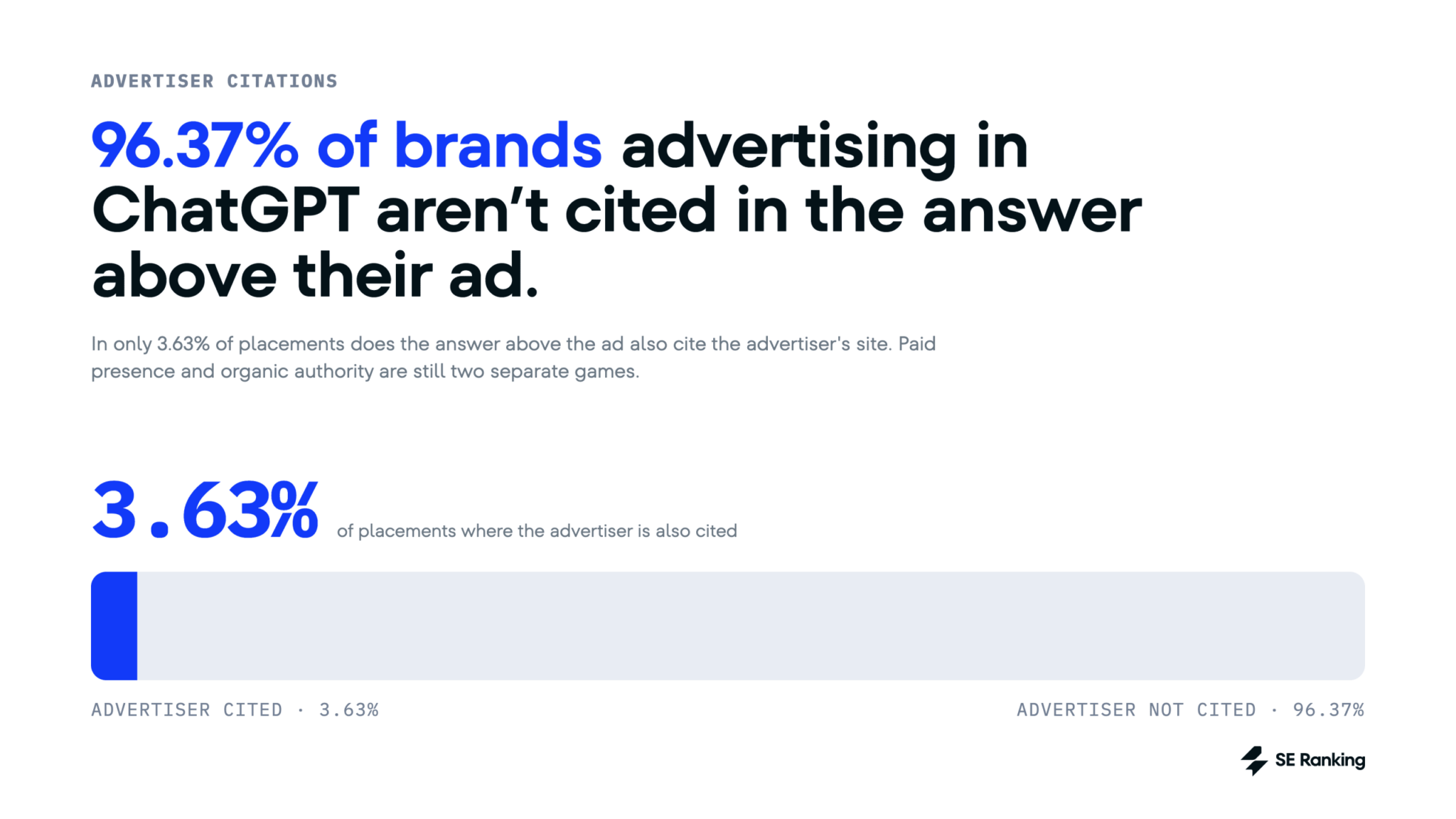
In other words, buying a ChatGPT ad doesn’t appear to make a brand significantly more likely to feature in the AI-generated response.
Sensitive categories stand out. ChatGPT also showed substantially more ads around some YMYL topics than Google’s AI Mode.
Ads appeared on 28.69% of healthcare prompts, compared with 2.64% in AI Mode. News & Politics showed a similar gap, at 28.76% in ChatGPT versus 6.8% in AI Mode.
That doesn’t necessarily mean ChatGPT has fewer safeguards, but it does show a meaningful difference in how advertising currently surfaces across the two AI platforms.
Why we care. ChatGPT Ads is quickly becoming a meaningful new paid media channel, but advertisers shouldn’t expect it to behave like Google Search.
Conversational targeting introduces a different set of challenges, particularly around relevance and reporting. With advertisers unable to see the specific conversations triggering their ads, precise context hints, audience targeting and ongoing experimentation will be particularly important.
Bottom line. ChatGPT Ads is already monetizing commercial intent at a rate approaching Google’s AI Mode, but SE Ranking’s research shows the platform still has work to do on matching. For advertisers testing the channel, the opportunity is real but so is the risk of paying to appear in conversations that aren’t particularly relevant.
Dig deeper. ChatGPT shows ads on 1 in 4 commercial queries. Yet, 1 in 7 appear for the wrong topic


