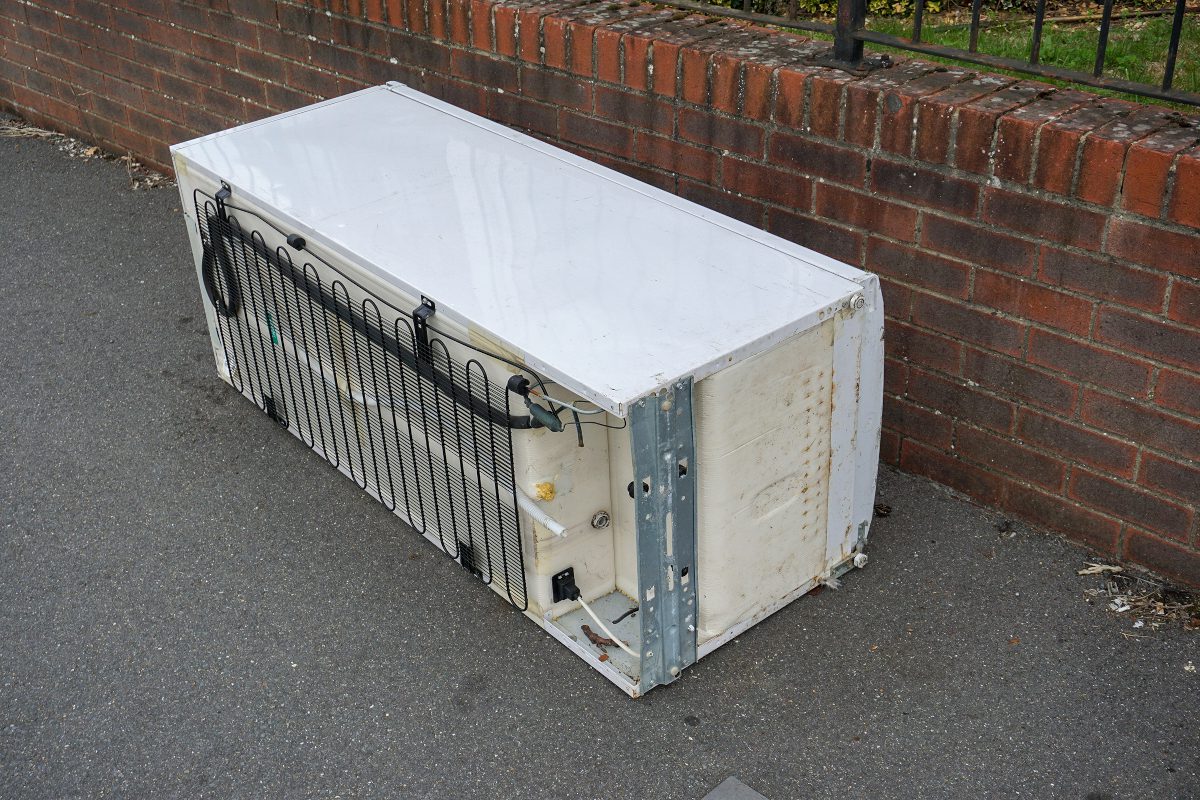
A shortage of specialist capacity for recycling discarded fridges and freezers is beginning to disrupt household waste services in parts of the UK, prompting local authority directors to call for government intervention to prevent stockpiling, fly tipping and environmental harm.
The Association of Directors of Environment, Economy, Planning & Transport (ADEPT) has written to Environment Minister Emma Hardy MP warning of an “acute national shortage” of fridge and freezer recycling capacity, after disruption at several of the relatively small number of UK plants capable of processing refrigeration equipment.1
Fires, breakdowns and plant closures have taken capacity out of the system, according to ADEPT, leaving some Producer Compliance Schemes (PCSs) unable to maintain collections from local authority recycling centres. The schemes have responsibility under the Waste Electrical and Electronic Equipment (WEEE) system for financing the collection and treatment of discarded electrical equipment on behalf of producers.
The effects are increasingly visible at household waste recycling centres (HWRCs). Unlike many waste streams, discarded refrigeration equipment cannot simply be redirected to a conventional recycling plant. Fridges and freezers contain refrigerants and insulating foams that require controlled removal and treatment, and processing is concentrated among a comparatively small number of specialist Approved Authorised Treatment Facilities (AATFs).
Industry reporting suggests the current difficulties reflect several successive losses of processing capacity. The Newport fridge recycling facility formerly operated by Unimetals represented an estimated 600,000 appliances of annual treatment capacity before the company’s financial difficulties and subsequent liquidation proceedings (initiated in November 2025). Further disruption followed fires at EMR’s Darlaston fridge recycling facility in the West Midlands in February 2026 and at Wiser Recycling’s Thetford facility in April.2
The consequences of the latter incident were felt directly by local authority services. The Thetford fire severely damaged the facility and led Norfolk County Council to restrict acceptance of several types of electrical waste while alternative arrangements were sought. Wiser subsequently lost its AATF status at the site.
By July, disruption had spread elsewhere. Carmarthenshire County Council temporarily stopped accepting fridges, freezers and other cooling appliances at all of its recycling centres, as well as through its bulky waste collection service, after sites reached or exceeded their safe storage capacity.3
Cllr Edward Thomas, the council’s Cabinet Member for Transport, Waste and Infrastructure Services, said: “Unfortunately, circumstances beyond our control have resulted in a temporary disruption to the collection and processing of refrigeration appliances. Our recycling centres have now reached their storage limits for these items, and we have had to suspend acceptance until further notice.
“We understand this will cause inconvenience for some residents and would like to thank them for their patience and cooperation while we work with our partners to resolve the situation.”
Dover District Council has also advised residents that it is currently unable to collect fridges and freezers through its bulky waste service because of “limited national capacity” for their disposal.4
Storage is emerging as one of the most immediate difficulties for councils. Environment Agency guidance requires permitted waste facilities to establish maximum storage capacities and not exceed them, meaning HWRCs cannot indefinitely accumulate refrigeration equipment while waiting for treatment capacity to become available.5
The Environment Agency has already taken steps to relieve the pressure. On 20 July it introduced Regulatory Position Statement RPS 375, specifically in response to “current national treatment capacity constraints” affecting waste temperature exchange equipment (WTEE), a category encompassing equipment such as fridges and freezers. The measure sets out circumstances in which operators in England can temporarily exceed normal storage capacity at permitted or unpermitted sites without the agency normally taking enforcement action, provided specified conditions are met.6
But ADEPT expresses concern that temporary storage not address the underlying shortage. Its letter asks government for clarity over the obligations of Producer Compliance Schemes when treatment plants are unavailable, including provision to ensure local authorities are not left carrying additional costs. It also wants continued support for the Environment Agency to operate a simple, rapid and risk-based system for approving temporary storage sites, alongside investment in additional domestic processing capacity.
The organisation says the pressure has been intensified by unusually hot weather, which has increased the number of fridges and freezers failing and entering the waste stream at the same time as recycling capacity has contracted.
Katie Stewart, ADEPT President, said: “This is a system-wide problem that no single organisation can resolve alone. Local authorities want to keep offering residents a safe, convenient disposal point for old fridges and freezers, but without urgent action the risk is stockpiles, fly tipping and environmental harm.
“With a changing climate, this year’s conditions are likely to become the norm, making this a recurring risk, not a one-off event. ADEPT is ready to work with government, the regulator and the compliance schemes to resolve this together.”
There is some additional capacity in the pipeline. Recycling company Enva announced in February that it is developing a 124,000 sq ft fridge recycling facility at Crossways Commercial Park in Dartford, Kent. Scheduled for completion in late 2026, the facility is expected to be capable of processing 35,000 tonnes of WEEE annually and will increase the company’s fridge recycling capacity in London and the South East while providing a UK-wide service.7
The immediate crisis also comes while the UK’s wider producer-responsibility regime for electrical equipment is undergoing reform. Current WEEE legislation places obligations on producers to finance the management of waste electrical equipment, while further reforms are being developed with the intention of moving towards a more comprehensive extended producer responsibility approach.8
ADEPT is calling for that process to include an urgent review of the WEEE Regulations to establish what it describes as “true producer responsibility”, under which producers would meet the full costs of managing electrical products at the end of their lives.
The current disruption appears to highlight a vulnerability in the existing system: while responsibilities for collecting and financing waste appliances are distributed across councils, producers and compliance schemes, the physical ability to deal with discarded refrigeration equipment ultimately depends on a small specialist treatment network. When several plants become unavailable simultaneously, the effects can rapidly work their way backwards through the system – from processors to compliance schemes, then to council storage areas and ultimately to householders trying to dispose of an unwanted appliance.
Notes
[1] “ADEPT calls for urgent government action on fridge recycling capacity crisis”, Association of Directors of Environment, Economy, Planning & Transport (ADEPT), August 2026; and associated letter to government. ADEPT letter on the fridge and freezer recycling capacity crisis
[2] “ANALYSIS: Local authorities stop collecting fridges amid capacity crisis”, letsrecycle.com, 15 July 2026.
[3] “Temporary suspension of fridge and freezer disposal at recycling centres”, Carmarthenshire County Council, July 2026. Carmarthenshire County Council announcement
[4] “Bulky item collection service”, Dover District Council, accessed August 2026. Dover District Council bulky waste guidance
[5] “Waste electrical and electronic equipment (WEEE): appropriate measures for permitted facilities – Waste storage, segregation and handling appropriate measures”, Environment Agency, GOV.UK. Environment Agency WEEE storage guidance
[6] “Temporary waste temperature exchange equipment (WTEE) storage due to national treatment capacity constraints: RPS 375”, Environment Agency, published 20 July 2026. Environment Agency RPS 375
[7] “Enva to open 124,000 sq ft State of the Art Fridge Recycling Facility at Goodman’s Crossways Commercial Park”, Enva, 2 February 2026. Enva announcement
[8] “Producer Responsibility – Waste Electrical and Electronic Equipment (WEEE)”, Department of Agriculture, Environment and Rural Affairs. Document outlining the UK-wide reform programme for the WEEE producer-responsibility regime.




