Optimum Communications saw some positive signs in Q2, including solid mobile line additions along with improved margins and cost reductions. However, the company’s massive debt load, which includes $6.3 billion due in 2027, continues to hang over Optimum like “The Sword of Damocles,” notes MoffettNathanson.
Optimum has another $6.2 billion due in 2028 and $3.8 billion in 2029.
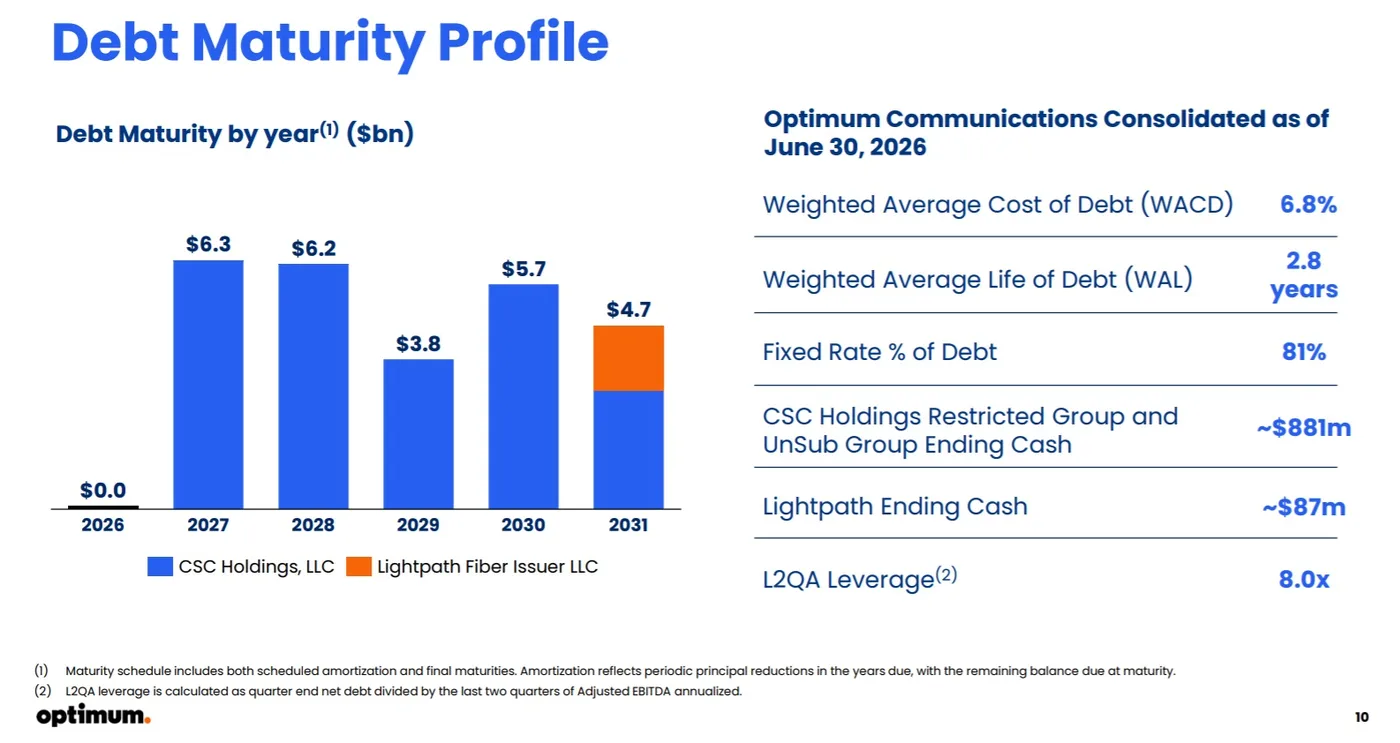
(Source: Optimum Communications Q2 2026 earnings presentation)
“Addressing those maturities remain a top priority,” Optimum CFO Marc Sirota said on last week’s earning’s call.
In June, Optimum pushed ahead with a series of transactions, including the consolidation of its Optimum East footprint (formerly Cablevision Systems) and its 50.1% in Lightpath, a fiber-focused business services unit, into a new unrestricted subsidiary called CSC Investments II.
That move essentially puts those assets out of the reach of CSC Holdings creditors, and could “set the stage for a Chapter 11 filing for CSC Holdings, which currently carries almost $22B of debt,” MoffettNathanson analyst Craig Moffett explained in a research note (registration required).
New Street Research analyst Vikash Harlalka reiterated in a research note (registration required) that the move also boosts the odds of a deal with creditors.
“Could management lever up the [new subsidiary] and use the proceeds to pay down some of the debt at the CSC level? Theoretically, that seems viable,” Harlalka explained. “This gives management some breathing room while they negotiate with the creditors.”
But there’s not a ton of time to figure it out. Moffett reckons that the $4.1 billion maturity in April 2027 “likely represents the ‘drop dead’ date for creditor negotiations.”
Optimum (formerly Altice USA) remains optimistic it can get it resolved. “We believe that the measures we have taken increase the likelihood of a consensual, comprehensive deal,” Sirota said.
Those comments arrived Q2 results that come amid Optimum’s broader turnaround strategy. However, in the absence of a settlement with creditors, the company’s operating metrics are merely a “side show,” Moffett said. “The debt restructuring is the main event.”
New multiyear deal with T-Mobile
Mobile was again a bright spot for Optimum in Q2. The operator added 49,900 lines (versus year-ago adds of 38,000), extending its total to 724,000. Mobile penetration of Optimum’s broadband base was about 9%.
“Mobile is central to how we manage and grow our base. We’re driving higher penetration through targeted upsell and cross-sell, simplifying our offers and expanding multiline adoption,” Optimum Chairman and CEO Dennis Mathew said.
Mathew noted that Optimum recently expanded its multiyear MVNO agreement with T-Mobile. Financial terms were not disclosed, but the agreement includes connectivity for wearable devices, “stronger roaming,” and enhanced connectivity for businesses and rural areas, he said.
More broadband losses
Optimum also shed another 35,200 residential broadband customers in Q2, which included a gain of 9,000 subscribers coming from a bulk contract conversion. Without those bulk contracts, Optimum’s Q2 broadband sub loss would have been 49,000 – about 14,000 more than in the year-ago period, New Street’s Harlalka pointed out.
Optimum ended the quarter with 3.71 million residential broadband subs.
The operator added 19,800 fiber-to-the-premises (FTTP) customers in Q2, including 18,500 residential subs and 1,300 business customers. Optimum ended the period with 748,900 FTTP customers (725,200 residential and 23,700 business).
Optimum added 68,200 additional passings in the quarter, for a total of 10.11 million. Those additions included 34,100 new FTTP passings, extending Optimum’s FTTP footprint to 3.15 million passings.
Optimum expects to add 150,000 to 175,000 passings for full-year 2026.
The company lost 44,000 residential video subs, a big improvement from a year-ago loss of 56,000 that’s due in part to Optimum’s new genre-focused packages. Optimum ended the period with 1.52 million residential video customers.


