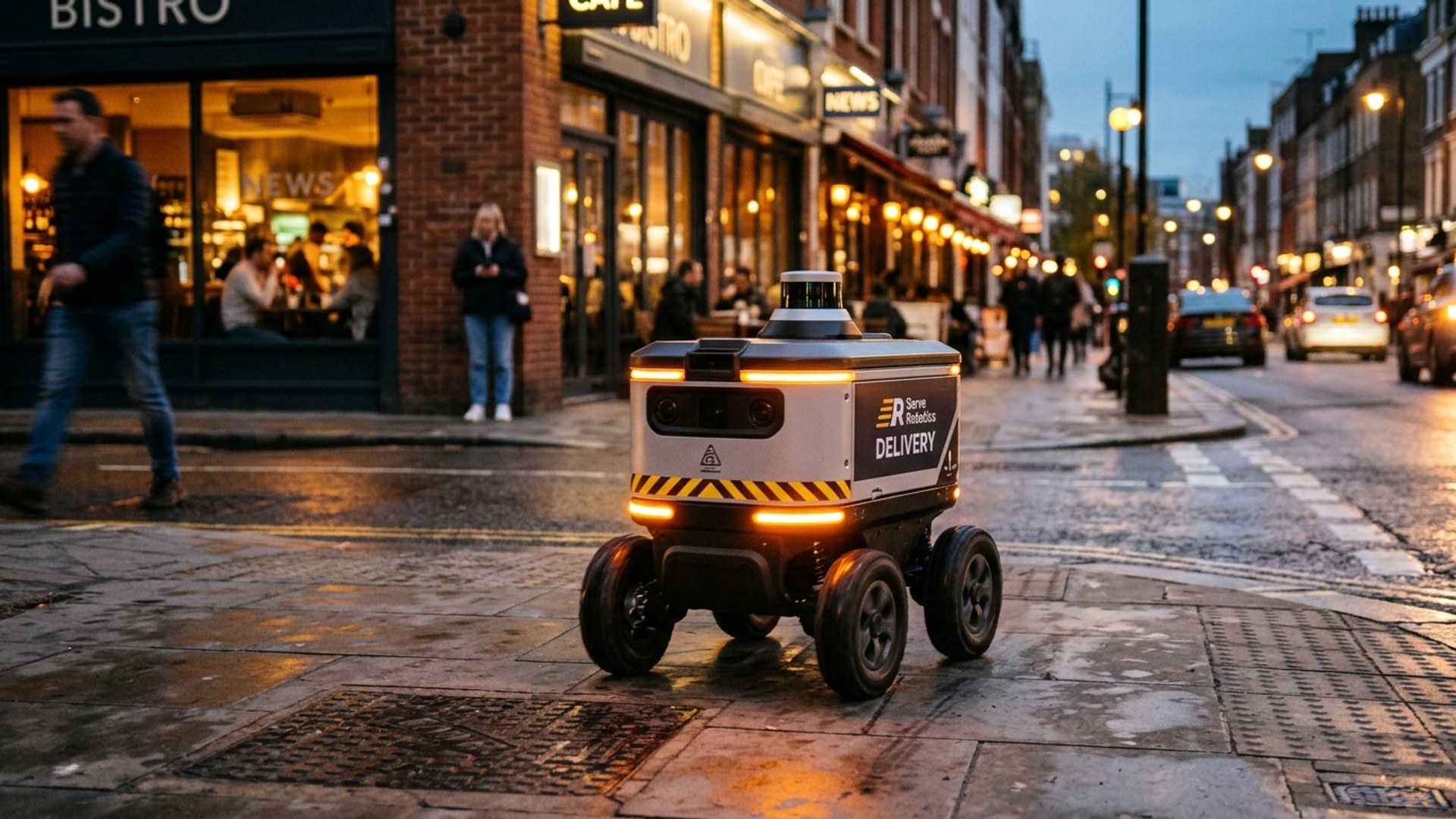
Serve Robotics and Grubhub have struck a partnership that puts Serve’s autonomous sidewalk robots on the Grubhub marketplace, starting in Chicago, Los Angeles and Alexandria, Virginia, the companies announced on August 17, 2026. More than 100 participating Grubhub merchants in Chicago and nearly 200 in Los Angeles are live at launch, with additional restaurants expected to join over time.
Grubhub is a subsidiary of Wonder, the food technology company that also runs its own storefront locations, and Wonder’s Alexandria site will offer robot delivery through Serve’s network as part of the deal. For Serve, a Nasdaq-listed operator that spun out of Uber in 2021, the agreement adds another major delivery marketplace alongside its existing DoorDash and Uber Eats relationships, extending the pool of orders its fleet can draw on.
The Grubhub deal headlines a broader expansion the company detailed in the same release: launches in Washington, DC and San Jose, California, its seventh and eighth major U.S. markets, both in partnership with DoorDash; a first micro-depot site planned for Miami; a next-generation hospital robot from its Diligent Robotics subsidiary; a countertop hardware product for restaurants called Beacon; and a new advertising product built around interactive robot characters.
“Welcoming Wonder and Grubhub to our network is the clearest signal yet of where we are headed,” said Ali Kashani, Serve’s co-founder and CEO. “Every new partner puts more robots to work, and every delivery makes the whole fleet smarter.”
New Markets, and a Cheaper Way to Enter Them
The two new metros reach a combined population of 8 million, joining Los Angeles, Chicago, Atlanta, Dallas and Miami on Serve’s operating map. In San Jose, the company’s first Bay Area market, robots have already completed their first month of deliveries. In Washington, DC, robots are delivering in Dupont Circle and parts of downtown, with early restaurant partners including Talkin’ Tacos.
The Miami micro-depot is the more operationally interesting piece. Serve describes it as a small-footprint site handling robot staging, charging, dispatch and maintenance, without the build-out time of a full-scale facility. Because micro-depots require minimal infrastructure and can be stood up quickly in high-demand neighborhoods, they give the company a repeatable template for entering new territory faster and at lower cost, a persistent constraint on sidewalk-delivery economics, where each new market has historically meant a dedicated operating facility.
The product announcements push in the same direction: more deliveries per robot. Beacon is a standalone countertop unit with built-in cellular that alerts restaurant staff when a robot arrives for pickup and requires nothing beyond power — no tablet, no added hardware, no changes to existing systems. It is aimed at restaurants whose back-of-house setups previously could not support robot pickup. Serve Advertising, meanwhile, launched Characters, which lets brands build a personality customers can talk with in real time through a conversational AI model on the robot. The first Character, co-created with Grubhub, is Chomp, a hamburger-wrapped robot that will appear across social media and select customer experiences.
Moxi 2.0 Takes Serve’s Autonomy Stack Indoors
The release also marks the first hardware fruit of Serve’s move into healthcare. Moxi 2.0, the next generation of the hospital delivery robot built by Diligent Robotics, has begun rolling out to health systems including Endeavor Health Edward Hospital near Chicago, Providence Saint John’s Health Center in Los Angeles, and Children’s Hospital Los Angeles.
According to the company, the updated robot perceives and interprets its surroundings up to 15 times faster, carries 10 times the onboard compute, runs up to 18 hours per charge with 30% faster charging, and handles dynamic hospital environments — crowded hallways, opening elevator doors, shifting foot traffic — without changes to existing infrastructure. Moxi 2.0 also introduces what Diligent calls a robotic World Model, a learning system in which each robot improves from the experience of the whole fleet. The upgrade builds on deliveries completed across more than 25 U.S. hospitals.
Serve agreed to acquire Diligent Robotics on January 20, 2026, in a transaction valued at $29.0 million in stock plus a potential earn-out of up to $5.3 million. At the time, Diligent’s nearly 100 Moxi robots had completed over 1.25 million autonomous deliveries across more than 25 hospital facilities, with annual sales per hospital expected to range between $200,000 and $400,000. Moxi runs on NVIDIA Jetson onboard compute and was trained and tested in simulation using NVIDIA’s Isaac tools. Austin-based Diligent, founded in 2017 by social roboticists Andrea Thomaz and Vivian Chu, had raised over $100 million from investors including Tiger Global, Canaan and True Ventures, and continues to operate as a Serve subsidiary under Thomaz.
Serve says it has deployed more than 2,000 robots across the U.S. since its 2021 spin-off, reaching a population of approximately 3 million and supporting delivery for more than 4,000 restaurants. Grubhub brings a marketplace of over 415,000 merchants in more than 4,000 U.S. cities. Grubhub brings a marketplace of over 415,000 merchants in more than 4,000 U.S. cities to Serve’s network of more than 4,000 existing restaurant relationships. Unite.AI previously covered Google’s Gemini Robotics ER 2, another push to make robot fleets share learned skills, and Starship Technologies’ $50 million raise, Serve’s closest sidewalk-delivery rival on fleet scale.


