1
Passive antennas are becoming strategic infrastructure for 5G-Advanced, as operators tackle capacity, uplink demand, energy costs, and site constraints while preparing physical networks for AI-assisted RAN operations. ABI Research has the story.
As 5G deployments mature and leading operators move toward 5G-Advanced, the passive antenna market is entering a new phase. Early 5G rollouts focused on coverage, new spectrum layers, and speed of deployment. In many markets, broad 5G coverage is already in place, but operators still face challenges around capacity scaling, uplink performance, latency consistency, site complexity, and energy costs.
Passive antennas are, therefore, no longer judged only on traditional Radio Frequency (RF) criteria such as gain, beamwidth, or band support. They are increasingly assessed by the value they create at the site level: supporting spectral efficiency, reducing tower clutter, contributing to power savings, and preparing the Radio Access Network (RAN) for automated and Artificial Intelligence (AI)-assisted operations.
ABI Research’s market analysis highlights this market transition. The worldwide passive antenna market generated US$3.47 billion in 2023 and grew to US$3.61 billion in 2024. Shipments increased from 4.29 million units in 2023 to 4.47 million in 2024. This is a low-growth market in value and volume terms, but one undergoing a meaningful shift in technology mix, deployment priorities, and vendor differentiation.
Passive antennas
As 5G networks have matured, telcos want to make sure their cell sites can handle dense traffic loads and uplink-heavy applications, maintain performance at the edge, and lower operating costs.
Traffic patterns are also becoming more complex. Mobile traffic has historically been downlink-oriented, but end-user livestreaming, user-generated video, real-time collaboration, industrial Internet of Things (IoT), Unmanned Aerial Vehicle (UAV) connectivity, smart transport, and Closed-Circuit Television (CCTV) infrastructure increase the share and importance of uplink traffic. How the cell site performs depends on several cellular antenna characteristics such as RF pattern stability, isolation, the number of ports, cross-polarization performance, and multi-band support.
New challenges
Telcos are constantly under pressure to deliver return on investment. Given the number of cell-sites a typical operator may have, it is therefore important telcos overcome 3 operational demands: limited physical capacity; energy-efficiency requirements; and readiness for automation.
The amount of space at the top of the tower, wind-load budgets, local government rooftop limitations, landlord restrictions, and the growth in the number of active cellular radios are constant concerns for telcos. This is driving telcos to seek out higher-port-count arrays, low-Passive Intermodulation (PIM) feed networks, more compact radomes, and active-plus-passive configurations.
Telcos are also expecting improved passive antenna performance. That antenna performance is defined by a complex mix of RF and production engineering solutions: beam shaping (the ability to concentrate radio signal energy on the users); the front-to-back ratio (the power gain of the main forward beam (0°) to the power radiated/received in the opposite direction); side-lobe suppression (the reduction of unwanted secondary radiation peaks); half-power beamwidth (the reduction of unwanted secondary radiation peaks); inter-band isolation (keeping defined frequency bands inside a multi-band antenna separate); and the perennial concern for PIM stability.
All these considerations can affect spectral efficiency and user experience, especially in dense or interference-sensitive environments.
Design choices
The ports on antennas not only deliver RF, but they also enable greater capacity expansion, spectrum reuse, and a Multiple Input, Multiple Output (MIMO) strategy. At present, the 10 to 16-port Frequency Division Duplex (FDD) antennas is proving to be a popular configuration with 1.15 million units shipped in 2023, accounting for 46.2% of the market, but as the AI era shifts traffic patterns, with uplink traffic likely to grow due to an increasing number of upload oriented use-cases such as social media, massive IOT deployments, etc., telcos will require higher receiver capacity, additional MIMO flexibility, and more antenna ports to address their customers’ needs.
Higher Digitalization
For most of the past 30 years, passive antennas have essentially been “static” infrastructure: difficult to verify, cumbersome to inspect, and disconnected from software-driven optimization. However, passive antennas are coming into the digital asset fold.
A new generation of “digital antennas” are embedding sensing and management capability into the antenna system. Telcos can retrieve engineering parameters automatically instead of relying on manual tower climbs. Better visibility into azimuth, tilt, positioning, and installation accuracy is critical because automated RAN optimization depends on reliable physical-layer data.
In dense urban areas, small alignment errors can affect sector overlapping, interference, and handover behavior. Antennas that support remote data collection can improve both operational efficiency and planning accuracy. Huawei was one of the first antenna vendors to integrate remote Three-Dimensional (3D) beam adjustment points into its antenna designs.
The next substantial infrastructure shift is the “AI-enabled autonomous network.” For autonomous RAN systems to function effectively, the physical layer must be measurable and controllable. Antennas that can communicate reliable engineering data to a network operations center can be fully integrated into a closed-loop operation.
Energy efficiency
Telcos are paying keen attention to energy efficiency. Active radios are a key power draw in the RAN, but the antennas RF characteristics influence how effectively RF power becomes usable coverage and throughput. Better antenna efficiency reduces wasted energy and improves signal quality.
ABI Research forecasts that green sustainable antenna shipments are expected to grow from 819,000 units in 2023 to 3.95 million by 2029. Sustainability is, therefore, moving from niche feature to procurement baseline, particularly as operator Requests for Quotation (RFQs) call for greener design principles.
Antenna green characteristics include feed-network loss reduction (minimization of internal RF energy lost as heat), improved radiation efficiency, stable beam control (ensuring a consistent radiation pattern), reduced mismatch loss (decrease in signal power reflected from an antenna), and solderless joints, or recyclability of the antenna radome and shipping materials.
Proprietary approaches such as Huawei’s Signal Direct Injection Feeding (SDIF) and Amphenol Antenna Systems’ Meta Lens technologies demonstrate a broader industry shift: vendors are differentiating through system efficiency, not just conventional RF specifications.
Landscape pressures
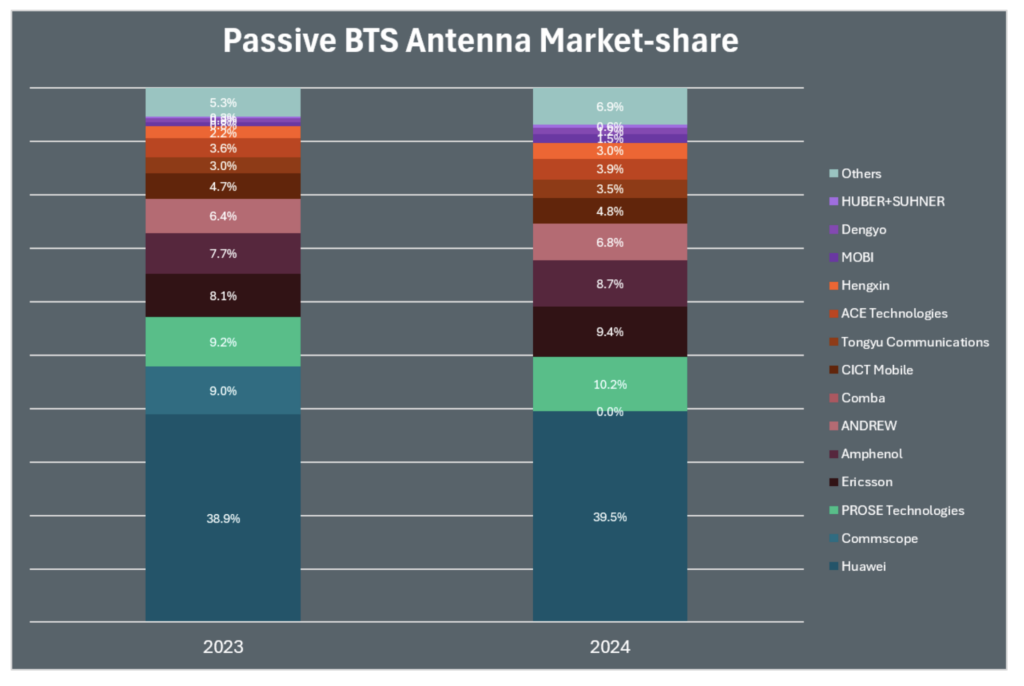
The demands and requirements by the telco community have led to consolidation in the antenna vendor market space and tightening focus on Research and Development (R&D), green sustainability credentials, streamlining operational and production costs, and meeting customer expectations. Operators do not buy antennas in isolation; they buy solutions that help sites perform better, consume less power, and remain easier to manage. In 2023, the top three vendors were Huawei (36.2%), CommScope (14.0%) and PROSE (8.5%). By 2024, the rankings have shifted: Huawei (39.5%), PROSE (10.2%) and Ericsson (9.4%).
Outlook
The passive antenna still has an active role to play in the 5G-Advanced era. As telcos shift from broad rollout to targeted optimization, passive antenna value increasingly lies in boosting capacity, uplink performance, integrating and integrating passive antennas into telcos’ automated networks. Antenna technical requirements are shifting from delivering conventional RF output toward site performance, enhanced end-user cellular link budget and quality of experience, lowered operational expenditure as well as sustainability.
Digitalization, improved energy efficiency, and overcoming cell site constraints have become critical considerations for telcos. Antenna vendors that provide engineering visibility, support remote adjustment, minimize energy loss, and simplify modernization will be better aligned with operator priorities. The vendors most likely to succeed will treat passive antennas not as mature commodity hardware, but as a strategic part of the intelligent, efficient, and constrained mobile site of the future.


