Key Takeaways
- A semantic layer sits between raw data and the AI systems that query it, translating physical data structures into governed business definitions — so every tool, team, and agent draws from the same source of truth.
- Without a semantic layer, AI returns confident, well-structured answers that can look correct while relying on the wrong metric, filter, or source of record.
- A semantic layer tells AI what a business term means. Data lineage tells it where that data came from and whether the source can be trusted. Together, they are the foundation for AI explainability.
Enterprise AI has made it easier than ever to ask data questions in plain English. A business user at a credit union can ask, “How many members do we have?” A developer can connect an agent to a warehouse, catalog, or API and let it generate SQL. A business leader can ask an AI agent “What is my total revenue” and expect an answer in seconds.
But convenience is not the same as trust.
Enterprise data often contains multiple technically valid answers to the same business questions. Take the member count example. Ask three different systems and you can get three different answers:
- All historical member records
- Active accounts only
- A regulatory or reporting view
Each answer could be defended from the perspective of its source system, but none of them are useful without shared business context: What does “member” mean?
The revenue example is even more dangerous because the wrong answer can look accurate. I recently saw this firsthand when an enterprise user asked AI, “What is my total company revenue?” The data existed, but revenue was stored as a quarterly cumulative, or snowball, figure. The AI treated each quarter as additive and summed them all.
The result was materially wrong, not because the model failed to write SQL, but because it didn’t understand the metric’s aggregation behavior. That’s why the semantic layer is becoming one of the most important architectural patterns in AI-powered analytics.
What is a Semantic Layer?
A semantic layer sits between raw data and the people, applications, dashboards, and AI systems that consume it. Its job is to translate physical data structures — tables, columns, joins, filters, and calculations — into governed business meaning: metrics, dimensions, definitions, relationships, ownership, security rules, and context.
Why AI Gets the Wrong Answer Without a Semantic Layer
When an LLM or AI agent queries data directly, it does not inherently understand which definition of ‘member,’ ‘customer,’ ‘revenue,’ or ‘churn’ the business has agreed to use. It sees tables, columns, and metadata patterns, then selects what appears most relevant, often without the context needed to distinguish between competing definitions across systems. The risk is not that AI fails to answer; it is that it returns a confident, well-structured answer that looks correct while relying on the wrong metric, filter, aggregation rule, or source of record.
Solving this challenge is rarely a technical exercise alone. Definitions, ownership, business rules, and exceptions are often distributed across functions, teams, and applications. A semantic layer creates the governed context that aligns those perspectives, giving AI a certified understanding of the business before it generates an answer.
How a Semantic Layer Makes AI Results Trustworthy
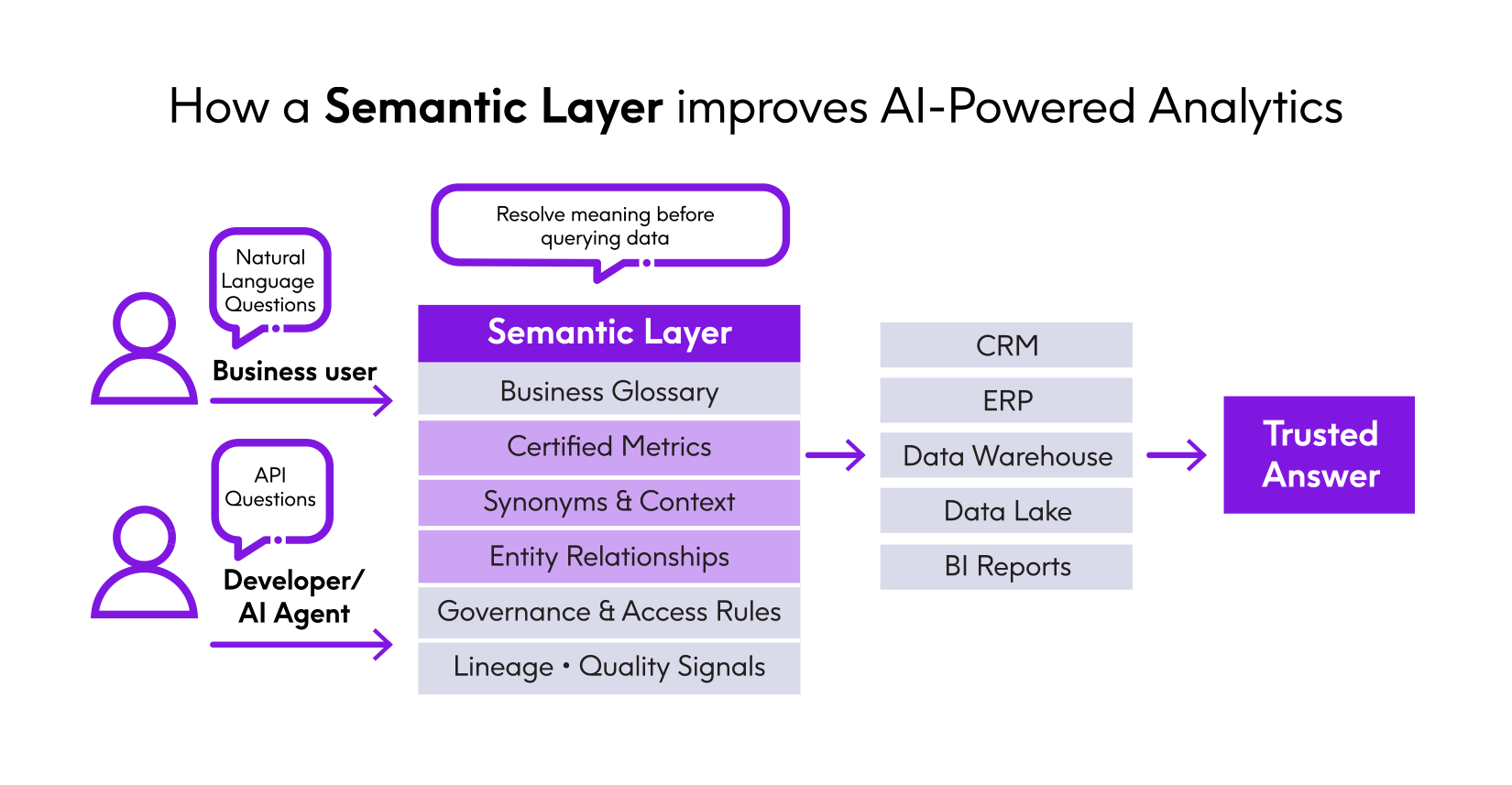
For business users, a semantic layer creates confidence. It defines what “member,” “customer,” “revenue,” “active,” “churn,” or “current quarter” means before a dashboard or AI assistant answers.
For developers, it creates a reusable contract. Instead of hard-coding business logic into every report, pipeline, agent, and API, teams can resolve questions through a shared layer of certified metrics, entity relationships, synonyms, lineage, governance, and quality signals.
This does not mean every organization needs one monolithic semantic model. It means organizations need governed semantic context where important decisions are made.
- Start with the metrics and entities that create the most disagreement: revenue, customer, member, product, account, retention, risk, and profitability
- Define the business meaning
- Identify the system of record
- Document aggregation rules, time logic, filters, and exceptions
- Link terms to physical data assets
- Add ownership, certification status, lineage, data quality, and access policies
Then, you expose that context to BI tools, APIs, copilots, and AI agents.
How Data Lineage Completes the Picture
While a semantic layer explains what a business term means, data lineage explains where that data came from and how it became the field an AI system ultimately uses. Lineage traces the journey of data across source systems, pipelines, transformations, calculations, and reports, creating a transparent record of provenance.
Together, semantic context and lineage provide the foundation for AI explainability.
A semantic layer can tell an AI agent what ‘revenue’ means; lineage can show which systems contributed to that metric, what transformations were applied, and whether the underlying sources can be trusted.
For example, a semantic layer may correctly define “revenue” as net sales, but lineage may reveal that a recently modified integration failed to load returns data from one region, inflating results. The definition remains correct, yet the answer is still wrong.
Explainable AI requires both business meaning and data provenance, allowing organizations to understand not only what answer was produced, but why.
This is also where data integrity and governance become inseparable from AI strategy. Precisely describes data integrity as data that is accurate, consistent, and context-rich. The broader lesson is vendor-neutral: AI-ready data is not just clean data. It is data with business meaning, governed definitions, and enough context for both humans and machines to know which answer is the trusted one.
Before and After: What Changes When You Add a Semantic Layer
Most organizations define their AI strategy around models, tools, and use cases — which LLM to deploy, which workflows to automate, which copilot to buy.
That’s necessary, but not sufficient. An AI strategy without a data strategy is a plan to automate guesswork. This is where data integrity and governance become inseparable from AI ambition.
Consider the credit union executive from the top of this blog who begins with a seemingly simple question: “How many members do we have?” One system reports 1.2 million members, another reports 1.4 million, and a third reports 1.3 million.
Each answer is technically correct according to the rules and definitions embedded in that particular application, report, or data mart. Faced with conflicting results, the executive spends more time debating the number than acting on it.
Now, imagine the same question being asked through an AI assistant connected to a governed semantic layer: instead of searching across multiple systems and selecting whichever metric appears first, the AI resolves “member” to the organization’s certified definition, applies the approved business rules, and retrieves the answer from the designated system of record.
Data lineage provides the supporting evidence, showing where the data originated, how it was transformed, and why the result can be trusted. The conversation shifts from “Which number is right?” to, “What should we do about it?”
The future of analytics will be won by the answer people can trust. A semantic layer is the bridge between natural-language convenience and enterprise-grade confidence. Without it, AI guesses. With it, AI has a business vocabulary, a governed path to the right data, and the context to know when not to answer at all.
The post Why AI Needs a Semantic Layer appeared first on Precisely.


