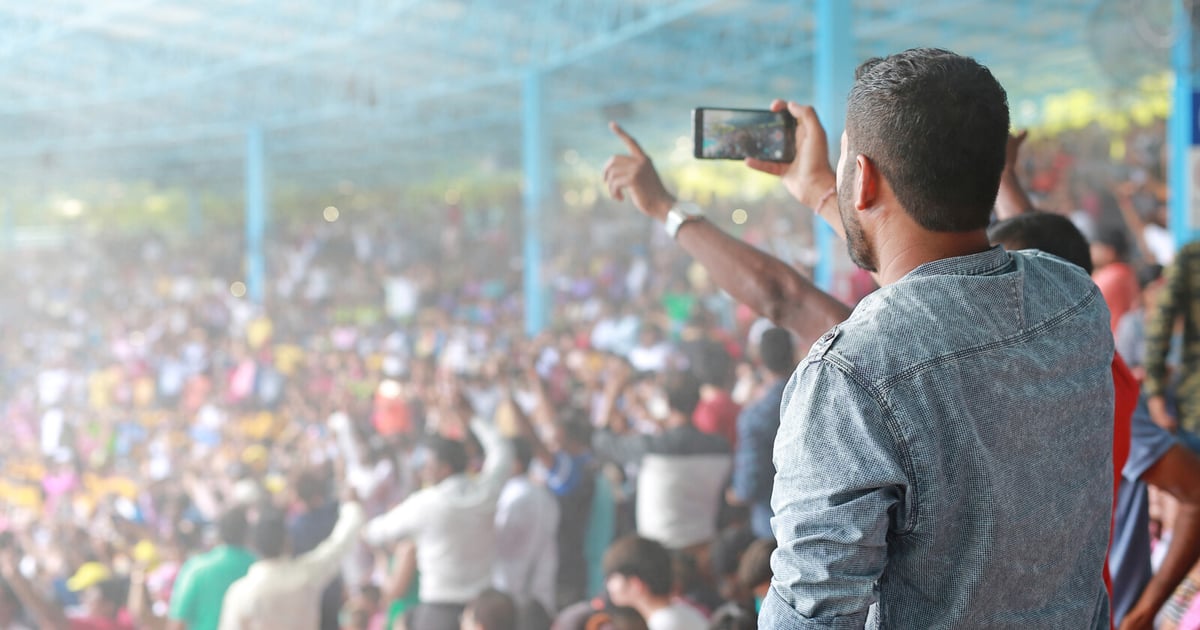
While still two years away, the 2028 Los Angeles Olympic and Paralympic Games (LA28) will place huge demands on wireless networks, and the time to prepare is now. A critical role at the games will be played by Wi-Fi, which will need to exploit the full 1200MHz of 6GHz unlicensed spectrum between 5.925 and 7.125GHz to meet demand.
Policymakers should protect and support optimal use of this band to ensure wireless performance, availability and predictability for spectators, athletes, broadcasters, venue staff, transport systems, hotels, airports and the wider visitor economy during the Games. Wi-Fi’s role complements the importance of CBRS networks, which will also be used for localized network needs, as discussed in a previous article.
The cellular industry may cite the Olympics as a reason to change the status of parts of the 6GHz band, either temporarily or permanently. Such demands would be unreasonable and non-evidence-based. Policymakers should ignore any such proposals – not least because no suitably functioning 6GHz 5G ecosystem could be ready by mid-2028 anyway.
LA28 will be a huge event for wireless
The Games will take place across 40+ competition venues and many other locations, mostly in Greater Los Angeles, but also elsewhere in Southern California and a few other US regions, including Oklahoma City. There will also be official fan zones, unofficial gatherings, hospitality sites, media compounds and temporary facilities.
In addition, there may be upwards of 2 million international visitors coming to the US for the Olympics, mostly arriving via airports and staying in hotels or rental properties.
Taken together, the Games will create huge wireless demands at venues and across California and the wider US visitor environment. Connectivity will be needed by:
-
Broadcasters and media, using cameras, laptops, drones, smartphones and specialist production devices.
-
Spectators using smartphones, tablets and perhaps wearable devices or AR headsets, often uploading images and video.
-
Athletes, coaches and other staff, using wireless equipment for training and personal / team social-media use
-
Venue personnel from organizers, retailers and security staff, using a variety of wireless devices such as phones, payment terminals, handhelds and ticket gates
-
Transit vehicles, shuttles and media buses, with connectivity needed inside vehicles as well as at stops and hubs.
Many devices such as laptops need Wi-Fi connectivity as they lack cellular radios. Furthermore, most users – especially international visitors constrained by expensive roaming, or children without flat-rate mobile data – expect Wi-Fi to have widespread availability and good performance.
California can credibly claim to be one of the spiritual homes of Wi-Fi. Leading Wi-Fi chip vendors such as Broadcom, Intel and Qualcomm are California-based. Linksys was originally based in Irvine, outside LA. Apple, which helped popularize Wi-Fi for consumers, is based in Silicon Valley, alongside enterprise Wi-Fi leaders HPE and Cisco. Cisco is also one of the Olympics’ designated technology sponsors.
That creates an opportunity. LA28 should showcase Wi-Fi as a major US innovation success story, not treat it as expendable spectrum collateral for speculative cellular lobbying.
Why 6GHz is critical for Wi-Fi
The 6GHz band has been available in the US on a license-exempt basis for indoor Wi-Fi use for several years. 6GHz-capable client devices and access points have progressively entered the market since around 2021 and are now becoming mainstream, although some telco ISPs, including key CTIA members, have been slow to support 6GHz in home routers and gateways.
6GHz adds essential capacity to the congested 2.4GHz and 5GHz Wi-Fi bands. It offers clean spectrum supporting up to seven 160MHz channels, or three 320MHz channels. That means more high-speed lanes for wireless traffic and more scope for non-overlapping channels in large buildings, venues, hotels, media centers, airports and dense urban environments.
The FCC has also expanded the practical usability of the band. It added access for outdoor areas under automated frequency coordination, or AFC, systems, very low power (VLP) for accessory and wearable devices, and more recently enabled geofenced variable power (GVP) for higher-power use cases in defined areas. AFC allows standard-power Wi-Fi to coexist with incumbent users such as broadcast-related applications and certain industrial wireless systems.
By 2028, the share of 6GHz-capable devices in the Olympic fan base and community should be even higher than it is today. Almost all top-tier smartphones, and a growing share of mid-range devices, already support the band. By the Games, most iPhones in active use, plus a large proportion of Android devices, are expected to be 6GHz-capable. Given the likely socio-economic profile of many Olympic visitors, a large majority are likely to carry modern higher-tier devices. One notable exception will be some visitors from China or Hong Kong, where Beijing has chosen to allocate 6GHz spectrum to cellular carriers rather than opening up the band for Wi-Fi.
Similarly, the laptops and tablets used by media, officials, sponsors, guests and other “business” users at the Olympics are likely to be modern and well-specified, potentially with Wi-Fi 7 or 8, and 6GHz support. If XR devices are used, they are also likely to either embed modern Wi-Fi internally or link via smartphones.
An important consideration is that the Port of Long Beach’s operational networks and a wide variety of broadcast and media devices may use parts of the 6GHz band for specialized applications. Wi-Fi needs access to the broadest practical width of the 6GHz band so that venue-by-venue constraints do not turn into capacity shortfalls.
6GHz would not be useful for 5G at the LA28 Olympics anyway
Localized and low-power networks will be a critical part of the overall wireless landscape for Olympic operations and spectators. But despite the clear value of Wi-Fi, organizations such as CTIA have started suggesting that parts of the 6GHz band should be changed from unlicensed use to high-power exclusive 5G use by mobile operators. They may use vague references to projected Olympics-related demand to justify this proposal.
But even if regulators urgently reclaimed 6GHz from unlicensed use, either for a rushed auction or temporary Olympic-specific licenses, it would be almost useless for LA28.
This is not just a matter of spectrum licensing and likely process and legal challenges. It is also about the lack of an established ecosystem or proper pipeline for US-suitable network equipment, chipsets and devices, and, especially, a lack of smartphones.
There are currently no mass-market smartphones available in the US that support 6GHz 5G, known in 3GPP standards as band n104. That is unlikely to change materially before the Olympics, especially given the usual release cycles of Apple iPhones and Google Pixel models in September or October, after the Games.
Some 6GHz-capable 5G devices may emerge from Chinese or other Asian suppliers, but these are unlikely to be sold in meaningful numbers in the US by 2028. They will also have limited penetration into the global visitor base by the time of LA28.
On the network supplier side, the main advocate for use of the upper 6GHz band for 5G is Chinese vendor Huawei, which made an announcement of its network product range in March 2026 – and is in any case banned from use in the US. Nokia has demonstrated a single radio unit in trials, but it does not currently have a commercial range of systems. Ericsson has stated that it used a “pre-commercial radio” but also does not have clear n104 support. There is also no obvious support for 6GHz 5G from the suppliers of in-building wireless systems, which would be needed for many of the Olympic venues.
In other words, there is essentially zero likelihood of the LA2028 Olympics featuring 6GHz 5G for normal usage, beyond tiny trials designed for press releases, not capacity for spectators.
Conclusion
There is no doubt that 5G cellular technology will be important at LA28, across the outdoor wide-area environment and inside venues. Carriers and vendors will likely use the Games to showcase new solutions and services.
But these will work in parallel to Wi-Fi (often relying on the ability to “offload” from cellular onto Wi-Fi) and cannot substitute for it. Visitors, athletes and media will expect good Wi-Fi performance in the venues, at their hotels, in the airports and in countless bars, restaurants and other sites. Using the 6GHz band is central to this. Every instance of 6GHz migration relieves pressure on the crowded 5GHz band for everyone else.
The US should showcase Wi-Fi technology as a home-grown innovation success story for both consumers and businesses alike, generating domestic employment and significant export revenues.
The policy conclusion is extremely clear. The US must ensure that all 1200MHz of the 6GHz band remains available to the Wi-Fi ecosystem and practically usable across the mix of low-power indoor, very-low-power and outdoor venue deployments. Indeed, as explored in a recent study, there should also be consideration given to early release of lower-7GHz spectrum for unlicensed use, if suitable devices and access points are available by that date.
LA28 should be celebrated as the Wi-Fi Olympics.
1 https://www.rcrwireless.com/20250929/analyst-angle/cbrs-la28-olympics
2 https://www.huawei.com/cn/news/2026/3/mwc-5ga-u6ghz-6g (in Chinese)


