Published August 21, 2026 04:05AM
It’s been years since I last cooked with a liquid-fuel stove. They have their strong points—they’re indispensable for trips to remote areas, where all that’s available to burn is kerosene—but overall, they’ve been supplanted by the canister. Modern canister-based camping stoves are lighter and more reliable than ever, and with smart management can be used even on winter trips.
But fuel canisters do have one big downside to them: every once in a while, they explode. While rare, canisters contain flammable gas under pressure. Treat it roughly enough, and they can combust, with spectacular results.
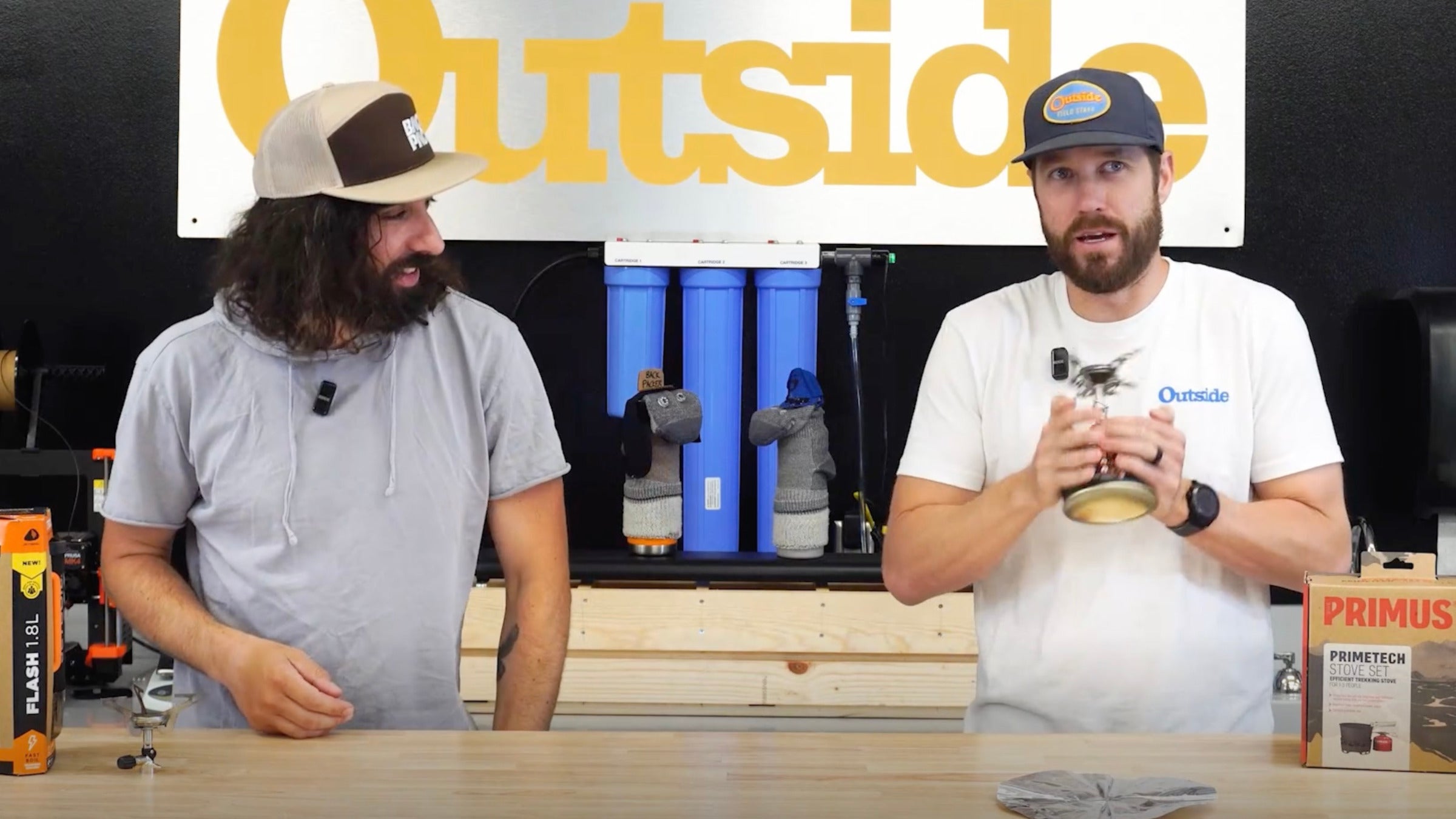
What are the most common ways that fuel canisters fail on and off the trail? To find out, Editor-in-Chief Adam Roy and Lab Test Editor Adam Trenkamp headed to the Outside Lab at CU Denver to talk safety, what an exploding fuel canister can do to your car, and what backpackers need to know about safely using their stoves.
Transcript
Adam Trenkamp: Can I get it warm enough to make it explode?
Adam Roy: I’m Adam Roy, Editor-In-Chief of Backpacker, and this is my colleague Adam Trenkamp, Outside’s Lab Test Editor. We are here at the Outside Lab at CU Denver. Adam, do you know what the quickest way to ruin a backpacking trip is?
Adam Trenkamp: Eating lettuce?
Adam Roy: Blowing your fingers off.
Adam Trenkamp: Oh, okay.
Adam Roy: Canister stoves were an important development in backpacking technology. They made cooking a lot easier, a lot simpler, and a lot lighter. But there is one effect of them that most people don’t think about, namely, we’re all walking around with a small explosive in our backpacks at all times. And that isn’t really a danger most of the time, but under some circumstances, this can be, well, I wouldn’t say deadly, but dangerous at the very least.
Adam Trenkamp: We basically have a pressurized can of gas or any other type of fuel that you have in here, the butane or propane. And as most things in the world due to physics, we know that as they get hot, things expand. So the fuel in this can will actually expand as it’s exposed to heat. With that being inside a metal container that has limited flexibility, that means it’s going to hit a breaking point. So at some point the heat’s going to get so high that it’ll make the pressure so great that it explodes.
Adam Roy: How hot does it have to get for this to burst?
Adam Trenkamp: Yeah, so pretty much every can will actually have this on their warning labels on the can. Typically, you want to keep the can under 120 degrees. There’s some research out there that shows cans like this will actually explode once they hit around 122 degrees Fahrenheit.
Adam Roy: That’s a pretty small margin of error.
Adam Trenkamp: Yeah, the warnings give you two… Now it could explode at, say, 135, 130, and they’re giving you a little bit more.
Adam Roy: That’s all well and good, but 120 is really hot. It’s not that it never gets that hot on Earth, but there’s only a couple places where it approaches that temperature, and I think most people in Death Valley in the summer aren’t really backpacking, let alone cooking there. Why is this an issue?
Adam Trenkamp: Yeah, so man-made disasters, I think we know a few things about those, and that’s where the fuel can comes into play. There are a few ways people accidentally overheat their cans without really thinking about it. And one of those is actually leaving the fuel can in your car on a hot day. So say you finished a backpacking trip, you’re headed into town for your first real meal in a few days. It’s 90 degrees outside, but it’s the middle of the day, direct sun. Your air temp in your car will start to increase rapidly in direct sun. So on a 90-degree day, within say 30 minutes, your car’s air temperature is 100 to 110. And within an hour, it’s hitting that 120-degree mark. So if you leave a fuel can in your car on a hot summer day, even if it’s sub-100 degrees, the air temp can push that 120, 130 degree Fahrenheit temperature and then cause a failure of the can itself.
Adam Roy: How bad would that failure be? Let’s say I forget my fuel canister in the car. What am I going to come back and see?
Adam Trenkamp: You’re going to walk home. You know, depending on the orientation of the can, if it’s pointed down, you might Flintstone it home. You might blow a hole in the floor, stick your feet through, and be able to like run it home.
Adam Roy: So leaving your fuel canister in your car is not the only way to get it to explode. There was a spate of incidents a while ago where people blew up fuel canisters while trying to refill them with fuel transfer devices. These are things like the FlipFuel. What’s going on there? What was the mistake they made?
Adam Trenkamp: Yeah, so the main thing we saw was a lot of heat. People were essentially boiling water, pouring that water into a different pan or pot, and then sitting their fuel can in it.
Adam Roy: Now why would somebody do this for someone who hasn’t used a FlipFuel before or a device like that?
Adam Trenkamp: Yeah, great question. So when you’re transferring fuel from one can to the other, the quickest and best way to do it to get the most fuel transfer is to have a pressure differential, which means you want a different temperature on top than what you have on bottom. So obviously one can is upside down, the other can is upright. But you want them to be at different temperatures to create different pressure so that the fuel flows easily. If they are the exact same, it’ll still transfer, but it’s going to be really, really slow. You may not get it all out. By having that different pressure, you’re kind of creating a vacuum effect for better or worse there. So if you overheat a can trying to create too great of a pressure differential, you’re creating an explosion instead, so you’re getting all the use out of that fuel, just not maybe the way you intended.
Adam Roy: So all the ways we’ve talked about so far to explode a fuel canister would happen off the trail, either in your car or in your home. Does this mean that once hikers are on the trail, are they in the clear as long as they don’t leave their canister out in direct sunlight on say a 100-degree day?
Adam Trenkamp: Typically yes, but there’s still one more way, because, you know, I love to be an agent of destruction in the lab. Reflective windscreens can cause quite an issue. Now, while this is not a true windscreen, this is actually a ground protector for a different stove here, it makes a great visual to show you that while you can use it to tan yourself and get a nice little shade out there on the trail, if you use this to block the wind and you have a good heat flame going from your stove, you’re now reflecting all of that heat back onto the canister itself, and you can increase the temperature. The weird part is, you can probably put your hand on the other side of the stove and it’s not going to feel quite that hot, but the transfer of the heat directly to the can will actually happen on that side and can slowly build the pressure up. This is a bit more rare, but it’s not an impossible thing to happen.
Adam Roy: And this can be a little confusing because these windscreens still show up in the box with quite a lot of stoves. The difference is the stoves that come with these reflective windscreens generally do not have the canister attached to the stove. It’s usually either going to be a remote canister stove where the canister’s say over here and the windscreen is in between it and the burner, or it’s going to be a liquid fuel stove where this would be a little less of an issue.
Adam Roy: So Adam, we’ve talked about dangers here. Let’s talk about solutions. Let’s say I’m going backpacking, but first I have to stop somewhere for a while. I don’t want to leave my fuel canister in the car. What should I do instead? Just take it with me?
Adam Trenkamp: Best option, take it with you if and where you can. There may be places you cannot. Another option is to find a nice shaded spot that will stay in the shade that you can place the can outside of your car. So if something does happen, it’s out of the way. It’s not going to hurt anyone or anything.
Adam Roy: And it is worth mentioning here that you got to be really careful with this because this is a wildfire hazard. You don’t want to risk putting a canister somewhere where it could end up in sunlight and start a blaze like that.
Adam Roy: So what about FlipFuels and other fuel transfer devices? Obviously there’s a safe way to use those. I’ve used them, and I’ve never blown up my house, not so far anyway. What should people do to use them more safely and still transfer fuel efficiently?
Adam Trenkamp: Yeah, so one thing, don’t boil water and then put the can directly in the water to help create a pressure differential. You don’t need as great of a temperature difference as a lot of people believe that you do in order to get good, efficient fuel flow between the two. So patience is key. And two, you can create that same pressure difference that you think you’re getting by boiling water and putting in really hot water if you just stick one of the cans in the freezer, and then take the other can and either sit it in some sunlight in your house for 5 minutes to let it get warm, say to 85 degrees Fahrenheit, which is a very safe temperature, your one in the freezer will come out much colder and then you get a really good fuel transfer.
Adam Roy: Last but not least, let me talk about windbreaks. Let’s go through this scenario: Let’s imagine I’m backpacking on a windy day, I’m having trouble keeping my stove lit or having it perform the way I want. What can I do to shield it safely without blowing up that canister?
Adam Trenkamp: Have you tried counteracting the wind by blowing from the other side of the wind? So if wind’s coming, you just… Tried just fighting the wind?
Adam Roy: I don’t know if my lungs are strong enough for that. I’ll try it, though.
Adam Trenkamp: Fair enough. So the scientific, good way to do that will be: One, use a windscreen that is not reflective. So that is the number one thing. So you can build a windscreen out of a number of different materials. You just need something to block the wind. Realistically, if you need to, you can block with your hands. I know that’s not really efficient and it gets through, but you could try a sheet of fabric in between, like rig up your rain shell a safe distance from the flame to block wind, hide it around a rock, or, again, use a pre-made windscreen that is built for these stoves. Just make sure it is not reflective, and if it is, maybe try putting some gaffer’s tape or something of that nature over it so that it is no longer a reflective surface. And you would also probably want to put a few small holes in it, not enough to allow the wind to disturb the flame, but you do want to allow heat to not build up with it and be, you know, kind of just blocking all the heat in.
Adam Roy: Backpacking can be exciting, but it’s safe to say an explosion is not the kind of excitement most of us want out of our trips. Fortunately, modern canister stoves are very safe as long as you keep a few simple things in mind. If you want more safety and gear tips, you can go to backpacker.com. Until next time, I’m Editor-In-Chief Adam Roy.
Adam Trenkamp: This is Lab Test Editor Adam Trenkamp.
Adam Roy: And we’ll see you next time.


