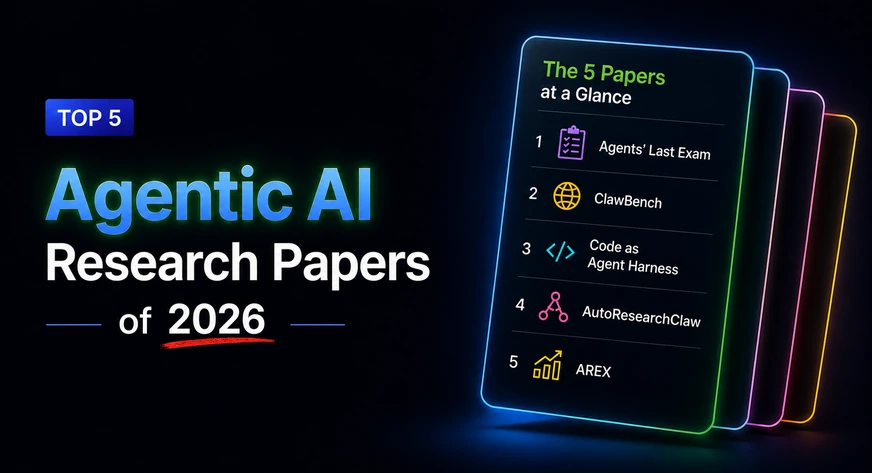
Agentic AI research in 2026 has moved past the basic question of whether a model can be called a tool. The harder questions are whether an agent can finish long workflows, survive live websites, verify its own work, recover from failure, and improve its process over time.
The five papers below map that shift well enough. Two focus on evaluation, one reframes code as the infrastructure around an agent, and two explore research systems that iterate on their own work. Together, they are a useful snapshot of what the research in Agentic AI field is trying to solve next, from model evaluation to deep research.
1. Agents’ Last Exam
CATEGORY
Agent Evaluation
Agents’ Last Exam (ALE) asks a more practical question than whether an AI can solve a hard prompt: can it actually finish a professional workflow and deliver something that can be checked?
Built with input from 250+ industry experts, ALE covers 1,000+ tasks across 55 subfields and 13 industries. The focus is on long-horizon execution and measurable outcomes, giving a clearer picture of how agents perform when the work resembles what people actually do.
What the paper found
- The hardest tier was nowhere near solved at publication: mainstream agent harness and backbone configurations averaged a 2.6% full-pass rate.
- Partial progress is not enough. The benchmark is designed around workflows where the final deliverable must satisfy a verifiable target.
- ALE is intended to be a living benchmark, so its task pool can expand as new industries and workflows are added.
TAKEAWAY ALE turns ‘can the model reason?’ into ‘can the system finish the job?’ That is a much more useful test for real-world agents.
2. ClawBench: Can AI Agents Complete Everyday Online Tasks?
CATEGORY
Web Agents / Benchmarking
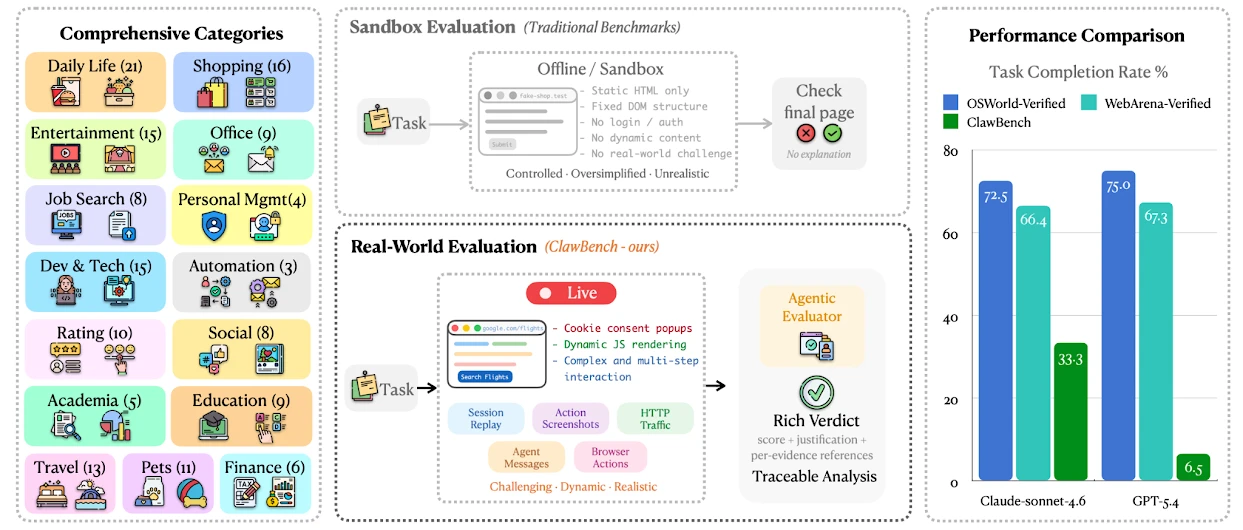
ClawBench tests AI agents where things actually get messy: on the live web. It evaluates 153 everyday tasks across 144 platforms, covering areas like shopping, travel, hiring, finance, and office work.
That matters because real websites introduce friction that clean benchmarks often remove. Authentication, dynamic pages, long forms, documents, and unexpected interactions all become part of the challenge, making the evaluation much closer to real-world agent use.
What the paper found
- The benchmark captures five layers of behavior, including session replay, screenshots, HTTP traffic, agent messages, and browser actions.
- A lightweight interception layer blocks the final submission request so agents can be tested on live sites without completing irreversible actions.
- Across seven frontier models, the strongest result reported in the paper was only 33.3% task completion.
TAKEAWAY If an agent is meant to use the web for you, test it on the web, not on a museum replica of the web.
3. Code as Agent Harness

CATEGORY
Agent Infrastructure
Code as Agent Harness takes a different angle, focusing on the infrastructure behind capable agents rather than another benchmark. It argues that code is becoming part of how agents reason, act, maintain state, use tools, and verify their work.
The important shift is that code is no longer just the final output. It can serve as the layer connecting the model to its environment, memory, control flow, tools, and verification mechanisms.
The three layers
- Harness interface: code connects reasoning to actions and environment models.
- Harness mechanisms: planning, memory, tool use, feedback, and optimization support longer and more reliable execution.
- Multi-agent scaling: shared code artifacts can coordinate agents, preserve shared state, support review, and verify work.
TAKEAWAY A capable model can still be a bad agent if the runtime around it is brittle. Harness engineering is becoming a first-class part of agent design.
4. AutoResearchClaw: Self-Reinforcing Autonomous Research with Human-AI Collaboration
CATEGORY
Autonomous Research
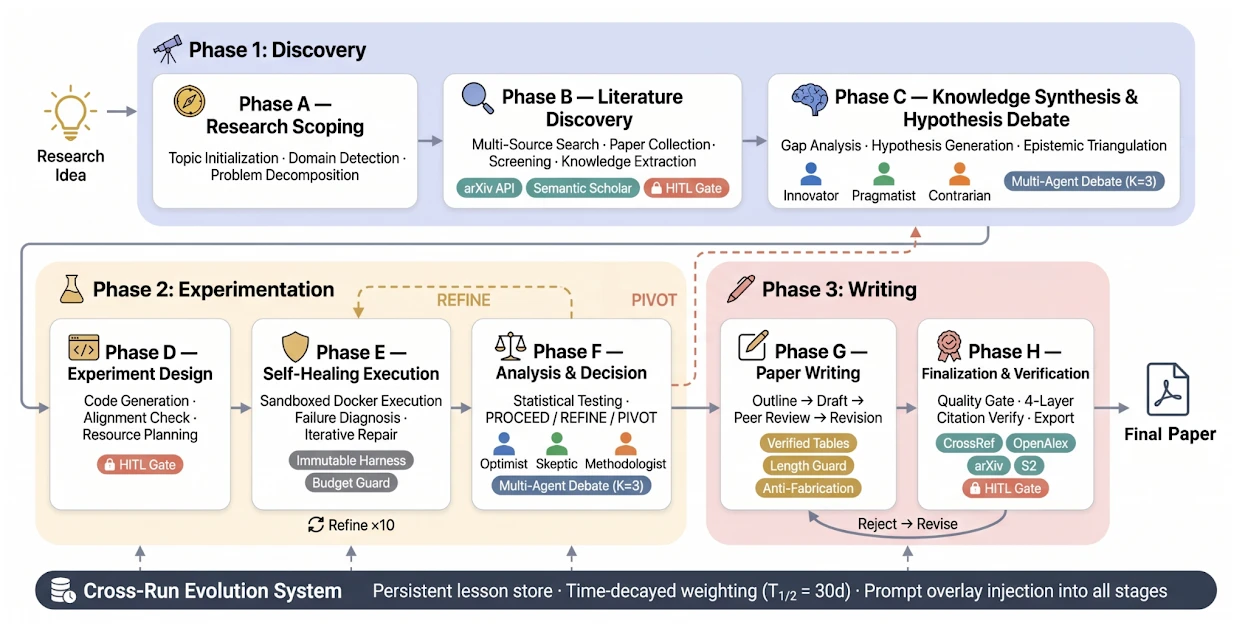
AutoResearchClaw treats scientific research as an iterative process rather than a straight pipeline. It combines multi-agent debate, self-healing execution, verification, and human collaboration so the system can respond when experiments fail or ideas need to change.
The interesting part is the feedback loop. Instead of simply generating a paper, the system can detect failures, choose whether to refine or pivot, verify results, and carry useful lessons into future runs.
What stands out
- Multi-agent debate is used during hypothesis generation and result analysis so one reasoning path does not dominate unchecked.
- The Pivot/Refine loop treats failed experiments as information. The system can repair an execution path or change direction instead of simply stopping.
- The framework includes seven human-intervention modes, ranging from near-autonomy to step-by-step oversight.
- On ARC-Bench, a 25-topic experiment-stage benchmark, the paper reports a 54.7% improvement over AI Scientist v2.
TAKEAWAY AutoResearchClaw treats research as an iterative system with checkpoints, repairs, and memory, not a one-shot prompt that happens to output a paper.
5. AREX: Towards a Recursively Self-Improving Agent for Deep Research
CATEGORY
Deep Research Agents
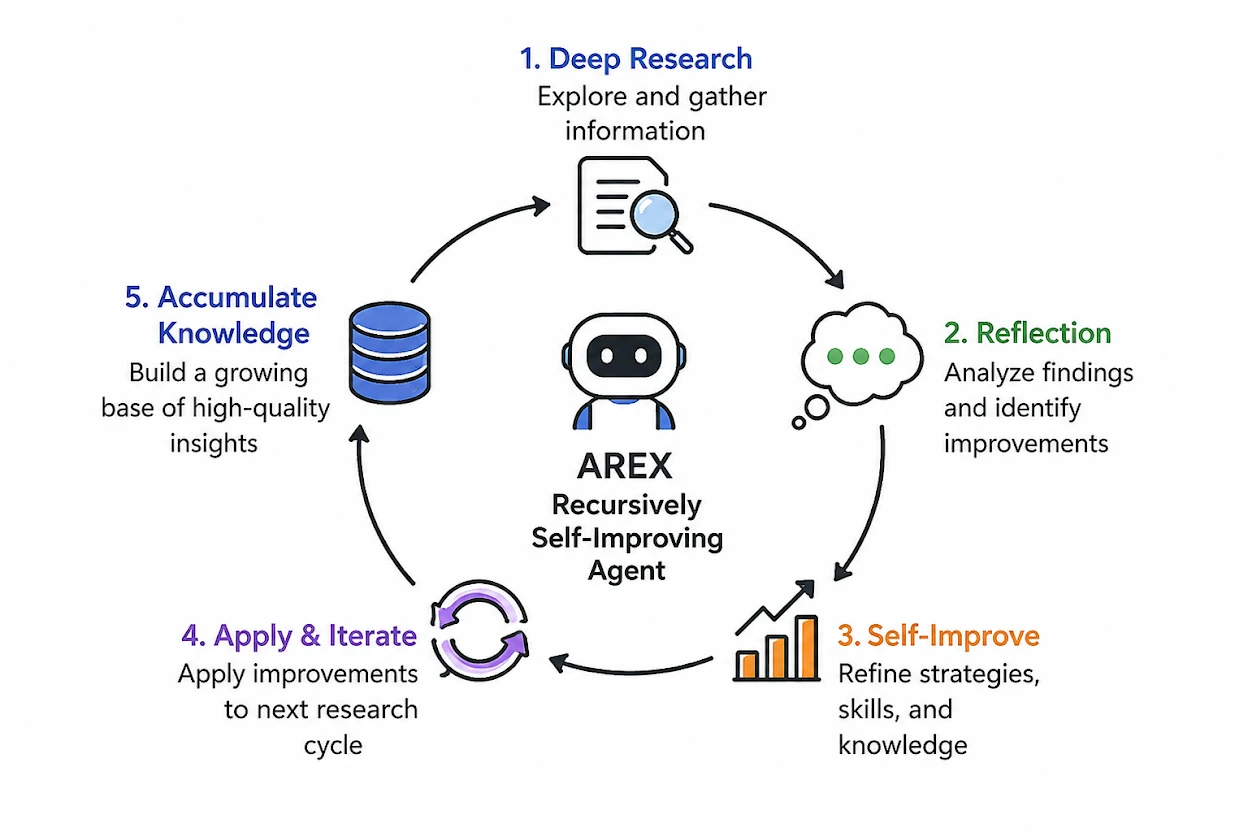
AREX takes a different approach to deep research. Instead of treating research and verification as the same process, it separates them. Finding an answer may be expensive, but checking whether it satisfies a specific constraint can be much easier.
The system uses two loops. One gathers evidence and builds an answer, while the other audits it constraint by constraint. When something remains unsupported, AREX triggers targeted follow-up research instead of starting the entire search over again.
What makes it different
- Constraint-wise verification separates discovery from checking, making it easier to identify exactly what is still unsupported.
- A learned context-update tool compresses long interaction history into a smaller improvement state that preserves verified evidence and unresolved constraints.
- The paper trains both a dense 4B model and a larger mixture-of-experts model using agentic mid-training and long-horizon reinforcement learning.
- AREX is evaluated across BrowseComp, WideSearch, DeepSearchQA, Humanity’s Last Exam, and other reasoning and tool-use benchmarks, where the authors report strong results against comparable-scale baselines.
TAKEAWAY AREX makes verification part of the research process itself. The agent improves by narrowing uncertainty, not simply by searching longer.
What These Papers Reveal About Agentic AI in 2026
If you’d take a closer look at the previous papers, a clear pattern emerges across them. Even though they’re from varying domains, they are hinting towards an overall shift of the domains toward the following tangents:
- Evaluation is moving from short benchmark questions to complete, work-like tasks with verifiable outcomes.
- The harness matters. Models need state, tools, execution, feedback, and verification around them to behave like reliable agents.
- Failure is becoming part of the loop. Newer systems try to diagnose bad attempts, refine them, and preserve useful lessons.
- Autonomy is being paired with checks. Human approval, deterministic verification, and constraint-level audits appear repeatedly across the strongest work.
Read more: Agentic Misalignment Explained: When AI Agents Go Rogue
Frequently Asked Questions
A. Start with Agents’ Last Exam for evaluation, Code as Agent Harness for architecture, or AutoResearchClaw if you are specifically interested in autonomous research systems.
A. No. They are a useful popularity signal, but they do not measure scientific rigor, reproducibility, or long-term impact.
A. AutoResearchClaw focuses on an end-to-end multi-agent scientific workflow with human collaboration. AREX focuses on deep research that recursively improves through constraint-wise verification and targeted follow-up research.

Studying, evaluating, and explaining AI systems for over 6 years.
“𝘖𝘯𝘤𝘦 𝘮𝘦𝘯 𝘵𝘶𝘳𝘯𝘦𝘥 𝘵𝘩𝘦𝘪𝘳 𝘵𝘩𝘪𝘯𝘬𝘪𝘯𝘨 𝘰𝘷𝘦𝘳 𝘵𝘰 𝘮𝘢𝘤𝘩𝘪𝘯𝘦𝘴 𝘪𝘯 𝘵𝘩𝘦 𝘩𝘰𝘱𝘦 𝘵𝘩𝘢𝘵 𝘵𝘩𝘪𝘴 𝘸𝘰𝘶𝘭𝘥 𝘴𝘦𝘵 𝘵𝘩𝘦𝘮 𝘧𝘳𝘦𝘦. 𝘉𝘶𝘵 𝘵𝘩𝘢𝘵 𝘰𝘯𝘭𝘺 𝘱𝘦𝘳𝘮𝘪𝘵𝘵𝘦𝘥 𝘰𝘵𝘩𝘦𝘳 𝘮𝘦𝘯 𝘸𝘪𝘵𝘩 𝘮𝘢𝘤𝘩𝘪𝘯𝘦𝘴 𝘵𝘰 𝘦𝘯𝘴𝘭𝘢𝘷𝘦 𝘵𝘩𝘦𝘮.” — 𝖥𝗋𝖺𝗇𝗄 𝖧𝖾𝗋𝖻𝖾𝗋𝗍, 𝖣𝗎𝗇𝖾
Login to continue reading and enjoy expert-curated content.


