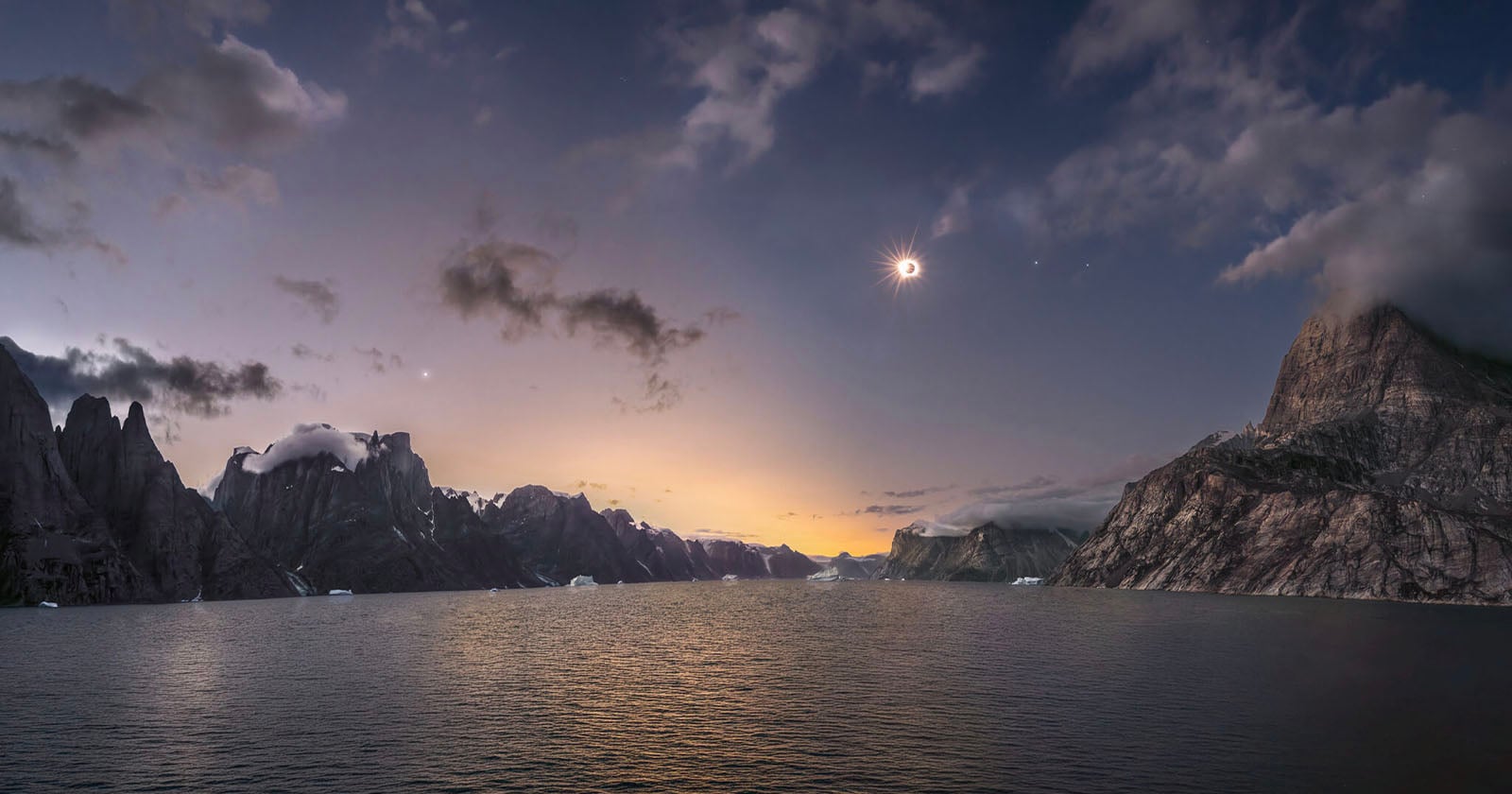
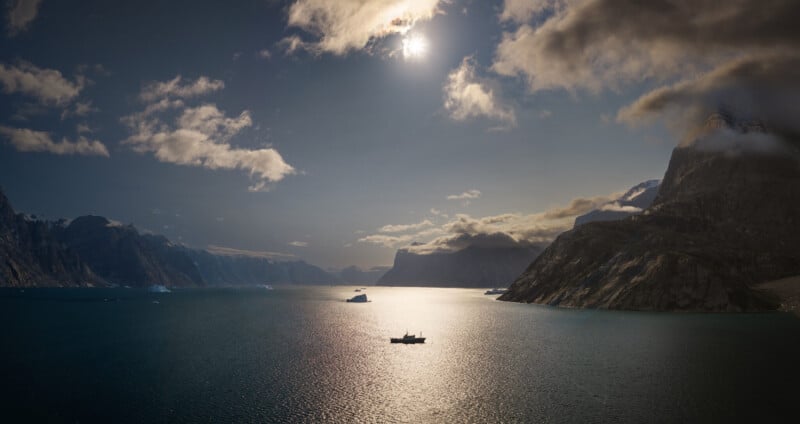
“It was just breathtaking,” Wayne says, the awe unmistakable in his voice. “It was the most epic thing I’ve ever photographed in my life.”
Despite leading photography workshops across the globe for years, this was the first total solar eclipse for both Marc and Wayne. Marc admits it had never really been on his bucket list—largely because those familiar telephoto shots of the corona, however technically impressive, tend to look the same no matter who’s holding the camera.
“Photographically, those types of compositions were never my goal,” Marc explains. “I knew I could just go to NASA and find a beautiful close-up shot of an eclipse. For me, it was more about the light around the eclipse, and how that affects the wilderness or the landscape wherever you’re standing. If I were to shoot an eclipse, the goal was always to go somewhere unusual.”
This particular eclipse was passing through multiple countries, but Greenland was Marc’s first choice of location. Having led multiple workshops to the island, he knew the landscape would be incredible, but plotting the path of totality over Scoresby Sund was a new challenge. “Marc knew of this fjord,” Wayne recalls. “We looked at the map, and it lined up perfectly, full totality right in the center for over two minutes. We knew we had the perfect spot.”
The Journey to Scoresby Sund
Running a workshop to Greenland is one thing, but getting a group out to Scoresby Sund takes extra planning. Commercial flights into the remote fjord only run once or twice a week, and those days didn’t line up with the timing needed to meet the ship. To make the dates work, Marc had to charter a private aircraft, adding a whole new layer of logistical complexity.
His initial plan to charter a larger plane fell through, forcing him to secure two smaller aircraft instead. But with smaller planes came a stricter weight limit.
To stay under the plane’s total weight ceiling, every single pound counted, including the photographers themselves. “Wayne weighs over 200 pounds—he’s all muscle, built like a wrestler,” Marc laughs. “So here we are flying over, and we’re only allowed 55 pounds between camera gear and clothes. It was tight.”
To help, Marc brought his own laptop for everyone to share, letting people offload their files onto portable hard drives instead. Between that, the ship’s onboard Starlink, and a laundry service run by the crew, nobody had to leave anything crucial behind.
An Eclipse in the Landscape
What set this month’s eclipse apart was its low position in the sky, measuring just 25° above the horizon. For photographers, this meant that it wouldn’t just be an event happening overhead but would sit low enough to become part of a larger composition, worked into the landscape rather than shot in isolation. It was exactly the departure from the standard eclipse shot Marc had been looking for.
“Wayne and I were in Utah during last year’s annular eclipse trying to figure out what 25 degrees in the sky would actually look like, just to get a mental picture of it,” Marc says. “We knew that in Greenland, 25 degrees meant the sun would be right above the mountain peaks, and the only way to compose that properly was from a ship.” To make the most of this unique celestial alignment, they chartered the Polar Front.
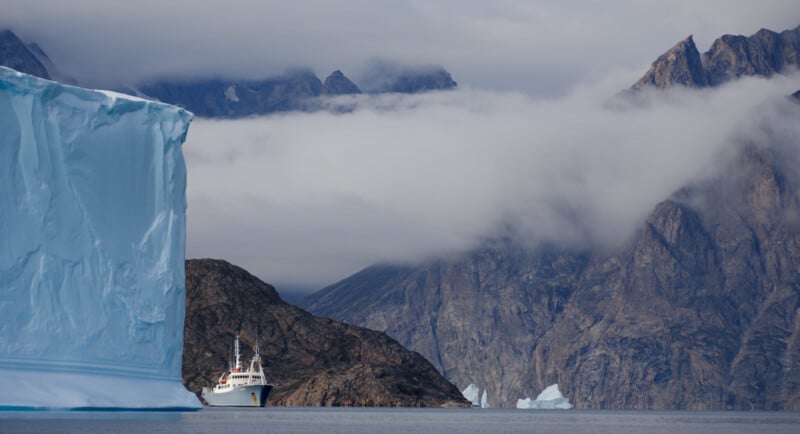
For Marc, having the ship meant placing the eclipse into an Arctic landscape that is breathtaking even under normal conditions. “When you’re floating around on a boat, you’re right up next to building-size icebergs with arches in them, and mountains shooting 6,000 feet straight out of the water,” Marc says. “It’s indescribable.”
The Lead-Up
With a few days on board before the eclipse, the group had plenty of time to photograph the towering icebergs and tidewater glaciers that Scoresby Sund is known for. Sailing to the far end of the stretch still open to visitors — Greenland recently closed off roughly half of Scoresby Sund’s traditional loop to protect its resident narwhal population — they even spotted muskox along the shore. Between outings on the ship’s zodiacs, Marc and Wayne used the time to get everyone ready for the main event, including demystifying the one piece of gear many first-time eclipse shooters get wrong.
When to Lose the Filter
“Everyone thinks you need a solar filter,” Marc explains. While essential during the eclipse’s partial phases, solar filters must be removed the instant totality begins. Left on, a near-opaque filter blocks virtually all light from the dimmed sky, resulting in complete underexposure.
As Wayne puts it: “You’re shooting through a 16 or 18-stop filter and going, ‘It’s black!’ And I’m like, yeah—you’re getting a cookie with a bite out of it. That’s all you’ll see.” To ensure no one panicked when the light dropped, Marc and Wayne ran the group through practice drills on deck so nobody was fumbling during those crucial two minutes.
While larger cruise ships sailed past toward the end of the fjord, Marc and Wayne arrived at their chosen spot a full 24 hours early. “We found our place and Wayne’s like, ‘We got to park on this just in case another ship decides that this is the spot,’” Marc recalls. “So we parked on it and started watching the weather.”
Lights Out
On the day of the eclipse, low clouds had drifted in and threatened to obscure the 6,000-foot spires of the mountain they had planned to use as a frame. “Those three spires were meant to be on the right side of our composition, and cloud came in and covered them,” Marc says. “But that’s the beauty of being on a ship. We just repositioned a little further out in the fjord where there was no cloud, giving us an open sky with nothing obscured.”
While totality lasts just over two minutes, the entire eclipse is a two-hour event. As the moon slowly took its first bites out of the sun, a quiet intensity took over the deck. For over an hour during the partial phases, the group tracked the changing light, adjusting their solar filters and checking test exposures right up until the shadow finally swept over the ship.
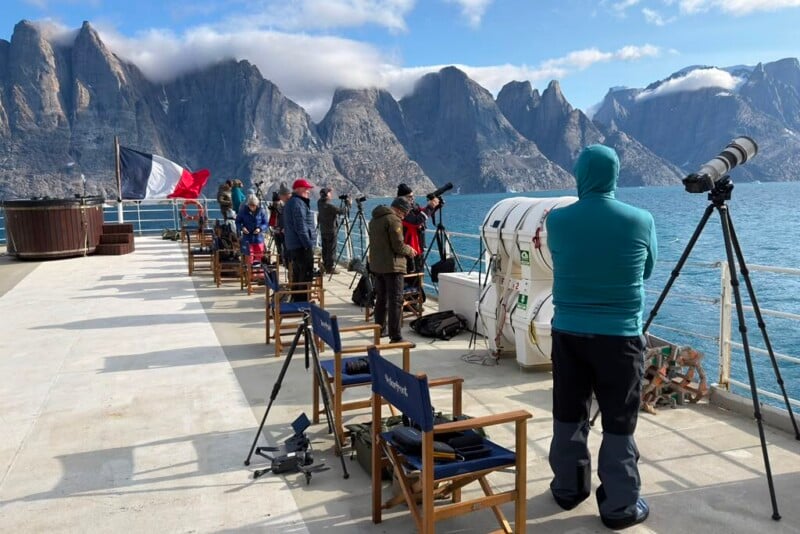
“Darkness just—boom!” Wayne remembers. “It took about four seconds and everything went from light to dark. It went into twilight, and suddenly you could see Venus to the left, and Jupiter and Mercury to the right of the eclipse.”
Marc’s own memory of it is just as visceral. The two minutes allotted by the astronomical charts felt like they passed in a blink: “What I won’t forget was how fast the lights went out, and the beauty of the light around me.”
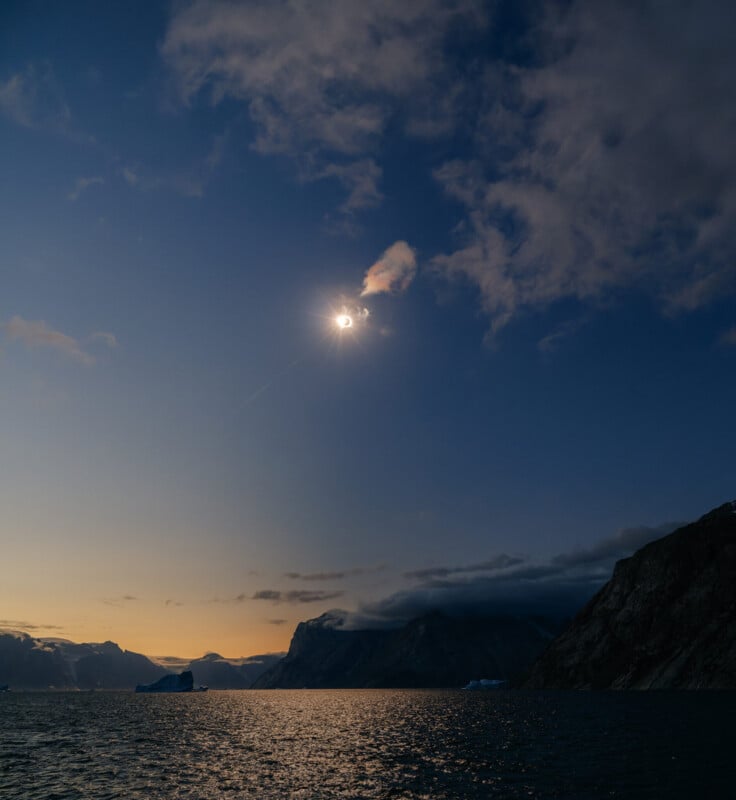
That rapid plunge into darkness caught even the most meticulous planners off guard—the deep Arctic fjord proved to be several stops darker than their calculations had suggested. Realising mid-totality that the shadow was devouring the scene faster and darker than expected, Marc and Wayne immediately bumped their ISOs and began calling out setting adjustments across the ship so the group could adapt in real time.
For two minutes, the deck of the Polar Front became an arena of hyper-focused energy: photographers managing dual-camera setups, swapping between telephoto brackets of the corona and wider handheld panoramas, and even sending drones up into the sky.
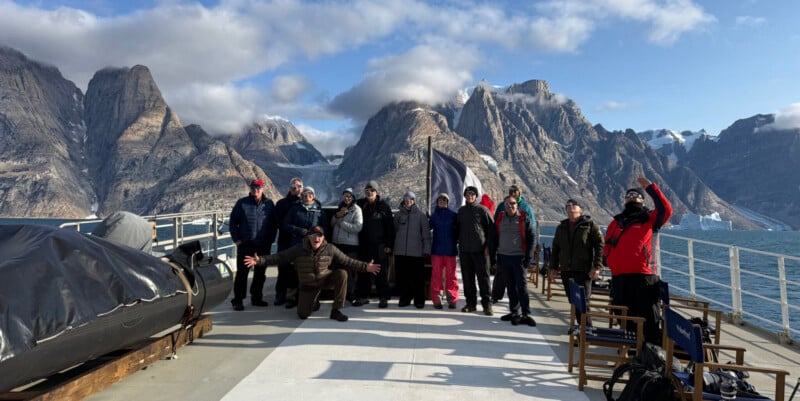
As the sun began to reappear, the relief and excitement on deck spilled over. “As soon as the diamond ring came out on the other side, the captain blew the foghorn on the ship, and everybody just erupted,” Marc says. “Everyone was cheering, hugging, high-fiving—it was total euphoria.” Their timing could not have been closer: “The crazy thing is, 30 minutes after totality ended, the entire sky clouded over completely. If we had been 30 minutes later we would have seen nothing.”
The Photographs
Pulling off those two minutes in open Arctic water came down to the captain’s seamanship as much as anything the photographers did. The fjord was over 500 feet deep—far too deep to anchor—so the captain held position purely by working the ship sideways against a 16-knot crosswind. Timing it on Marc’s radio instructions, he kept the entire vessel lined up exactly right the moment totality hit. “It was phenomenal,” Wayne says. “He timed it perfectly.”
Even while managing the entire deck, both pros managed to pull off defining shots of their own, though Marc’s centerpiece image was nearly lost to distraction.
Marc’s View From Above
Ten minutes before totality, Marc sent his drone up to hover at around 300 feet and then got swept up in his own on-deck shooting—swapping lenses on his medium-format camera, firing off close-ups—and nearly forgot the drone was still in the sky. “I looked over at Mike, one of our participants, and he had his controller in hand, and it suddenly reminded me—I’ve still got the drone up,” Marc says.
He got the shot almost by instinct; one bracketed frame of the ship, the icebergs, and the eclipse together, captured with a single tap of the controller. It wasn’t until he was home reviewing files that he realised what he’d managed to catch: a visible line between light and shadow across the frame, the edge of the moon’s shadow itself falling across the water. “I looked at it and went, oh, wow—I didn’t expect this,” he says. “It might even be my favorite shot.”
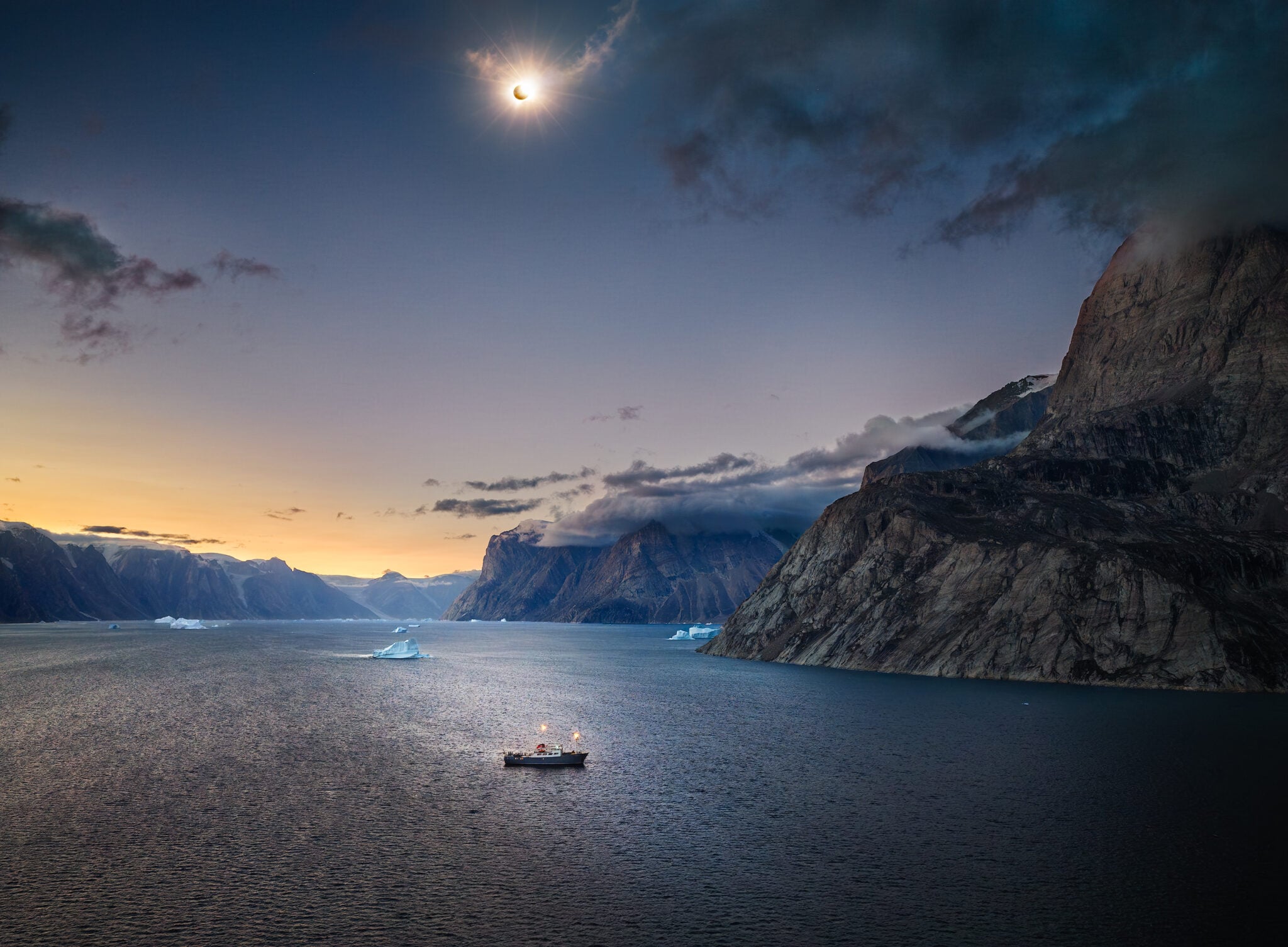
“In hindsight, of course, I wished I could have just put the drone on video and watched it go into eclipse and then emerge,” he says. “Because it would have shared a little more of the experience.”
Wayne’s Handheld Panorama
Wayne’s own hero shot was pure improvisation. Partway through totality he realised the eclipse sat higher in the frame than he’d wished for, and that the light on the water was too good to ignore. “I thought, I’m going to try this,” he says. “And I got lucky—it was right as the diamond ring effect was happening when I swept across.”
Working handheld at a high ISO, fielding client questions the entire time, Wayne pieced together a 12-image, multi-row panorama—sky, mountains, and water each shot separately and stitched together—without any idea it would actually come out. “When I got home, I had no idea it would go together. I didn’t think it was possible, to be honest. But it did.”
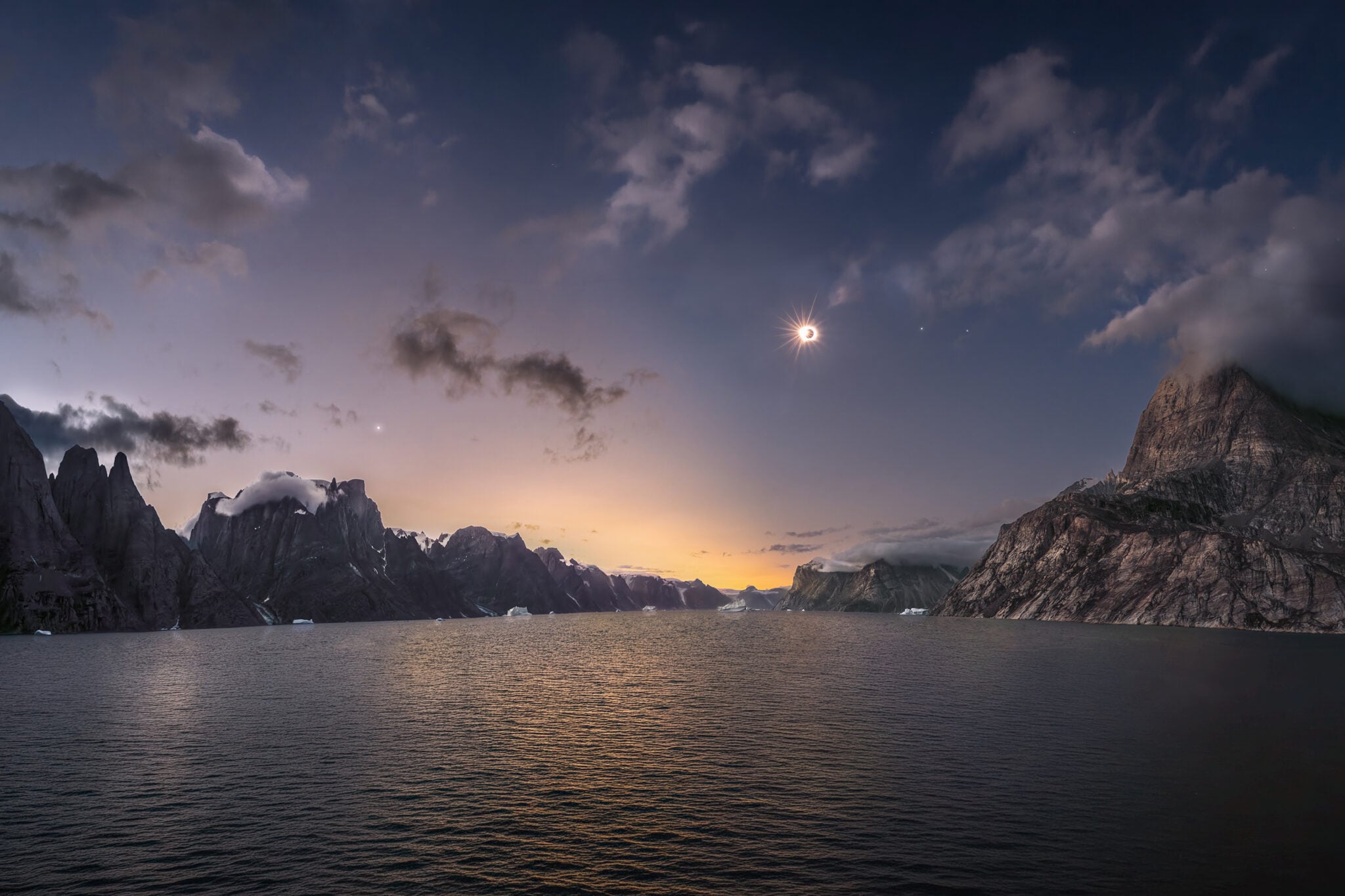
When it came to editing, he turned to the same processing techniques he uses for astro-photography. “It’s very similar to night processing, honestly—we were shooting at bumped-up ISOs, so there was noise reduction to deal with. Once the panorama was together, I used three masks in Photoshop: one for the water, one for the mountains, one for the sky. That was it.”
Crucially, he resisted the temptation to enlarge the sun in post. “A lot of people overdo the size of the eclipse because they want it to stand out. But for Marc and me, the landscape always takes precedence over what’s happening in the sky—no matter how epic it is. We preach that constantly. Everybody on that boat wanted the landscape shot.”
Golden Rules for Your Next Eclipse
Most people won’t get to charter a ship into an Arctic fjord for an eclipse—but Marc and Wayne’s advice travels well regardless of where you’re standing:
Choose the right focal length: “Have a 35mm lens on hand, assuming the eclipse falls within that frame,” Marc says. “Go wider than 28mm and the eclipse becomes very small. A slightly longer wide-angle—35mm, even 50mm—is a lot more forgiving.”
Bracket during totality: “Shoot a bracketed set, two stops apart, both under and over,” Marc says. “That alone will get you close to the overall feeling of the moment.”
Stop down for the diamond ring: “Right as the sun emerges or disappears, that’s the golden, diamond light,” Marc notes. “You want to be down around f/13 to f/16 to pull out all the rays.”
Don’t underestimate the corona: “People don’t realise the eclipse is actually much bigger than it looks,” Wayne adds. “When the corona appears, it can be twice the size of the moon or sun itself, sometimes more. You need to leave room for it in the frame.”
Commit to your vision: Not everyone on the trip chased the wide landscape shot—one participant stayed locked on telephoto the whole time, working at 150mm and 300mm, and came away with stunning corona detail. Marc’s takeaway: pick one approach and commit to it, rather than trying to do everything in two minutes.
The Afterglow
The day ended in the ship’s lounge with the entire boat coming together. “We threw a big party with the captain,” Marc recalls. “And we showed a six-minute slideshow to the crew of everyone’s photos from the whole trip and the eclipse.”
The sense of awe is still evident as Marc and Wayne reminisce about it, days later. “We couldn’t believe what we just experienced. We captured it. We were celebrating. It was so memorable.”
“I’m the luckiest guy in the world,” Wayne says. “It was just… it was mind-blowing.”
Wayne Suggs and Marc Muench are nature photographers and instructors with Muench Workshops. Marc is a third-generation photographer and son of legendary landscape photographer David Muench, while Wayne has spent more than 40 years photographing landscapes and wildlife. Founded in 2007, Muench Workshops leads small-group photography workshops and expeditions around the world. This article was also published here.
Affiliate Disclosure PetaPixel articles may include affiliate links; we may earn a commission if you buy through one.


