
Keyword research can help you understand what people search for, but it doesn’t tell you why they’re searching or what they need next.
Better content briefs start with the situations your audience finds themselves in, then use those situations to shape what you create and how you measure success.
When keywords become the brief
Briefing keywords alone is one of the reasons we have a slew of 300-word articles written somewhere between 2015-2018 that we’re now responsible for cleaning up.
It’s why every accountant in the U.S. has an FAQ answering “what’s the fiscal year?” on their website somewhere. We wanted to chase the perceived volume of impressions and clicks that answering that kind of question would get us.

For a specialist service like accounting, answering these kinds of basic questions to get a shot at visibility for broad questions does your expertise a disservice.
It leaves you with pie on your face because you’re putting yourself up against the governmental agency that dictates these kinds of things and saying, “Hey, I’m better than the entity that set these standards. Google, please give searchers my answer instead.”
That’s never going to happen. Honestly, I’m not sure why we ever thought it was a good way to gain visibility in our areas of expertise.
Plus, when you’re offering that information on your website, you’re assuming people coming to your website don’t already know it. And it should raise two uncomfortable questions as a business owner:
- Why am I trying to outrank the entity that should clearly be the only answer served for this question?
- Why, as a business owner, would I want clients that don’t already know the answer to this broad, basic question or know how to find it out themselves?
This should lead us to take a step back and look to understand the larger picture keywords were always trying to tell us: What journey is our audience on, and how can we answer their concerns along the way?
Track, grow, and measure your visibility across Google, AI search, social, local, and every channel that influences buying decisions.
From keywords to audience situations
As the return of conversational search with large language models should remind us, humans don’t natively think in keywords.
It’s not “best new sweet snacks 2026,” it’s:
- “My wife is pregnant and craving weird sweets she’s not tried before.”
- “I want to give new candy out for Halloween this year.”
- “I want to impress my friends with something different for dessert at the next dinner.”
The situation is much more aligned with topic-level thinking than individual keywords.
It’s also more aligned with how large language models are trained to think alongside folks using their platform.
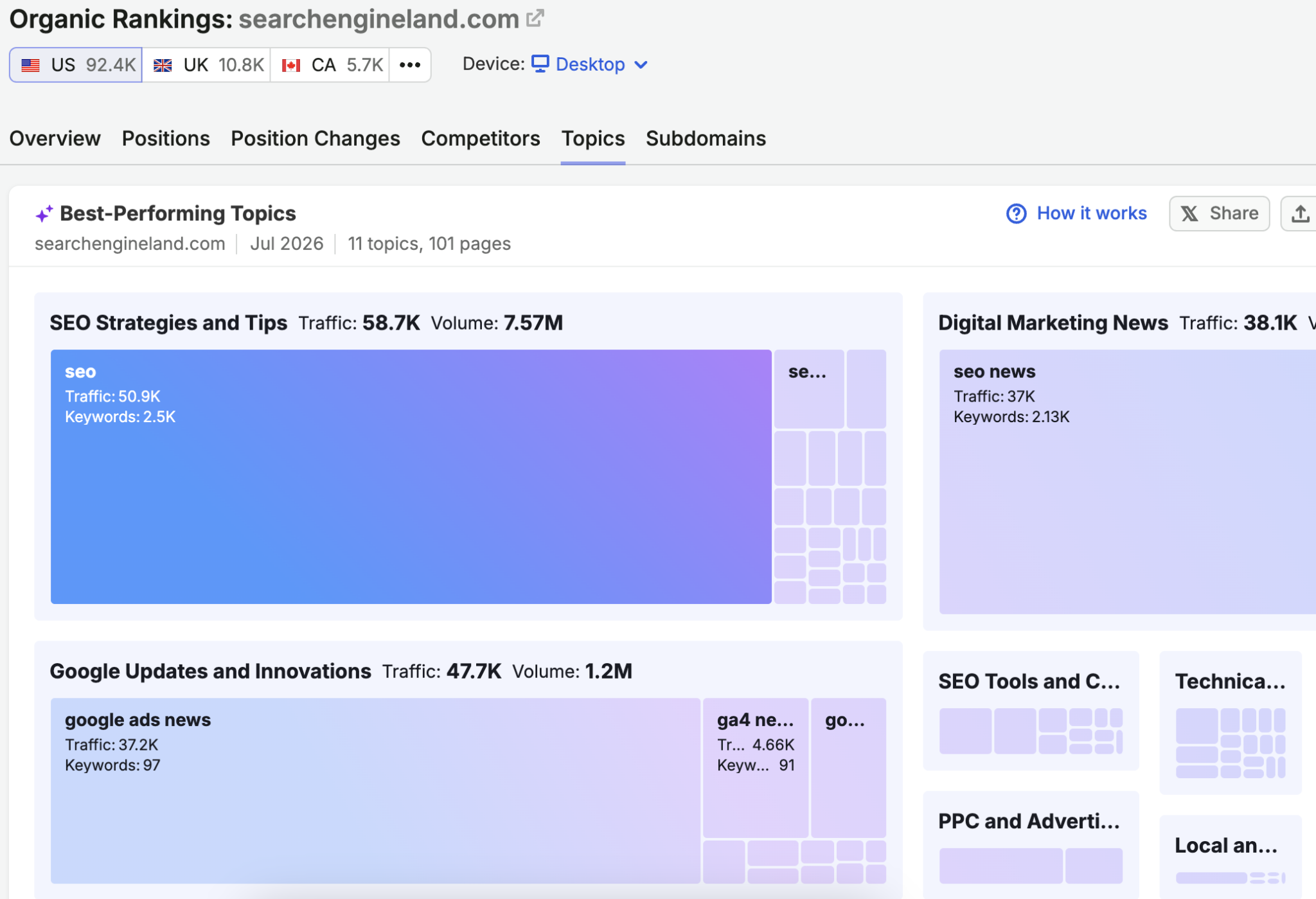
Topics themselves are the first step into category entry points (CEP). If you’re drawing a blank on topics, Semrush has a topics overview to kick-start your thinking.
CEPs are much more qualitative and people-based. They’re the jump from the topic back to the situation that created it. They’re the 7 W’s, as described in Jenni Romaniuk’s Better Brand Health:
- Why.
- When.
- Where.
- While.
- With whom.
- With/for what.
- How feeling.
Answering those 7 W’s is the exercise you want to go through when building a brief. And honestly, it’s the exercise you should go through before creating anything new for your website or your brand.
The people most likely to help you with this are the folks who interact with your audience the most: support, sales, in-store staff (if you have them), or anyone who’s become a public brand representative in some way.
One element to understand here: This process is based in brand science and marketing principles. It’s not easily expressed in a metric the same way keyword volume is.
Keyword volume, though, has always been abstracted away from your actual audience and their concerns.
Using the 7 W’s forces you, your team, and your leadership to ground your choices in your actual audience.
Less measurable, more defendable: “This is the feedback we got from our support team from the last six months” versus “This has the biggest search volume in the U.S. for our vertical.”
If you were a business owner, what would you prefer to act on? Hopefully, the latter.
Dig deeper: Building a brand worth finding: Signals that fuel discovery
The actual brief
The fields I’d suggest having in the brief:
- One line for each of the 7 W’s. Include who on the team you got the information from, if you can — the traceability can be useful if your team needs to fact-check or get a slightly different level of detail.
- The scenario you’re solving for: the panicky business owner near the end of their first financial year, someone taking over a new business, or the young apprentice learning the ropes.
- Everything else you’d have for a typical content brief: the content type (informational, consideration, transactional), short suggested outline, any brand tone notes, existing coverage check, length guidance, and the measure of success.
This gives your content a shape focused on the situations your audience finds themselves in and the journey they’re on — and cements, with real feedback from real people, where your brand isn’t answering their concerns. It also gives you a direct, scaffolded way to answer those questions within the context of your brand and business.
The proof is in the pudding
If you have a leadership team that may be skeptical of working this way, I’d suggest doing what I usually suggest: Test it.
Write a traditional keyword-based brief and one based around the 7 W’s and those scenarios. Review the quality of what you get back from your writers and, if you can, A/B test them on the website for things like scroll depth, interaction, and impressions.
Hopefully, you’ll come away with an audience that has more of its concerns about your business answered before purchasing a product or service from you. Your internal teams should also be more attuned to their audience’s concerns than they were when they focused on keywords.
That’s a win-win for your business in the long term, much more so than ranking No. 1 for “what’s the fiscal year” for your entire tenure with the company.
Dig deeper: How customers build confidence across the search journey


