Published August 25, 2026 02:53PM
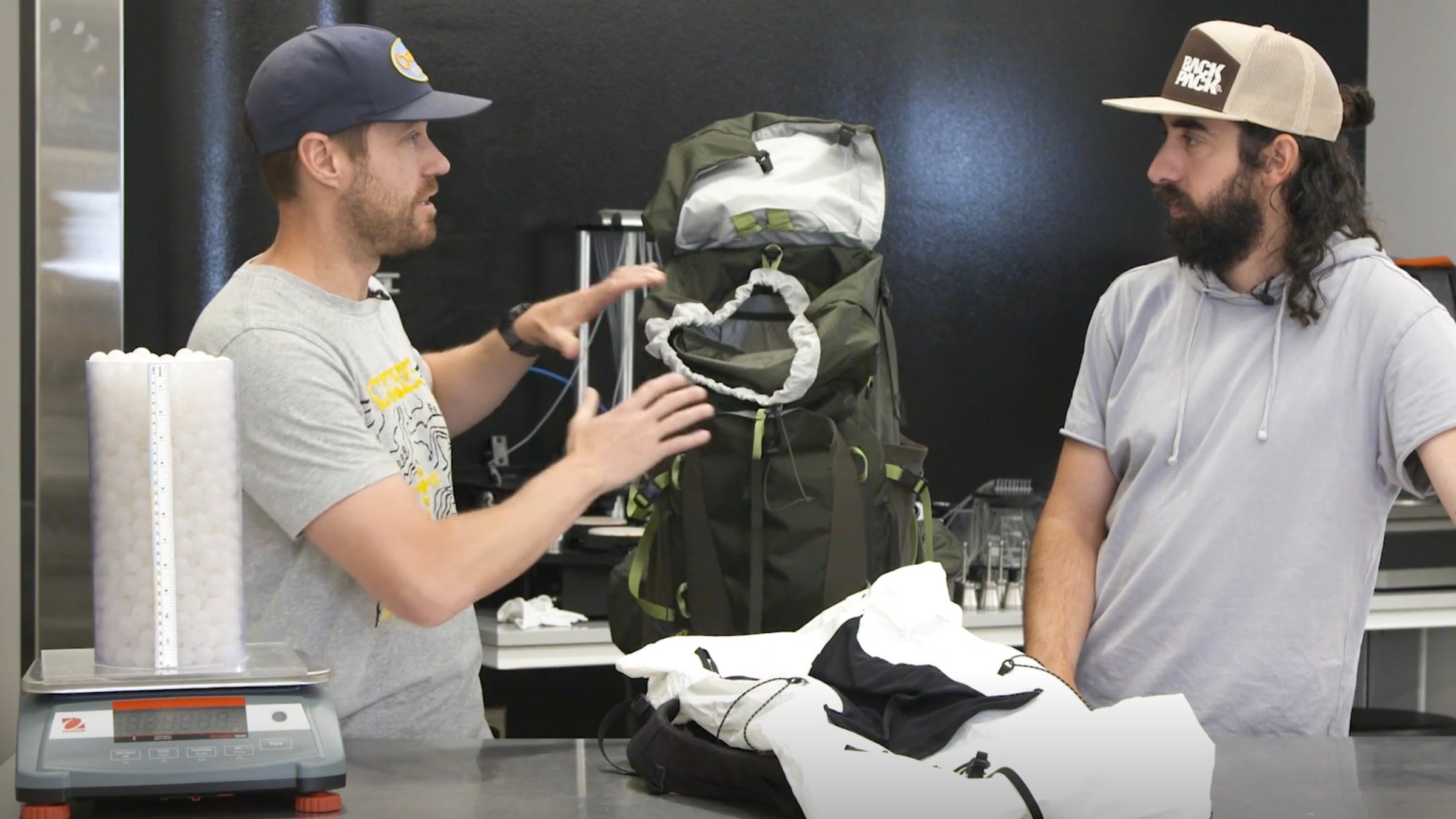
What we did: For this story, Backpacker tested the 18 traditional and ultralight backpacks featured in this year’s summer gear guide in the Outside Lab, comparing their claimed capacities against their actual ones and measuring how they divided those up between main and accessory pockets.
What does that 40, or 50, or 60 in your backpack’s name mean? If you answered “the number of liters it can hold,” you’re correct. Knowing how much you can fit in any of your backpacking packs is essential to planning—it lets you know how much and what kind of gear you can bring, and how you’ll have to organize it.
But as I learned when I went to the Outside Lab in Denver, Colorado earlier this year, that’s not the whole story. Each backpack on the market carries its weight differently. To find out how, I asked Lab Test Editor Adam Trenkamp to walk me through how the lab verifies the capacity of the backpacks we review, and what backpackers should know before they buy their next one.
Transcript
Adam Roy: P, passionate. C, capacity. P, also packs…Yeah, we’re trying to figure out how many liters each of us is equivalent to.
Adam Roy: So here at Backpacker, we test a lot of different kinds of gear. There is only one piece of gear, however, that is in our name. That is, you guessed it, the humble backpack. I’m Editor-in-Chief Adam Roy, and I’m here at the Outside Lab at CU Denver with my colleague, Test Editor Adam Trenkamp. Adam, how you doing today?
Adam Trenkamp: Good, Adam. How are you?
Adam Roy: I’m doing pretty good, and I have a couple questions for you.
Adam Trenkamp: Bring it on.
Adam Roy: So, I was thinking about some myths about backpacks that I’ve heard from readers, and one of them is this assumption that if a backpack is listed at a capacity of, for example, 60 L, this section here, the main pack bag, should be able to hold that much.
Adam Trenkamp: Not to make capacity too complicated, but it is a little more complicated than that. So, on a fully featured pack like you find in most traditional backpacking bags, the main compartment doesn’t necessarily hold the entire capacity that’s listed for the bag.
For example, a 60 L pack like this one only holds 45 L as we measured in the main compartment. The bag itself does still hold a total of 60 L, but you have the use of the lid with extra pockets, you have a stuff on the front, you have some extra stuff on the side that are not bottle pockets, because this one has special bottle pockets in the back, you even have a little extra capacity in the hip belt as well. Fully featured bags with a lot of organization don’t necessarily hold the total bag capacity in what you would think, which is the main compartment.
It’s important when you pick out a pack in knowing maybe how much you’re going to take with you, add a little extra to what you think you’re going to take, and think about how that might fit in. So maybe know what the size of things are, and when you look at a pack, how much does it actually expand out? Is that item going to fit inside? Versus something like an ultralight pack that’s one main pocket, you know the total volume is inside that main pocket, so you can guess how much is actually going to fit in there pretty easily. On a fully featured pack, you got to kind of look at what you take with you, where’s it going to stuff and fit, and then does that work best for you?
Adam Roy: So if the listed capacity on every pack we test is pretty faithful, in that case, it seems to me like the difference between a pack where most of the capacity is in the main pack bag like this one, versus one with more pockets, is just personal preference in how you hike. So if you’re going to be an ultralight hiker who’s pretty much packing up in the morning and just on the trail all of the day, not really in and out of your pack much, you’d be best served by something like this. But if you need organization, if you’re making a lot of stops, stopping to see the sights, getting stuff out, you might benefit from having less of the volume in the main pack bag and more in other compartments like this.
Adam Trenkamp: Yeah, I agree with that, because that lets you kind of put the things you want to get to more frequently in those other organized pockets. That way you can get in and out, it’s not going to really create an issue where you’re unpacking the bag or repacking the bag.
Adam Roy: And having less of the volume in the main pack bag would be less of a tradeoff in those circumstances.
Adam Trenkamp: Yeah, absolutely.
Adam Roy: Well, there you have it. Just because a pack is listed at a capacity does not mean the main pack bag can hold that much. Now, if you’ll excuse me, Adam, I am going to take my balls and go home.
Adam Trenkamp: Those were mine. Those were mine.


