As we skidded off the main road and onto a mud path maintained only by tire treads, lines began to blur.
Flanking our two-track trail were a series of parallel lanes no more than a foot wide, which forked, merged, and crisscrossed our own. In the distance, I saw what looked like a ghost train, faintly visible and thrust forward by howling Siberian winds.
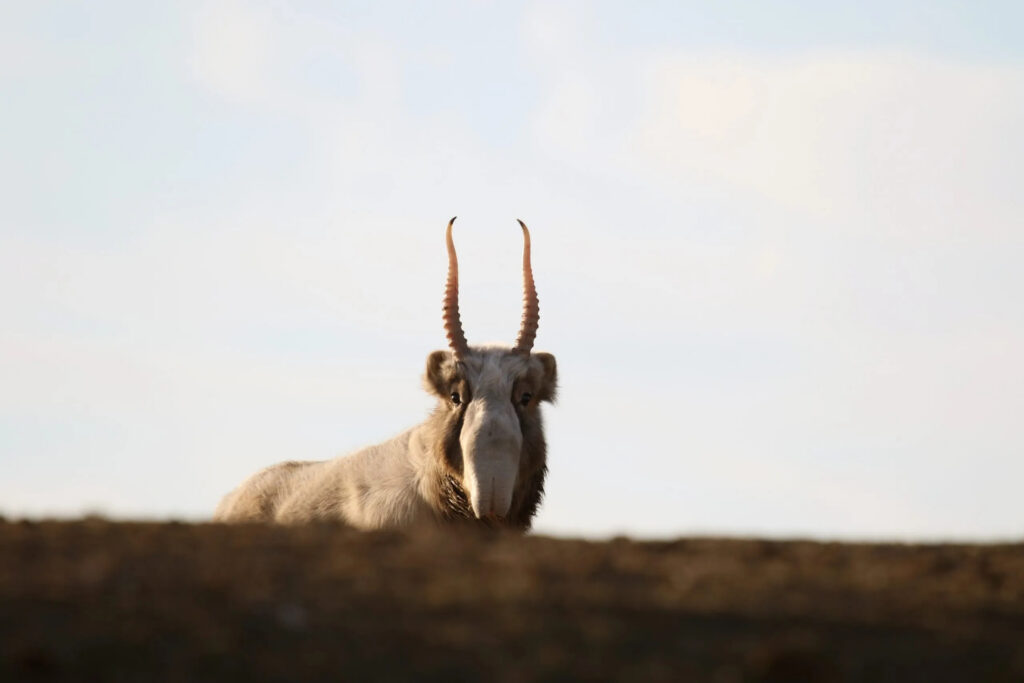
Through borrowed binoculars, I soon got my first glimpse of an ancient tableau, seemingly untouched since Neanderthals roamed the earth. On the far horizon, hundreds of nomadic travelers pierced the frigid air with their ringed horns, inhaling the brittle shards through Snuffleupagus snouts as they sprinted across the desolate steppe.
Watching them charge through the treeless plain at full bore, I was reminded of a saying I’d heard shortly before arriving in this remote corner of Kazakhstan: “The saiga is a freedom-loving animal.”
Since time immemorial, saiga antelope have blazed trails across Central Asia while other civilizations rose and fell around them. They once inhabited a world dominated by woolly mammoths, saber-toothed cats, and giant deer with antlers 12 feet across—and outlived them all. When pioneering human caravans first attempted to navigate this unforgiving land, they considered the saigas to be their guides.
Ahead of my arrival, seasonal rains transformed once-green grasslands into sludge punctuated by tufts of withering brush. Driving through such muck is, I would soon discover, akin to controlled hydroplaning. The steering wheel bucked wildly as our tires swerved, shredding deep into the gunk and desperately gripping anything remotely solid enough to push off from.
In the front seats were Alexandr and Albert, two team members from the Association for the Conservation of Biodiversity of Kazakhstan, or ACBK. Between them, they have more than twenty-five years of experience following saigas across the steppe, and I’d arranged to join them for the western leg of one of their field audits.
Our visit was timed to coincide with the rutting season, a critical part of the year for saigas. This is a gathering time, when antelope from across the region sprint together in massive single-file lines, before congregating for a series of competitive battles and subsequent mating rituals.
For males, it’s a time for strutting and headbutting to demonstrate one’s physical prowess to female onlookers—an activity so energy-intensive that many will forget to eat and keel over from extreme physical exhaustion. For females, this is a time of choosing. In addition to assessing fitness, they pay particular attention to one distinctive feature: a potential mate’s floppy, elongated nose. The saigas’ sniffers are essential for filtering out dust in the semidesert plains and for warming frigid winter air before it reaches their lungs. A large nose is the ultimate sign of virility, so as the males marched into these annual gatherings, they were doing everything they could to accentuate their schnozzes.
Because of the saigas’ preference for large-scale migrations across a landscape almost entirely devoid of trees, they have long been a favorite of global wildlife trackers. The isolation and starkness of the saiga world is a strength when it comes to GPS collars, which deliver a reliable stream of daily pings without risk of visual obstruction. Prior to such breakthroughs, conservationists would sometimes spend weeks roaming the boundless steppe unsuccessfully trying to locate the nomadic herds.
The wildlife sanctuary we were traveling through was created only a year prior, with its boundaries informed by tracking data that Albert and his team personally collected. He seemed pleased that the animals were continuing to use the newly designated space as intended. Standing along the roadside, Alexandr spotted a stream of the famously skittish ungulates wrapping around the contours of the earth. As he did, ripping wind and snow started blowing in sideways—the outer ring of an encroaching storm.
These were no fluffy flakes. This was the harsh, crunchy ice of a walk-in freezer, which instantly hardened our truck’s caked-on mud like liquid nitrogen.
Seemingly unperturbed by the dropping barometer, Albert chirped, “Who’s hungry?” Setting up an impromptu picnic, he and Alexandr dug into a prepared meal of fresh bread, tea, and dried meats of unknown provenance. In a muted attempt to thaw my face, I opted to guzzle spicy instant noodles.
A tradition of nomadism has loomed large in this corner of the world since at least the Early Iron Age. The very word kazakh is thought to be derived from the Turkic word qaz, which means “wanderer” or “vagabond.” For millennia, small human groups routinely migrated to higher altitudes in the hot summer months, where melting snow made for abundant water and greenery, before returning to sheltered valleys ahead of winter’s whipping winds. At various times of the year, disparate nomads would also congregate for formal meetings and large cultural festivals, complete with physical challenges like wrestling and tug-of-war. When the gatherings were finished, the nomads dispersed once again.
Historical analysis has shown that nomads’ seasonal migrations and time-honed transit corridors may have helped pave the way for portions of the Great Silk Road, which was less a singular route than an ever-evolving web of pathways and bypasses that linked together reliable stopovers. At the Silk Road’s peak, this corner of western Kazakhstan along the fertile banks of the Ural River became a vital transcontinental crossroads. To this day, the river still serves as a natural boundary between Asia and Europe, meaning this part of Kazakhstan is, quite literally, where East meets West.
The land above the Caspian Sea also served as a main artery that linked together key transit points. Strategic settlements along the riverbank allowed weary caravans to rest their heads, unwind in large public baths, exchange knowledge, stock up on essential supplies, and regroup before moving onward.
Among overland voyagers traversing the continental divide, saigas have long been spoken of with an almost mythical reverence. Cave paintings of the antelope created as far back as the seventh century BCE depict them as resilient, elusive, and charismatic. Expert navigators who embody the true spirit of a most inhospitable terrain.
In human society, traditional nomadic practices persisted even as the land itself was variously claimed and reclaimed by Turkic tribes, Genghis Khan, and the Russian Empire. Only with the rise of the Soviet Union in the twentieth century did mandatory sedentarization efforts successfully manage to lock nomadic people in place, force them to farm, and extinguish a cultural flame that had burned brightly for millennia. Denied the ability to live in perpetual motion, people’s navigational muscles began to atrophy.
This transition was viewed by many as an inevitable shift toward “modernization,” but it also represented a significant diversion from our own history as a species. Of the roughly 300,000 years that Homo sapiens have existed, we spent the first 288,000 of them living in small, mobile groups that followed the migratory patterns of other animals. Forcing nomads into agricultural plots was also a colossal failure because much of the steppe soil was unsuitable for growing crops, which is why so many people were nomadic in the first place. Iconic filmmaker Werner Herzog once remarked that “whatever went wrong and makes our civilization something doomed is the departure from the nomadic life.”
Whether by choice or necessity, most Kazakh people now lead stationary lives in urban centers. The world that nomads once freely roamed has also been feverishly transformed, not only by agriculture but through the construction of new roads and railways.
For the saigas, whose nomadic days never ceased, these new layers now represent an existential threat.
With the weather taking a turn for the worse, Albert and Alexandr ultimately decided to call it a day and start fresh in the morning. After a blistering drive through whiteout conditions, we hunkered down in a tiny village less than 10 miles from the Russian border, where Albert pulled out his laptop and showed me how saiga movements have changed over the years.
“They would routinely trek hundreds of miles as part of an expansive migratory route across the Eurasian steppe,” he said. “Saigas could be found from the Caucasus Mountains to Mongolia, and everywhere in between.”
For millennia, they lived with few barriers and obstructions on the landscape. Then, seemingly overnight, rattling railways and roaring roads began to crisscross the region, fragmenting the saigas into smaller, more isolated groups. As the interior steppe got more accessible to vehicles and passengers, development begat more development.
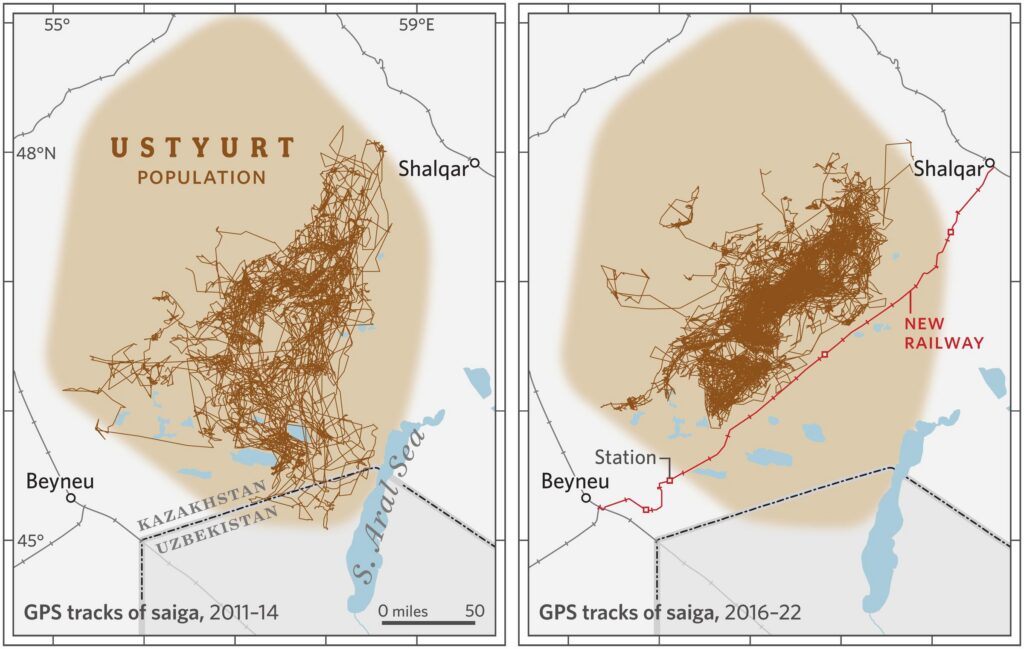
On his screen, Albert clicked open a recent map that showed how a population of GPS-collared saigas once routinely traveled deep into Uzbekistan before being unceremoniously clipped off by a new rail line in 2014. The data from the years prior to the railway’s construction showed a flurry of squiggly lines representing individual animals zipping back and forth with the seasons. The post-construction slide showed those same animals spinning around despondently on the northern side of the tracks, while the fresh grasses and water they had come to rely on withered away to the south.
Such interruptions can lead to a complete collapse in spatial knowledge—a loss that science writer Ben Goldfarb once wrote is “as thorough as the erasure of a language.” Just as human nomads forced to stay in one place eventually lost connection to the physical landmarks of their ancestors’ journeys, young saigas learn where they can reliably find food and shelter, as well as places to stay away from, through active participation and observation. This cultural exchange keeps their world in orbit and is one of the reasons they have been successful at navigating a terrain fatal to so many before them. As the land they know is cleaved and partitioned, whole stretches of the Saiga Silk Road begin to fade from memory.
To unwind this damage, Albert’s team has partnered with the Kazakh government to construct dozens of saiga-friendly crossing points, where slightly sloping dirt ramps rise up to match the height of the train tracks, making it appear from a distance as though there’s a natural gap in the rail line. Cattle-guard fences positioned far away from the crossings ensure that trains and saigas never actually run into each other at these intersections, which would shatter the illusion of safety.
ACBK has also worked with the Uzbek government to reshape its border fences from a barbed-wire wall to an X-shaped barricade that blocks vehicles from driving through but leaves just enough space for saigas to pass. Over time, Albert hopes such efforts can rebuild the trust necessary for them to confidently return to a plateau they once relied on.
The next morning, I was astonished by how austere the steppe looked compared with the day before. Gone was the slippery muck and browning grasses of shifting seasons, replaced by a blanket of crunchy snow. Against this stark black-and-white backdrop, the fresh crystals functioned like fingerprint dust, illuminating the only remaining pops of color: the rust-red streaks of human and nonhuman pathways in the dirt.
Parked in an otherwise empty tract of prairie land, we watched in stunned silence as thousands of saigas seized the day, flying like banshees across the periphery, their hooves gouging the frozen crust and stamping pigment into an earthen canvas.
As I gazed east toward the colorless horizon, I tried to envision how it might have looked in the thirteenth century, when this corner of the world boasted a vast network of caravanserai, or road inns, where exhausted travelers could rest and recover before continuing onward into the great unknown.
I pondered what it must have felt like for an intrepid merchant to know that they would not see another human being for many days, maybe weeks. To be fearful of what you may soon encounter, but take solace that the space between is not wholly empty. For there is life beyond humanity’s margins, and among nonhuman communities, that in-between space is the center of everything. That, I imagined, must have offered some measure of assurance that the road ahead, perilous though it may be, is well traveled.
This essay was adapted from the new nonfiction travelogue The Hidden Nations of Animals and is published here exclusively for Adventure Journal, with permission from Penguin Random House.


