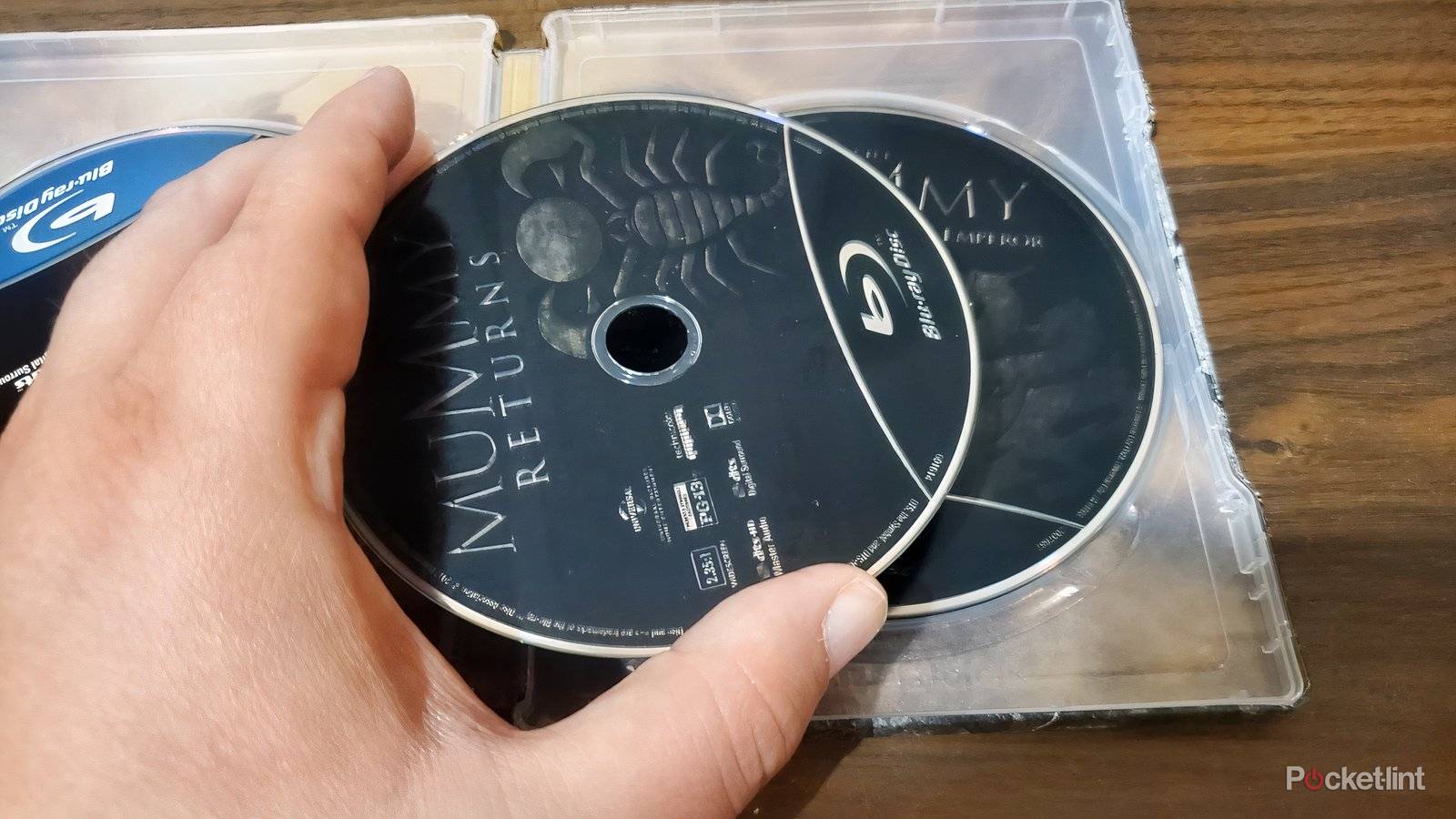
Being a collector of physical media certainly comes with its frustrations. After all, each disc that we add to our libraries is an investment that enables us to maintain control of the movies, shows, and games we own. Not to mention, we also pay hard-earned money for our media. With new-release Blu-ray prices where they’re at these days, owning physical media can now come at a premium cost. So, let’s see just how valuable your physical media library is to you with a thought experiment. Have you ever ordered a movie or game online only to receive the item in the mail with the disc loose inside the case rattling around? There’s a certain bit of “irk” I know that I feel, and I can imagine other collectors feel, sensing that a disc made a postal journey unsecured within its own case.
If that scenario caused you any discomfort in either imagining or recollecting instances in which that has occurred in your life, then protecting your Blu-rays is likely very important to you. As acquiring Blu-rays becomes increasingly a collector’s sport, we have to do what we can to preserve our physical media and ensure that the discs last a long time. And with special editions and collections becoming a hot ticket item with physical releases, sometimes you have to protect your discs again the very packaging they arrived in.
 Quiz
Quiz
Physical media storage and preservation
Trivia challenge
Vinyl, Blu-ray, or magnetic tape — find out how much you really know about
keeping your physical media safe.
VinylOptical DiscsPreservationStorageFilm
What is the recommended temperature range for storing vinyl records to prevent
warping?
Correct! Vinyl records store best between 15–25°C (59–77°F).
Temperatures above this range cause the PVC material to soften and warp, permanently ruining playback
quality and potentially damaging your stylus.
Not quite. The sweet spot for vinyl is 15–25°C (59–77°F). Extremes in
either direction are dangerous — too cold makes vinyl brittle and prone to cracking, while too warm
softens the PVC and leads to irreversible warping.
Which storage orientation is recommended for DVDs and Blu-rays to prevent disc rot
and warping over time?
Correct! Optical discs should always be stored vertically upright, just
like books. Storing them flat — especially stacked — places uneven pressure on the disc substrate, which
can cause warping and accelerate the delamination process known as disc rot.
Not quite. The correct answer is vertically upright, like books on a
shelf. Horizontal stacking puts pressure on the disc layers and can warp them over time, while loose
storage risks surface scratches that scatter the laser beam during playback.
What is ‘disc rot’, the phenomenon that can render optical media like CDs and DVDs
unreadable?
Correct! Disc rot refers to the oxidation or chemical degradation of the
aluminium, silver, or gold reflective layer sandwiched inside the disc. As this layer breaks down, it
becomes translucent in spots, scattering the laser and making data unreadable — sometimes visible as
pinholes when held up to light.
Not quite. Disc rot is specifically the oxidation or chemical breakdown
of the reflective metallic layer inside the disc, not a surface issue. Poor manufacturing, humidity, and
contaminants penetrating the lacquer seal accelerate the process, which is why high-quality ‘archival
grade’ discs use gold layers for longevity.
Which type of inner sleeve is widely recommended by audiophiles for protecting vinyl
records from static and scratches?
Correct! High-density polyethylene (HDPE) or rice paper anti-static
inner sleeves are the audiophile gold standard. They reduce static charge build-up, release records
cleanly without dragging particles across the grooves, and don’t off-gas chemicals the way older PVC
sleeves can.
Not quite. The best choice is HDPE or rice paper anti-static inner
sleeves. Standard paper sleeves shed fibres into the grooves, while PVC sleeves are notorious for
generating static electricity and can actually leach plasticisers onto the record surface over decades,
causing permanent damage.
At what relative humidity level is photographic film and celluloid generally
recommended to be stored for long-term archival preservation?
Correct! Archival institutions like the Library of Congress recommend
storing photographic film at 20–30% relative humidity. Higher humidity accelerates hydrolysis of the
film base, promotes mould growth, and causes colour dyes to shift — the same chemical process that
destroyed countless early Hollywood films.
Not quite. The recommended range is 20–30% relative humidity. While very
high humidity causes mould, dye fading, and chemical decay, excessively low humidity below 15% can make
the film base brittle and prone to cracking during handling, so maintaining a stable low level is the
goal.
What common household mistake is most likely to cause physical damage to a
collection of stored magnetic tape cassettes?
Correct! Strong magnetic fields — produced by speakers, motors, and even
some power bricks — can partially erase or corrupt the magnetic particles on tape. This is why
archivists store magnetic media well away from large speaker enclosures and electronics, and use
shielded storage cabinets for irreplaceable recordings.
Not quite. The culprit is proximity to strong magnetic fields. Speakers
contain powerful permanent magnets, and even modest field strength can partially randomise the iron
oxide particles that carry the audio or video signal. Storing tapes in their cases and playing them
periodically are actually considered good practice, not harmful.
Which type of recordable CD or DVD is generally considered more archivally stable
than standard pressed discs for long-term home storage?
Correct! M-DISC media uses an inorganic rock-like recording layer rather
than organic dye, making it immune to the chemical breakdown that causes disc rot on standard burned
media. Testing by the US Department of Defence found M-DISCs retained data under conditions that
destroyed conventional recordable discs.
Not quite. M-DISC is the standout archival choice. Rewritable formats
like CD-RW and DVD-RW are actually the least stable, as their phase-change recording layer is more
sensitive to heat and light. Standard pressed discs are reasonably stable but still vulnerable to disc
rot, whereas M-DISC’s inorganic layer does not decay the same way.
Why do archivists and collectors recommend storing physical media away from direct
sunlight, even inside a case or sleeve?
Correct! Ultraviolet radiation breaks down the polymer chains in
plastics, fades organic dye layers used in recordable discs, yellows paper inserts, and weakens adhesive
lacquer coatings. Even indirect light through a window adds UV exposure over years, which is why
archival storage typically uses opaque, UV-blocking containers.
Not quite. The real danger is UV radiation, which degrades plastics,
organic recording dyes, and adhesive seals over time. This is why museum-grade storage uses UV-filtering
cases and archival boxes — even indirect daylight through a window contributes meaningful UV dosage over
years that cumulatively damages your collection.
Your Score
/ 8
Thanks for playing!
Stacked Blu-ray cases might be convenient, but they’re terrible for collectors
Any opportunity for friction is a bad scenario for discs

Since the early days of Compact Discs, the architecture of their packaging has been designed to minimize friction and keep the disc from any surface wear on either side while sitting within its package. The retention hub in the middle keeps the discs slightly lifted off the back of the case with enough room when collapsed or closed to keep minimal space or pressure between the top of the disc and the other half of the case. It’s been a full-proof design structure that has long been employed in most disc media, including the Blu-rays we buy today.
But what happens when a distributor gets lazy with a collection or multi-disc special edition and simply decides to stack multiple discs on top of each other on one central retention hub? Enter the stacked disc Blu-ray case. It’s a convenient packaging method for disc makers, but not so convenient for collectors. For starters, you have to remove all the discs if you wish to reach the disc at the bottom. This already increases the chance of wear over time. But more importantly, the discs are largely sitting on top of each other with opportunities for friction, and opportunities for friction are bad news for the long-term health of your media investment. Let me be clear, stacking discs doesn’t guarantee that they’ll be ruined. However, it does introduce additional opportunities for them to be damaged by scratching and wear over time, especially with each use and removal from the case. Blu-rays might be tougher than traditional CDs, but they’re not scratch proof.
How to handle stacked discs
There are a few practical steps you can take

Keep in mind, that there isn’t any inherent danger to your discs sitting in a package on a shelf stacked in the case and mostly untouched. If you’re more of a physical media collector who primarily uses digital options in order to keep your physical collection pristine, then there is probably nothing to worry about here. But if you’re like me, one who often enjoys the features that come with Blu-ray use, then it behooves you to look at your options when it comes to collections or multi-disc special editions that come in stacked cases. It’s the repeated removal and replacement that is cause for concern.
One might say that the practical solution here is to obtain an individual case for each disc. But that actually doesn’t sound very practical to me. Multiple cases take up real estate on your shelf, and they don’t look all that appealing without movie labels or covers. However, it is an option that you can employ for a low cost. You can buy packages of Blu-ray cases on Amazon for around $10-17. Some options include a package of 6 single-disc cases. There are also cases with multiple disc options. Whatever the case may be (pun not intended), if you’re keen on separating your Blu-rays into individual discs, you’ll find something that suits your needs on Amazon.
However, if you don’t wish to add additional Blu-ray cases to your lineup, there is a more practical option. The real threat is dust or grit that lands between discs when stacked. They can then cause circumferential abrasions if debris is impactful enough. These are the worst kind of scratches, according to instructions from the National Archives. In fact, that is why it’s recommended that you don’t clean discs using a circular wiping motion. The rare chance that scratch-potential debris is on the fabric you’re using could cause more significant damage, than a scratch simply emanating from the center outward. Each time you use the discs, wipe the surfaces that will be touching each other with a microfiber cloth when replacing the discs in the case. This will help ensure that harmful debris is removed when storing the discs for future use. It’s a simple task, but one that can prove to be beneficial. A little bit of care can go a long way to keeping your discs healthy long-term.


