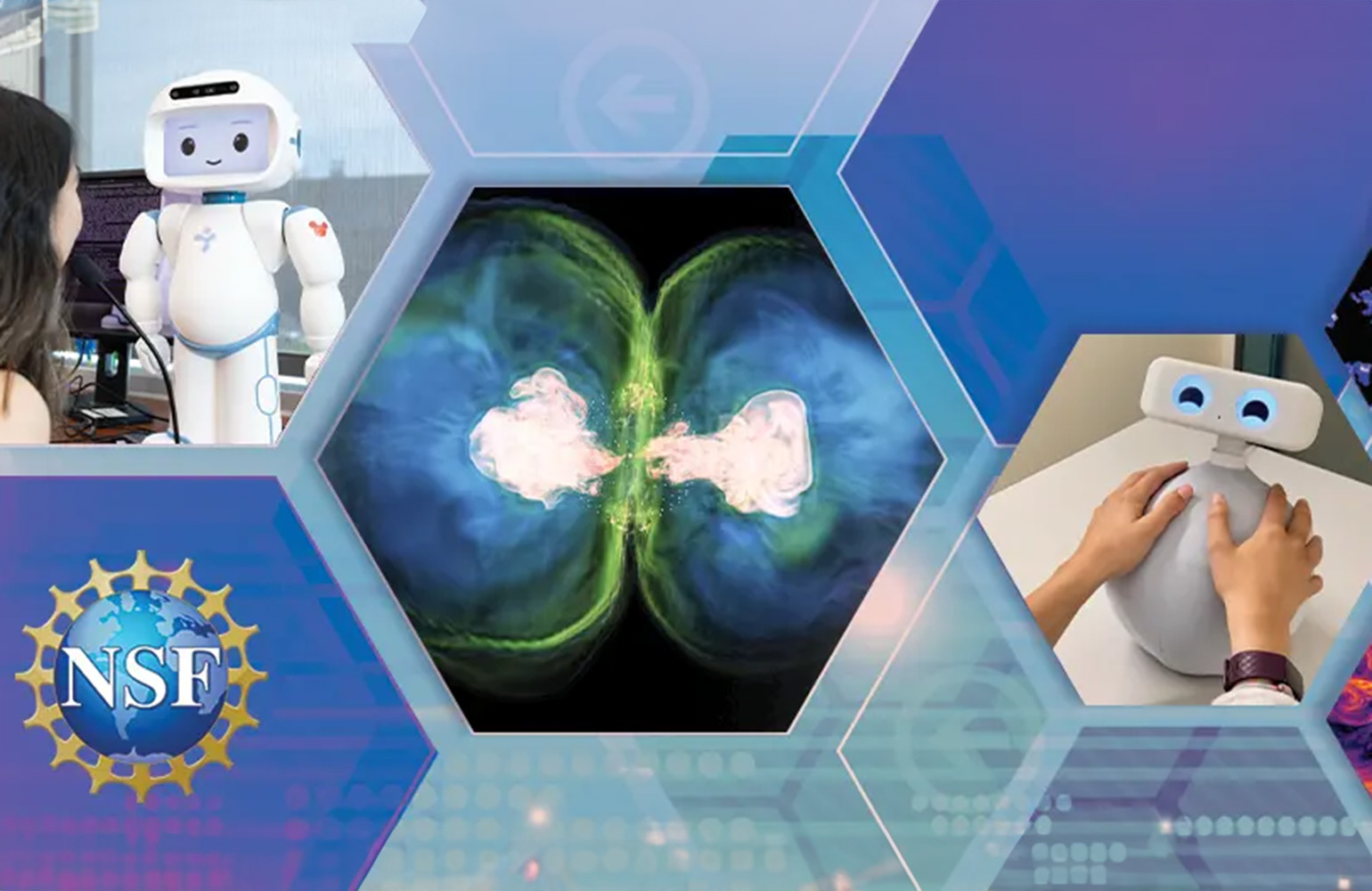
Science and Technology Centers focus on building sustained partnerships across universities, industry, and government and accelerating the use of new ideas and technologies for scientific discovery. | Sources: NSF, left to right: Indiana University, Bloomington; Michigan State University College of Engineering; Brian Scassellati and Kayla Matheus, Yale University
The U.S. National Science Foundation yesterday said it is investing $90 million over five years to support three new Science and Technology Centers, or NSF STCs. The NSF will allocate $6 million annually for an initial five-year period to each of the three centers.
After the first five years, the centers will have the opportunity to compete for up to five additional years of support. The foundation said the centers will advance American leadership in science and technology, strengthen the nation’s STEM workforce, and accelerate innovation in a variety of fields, including AI and robotics.
“Maintaining the United States’ leadership in science and technology requires bold research, strong partnerships, and a skilled workforce,” stated Brian Stone, who is performing the duties of the NSF director. “As advances in foundational science and technology open new possibilities, these Science and Technology Centers will help American researchers seize those opportunities, accelerate scientific discovery, and develop the talent and technologies needed to turn innovation into solutions that benefit the American people.”
Austin center will focus on human-robot collaboration
One of the new centers will be the Center for Human and Robot Co-Adaptation, led by The University of Texas at Austin. This center will study how people and robots can securely and effectively adapt to one another as service and assistive robots become more common in homes, hospitals, workplaces, and public spaces.
Researchers at the center will combine robotics, AI, and human factors to develop new methods that help robots with embodied intelligence learn from people, understand their needs and preferences, and then adapt physically and cognitively to changing environments and different people. The center aims to advance secure, useful robotic technologies that can support independent living, healthcare, and other human-centered services.
The other two centers include the Center for Transformative Explorations in Multi-Physics and Engineering of Scientific Turbulence (TEMPEST), led by Michigan State University, and the Center for Genome Intelligence Engineering (GENIE), led by Northwestern University.
More about the NSF STC program
Since its inception in 1987, the NSF STC program has driven the emergence of new fields of discovery, catalyzed strong partnerships, advanced breakthrough technologies, sparked numerous start-up companies, and trained generations of researchers and innovators.
The program supports large-scale, transformational research that opens new areas of discovery and drives technological innovation. By combining expertise across organizations and partnering with industry and other groups, STCs tackle complex, high-risk challenges in foundational research and help move promising ideas toward real-world benefits.
The NSF added that the centers will strengthen the nation’s scientific and technical workforce by providing students and early-career researchers with hands-on experience in emerging fields. The class of 2026 STCs will focus on strengthening foundational research, advancing critical and emerging technologies, developing the workforce, and translating discoveries into technological advances and national benefits.
 Register now and save on your pass to RoboBusiness 2026
The post NSF to invest $90M into three new technology centers, including one focused on robotics appeared first on The Robot Report.


