Introduction
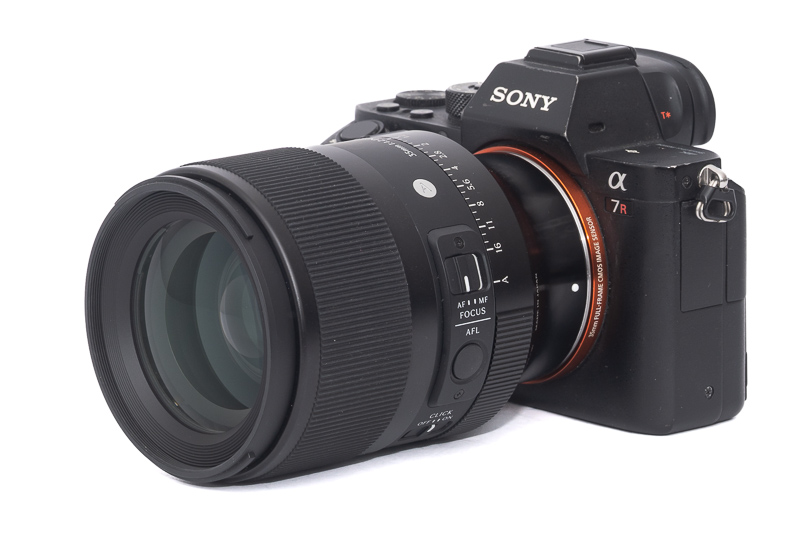
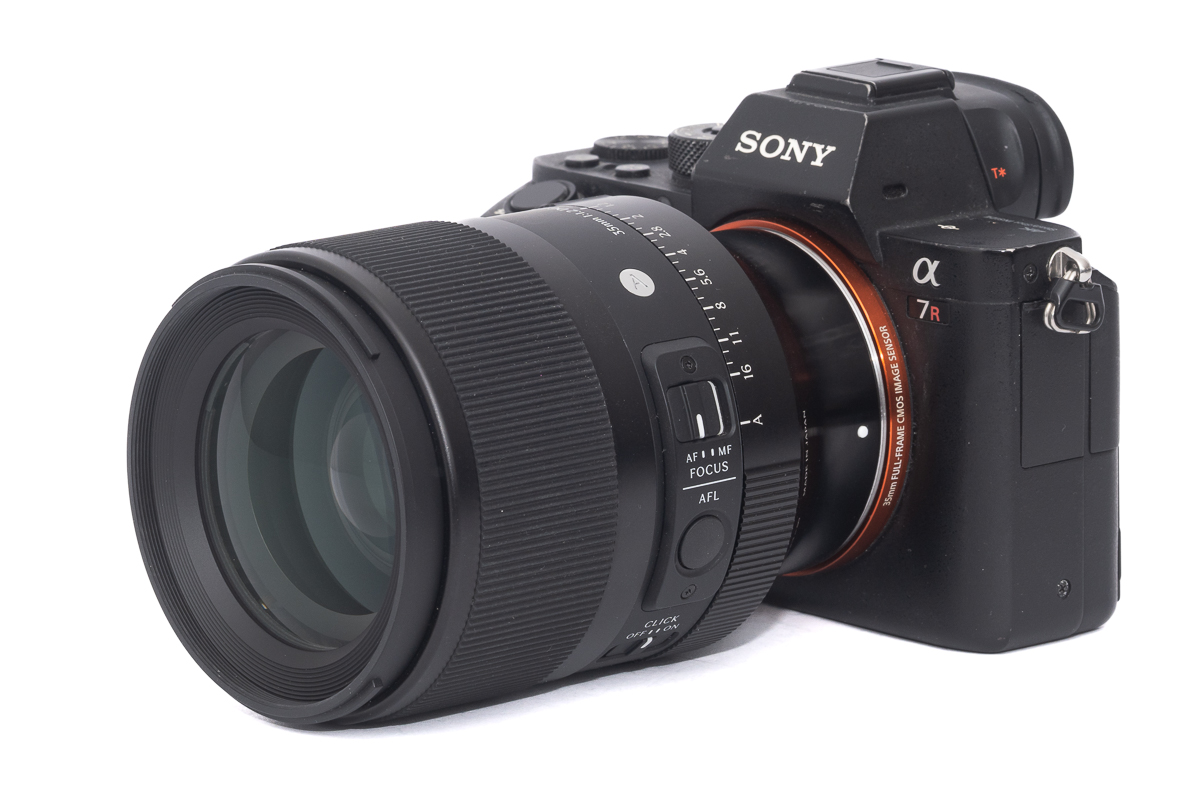
Released in 2019, the original Sigma 35mm 1.2 Art DG DN was the first 35mm 1.2 AF fullframe lens. It took until 2025 for another manufacturer to challenge Sigma by releasing a 35mm 1.2 lens with autofocus of their own. Actually, there were two at almost the same time: Nikon with their Nikon Z 35mm 1.2 S and Viltrox with the Viltrox AF 35mm 1.2 LAB. It seems Sigma saw some room for improvement, as in late 2025 they released an updated version, this Sigma 35mm 1.2 DG Art II. On paper it is surprisingly lightweight and small compared to its predecessor, but what about the optical qualities? Let’s find out in this review!
Sample Images


Most of the sample images in this review can be found in full resolution here.
Specifications / Version History
In 2019 Sigma was the first to release a 35mm 1.2 lens for fullframe with autofocus. In late 2025 Sigma released an updated version which is significantly lighter and a fair bit smaller.
- Sigma 35mm 1.2 DG DN Art
1082g, 137x88mm, 17/12 design, 82mm filter, MFD 0.3 m, 1:5.1, released 2019 - Sigma 35mm 1.2 DG Art II
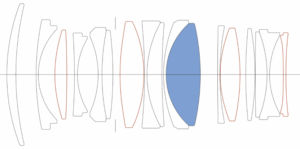
745g, 114x81mm, 17/13 design, 72mm filter, MFD 0.28 m, 1:4.6, released 2025
This is a review of the Mark II model for E-mount. Its full specifications are:
-
- Diameter: 81 mm
- Field of view: 63.4° (diagonally)
- Length: 114 mm
- Weight: 745g (without hood[52g] and caps)
- Filter Diameter: 72 mm
- Number of Aperture Blades: 11 (rounded)
- Elements/Groups: 17/13

- Close Focusing Distance: 0.28 m
- Maximum Magnification: 1:4.6 (measured)
- Released: September 2025
- Mount: E-mount, L-mount
buy from amazon.com | amazon.de | B&H | ebay.com | ebay.de (advertisement/affiliate links) for $1499
Disclosure
Our long time reader Mathias lend me this lens for a few weeks to write this review and to compare it to the Viltrox 35mm 1.2 LAB as well as the Nikon Z 35mm 1.2 S Nikkor. Thanks a lot!
Handling/Build quality
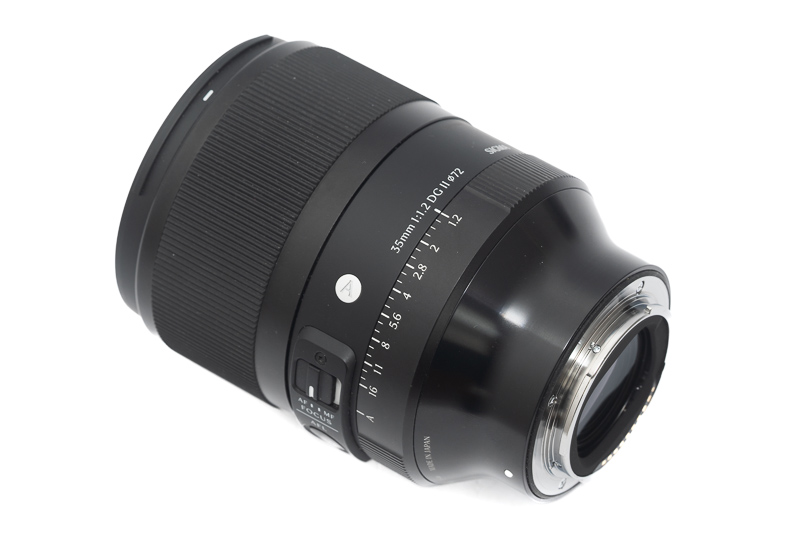
This updated Sigma lens handles just like its predecessor or Sony’s GM lenses which is a good thing.
The focus is by wire and it takes exactly 180° from the minimum focus distance to infinity. The coupling is also perfectly linear. In this regard it handles like Sony’s GM and most of their G lenses which I think is a very sensible design decision.
As is the case for many modern AF lenses the focus groups move freely when without power, so when shaking the lens you will notice the focus groups moving around. This is normal.
The aperture ring has 1/3rd-of-a-stop click-stops and an “A” setting which lets you set the aperture value in camera.
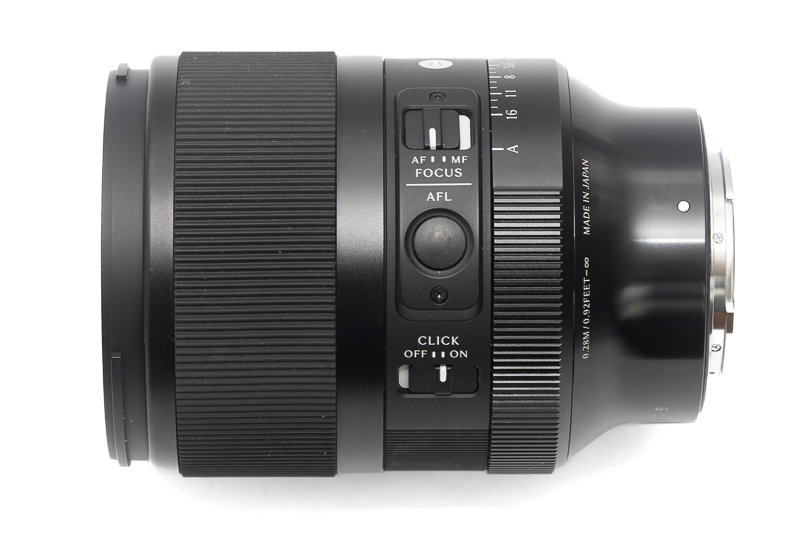
On the left side we have an AF/MF switch, a lens button and a de-click switch for the aperture ring.
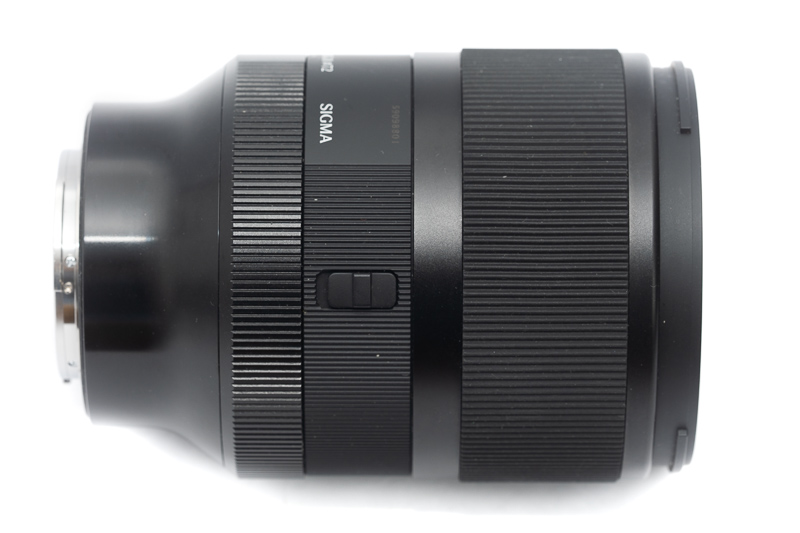
A new addition is the iris lock switch on the right side which lets you lock the aperture ring at the “A” setting.
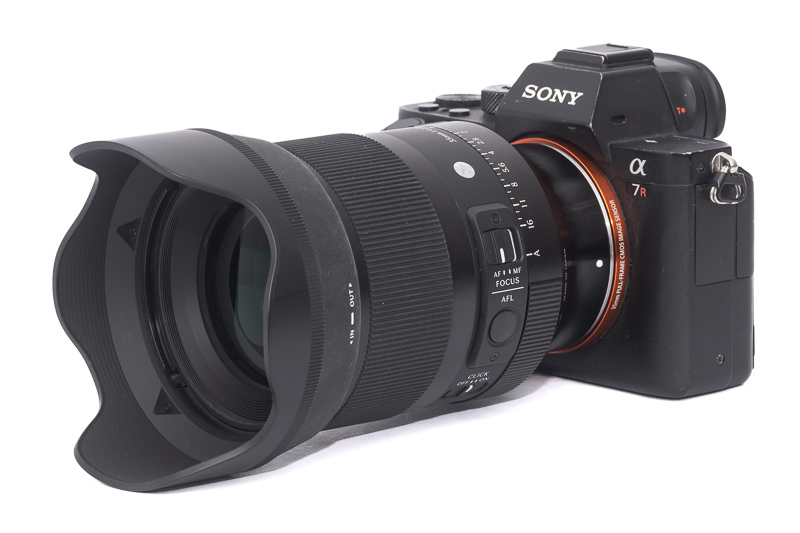
A sturdy bayonet style hood is part of the package. It can also be mounted reversed.

Many people were put off by the first generation Sigma 35mm 1.2’s size and weight. Sigma surely seems to have listened to those people, as they now gave us the smallest and lightest 35mm 1.2 fullframe lens with AF yet: 337g lighter than its predecessor, 172g lighter than the Viltrox AF 35mm 1.2 LAB and with a 72mm filter thread (Sigma MKI: 82mm, Viltrox: 77mm).

On the Nikon Zf I also tried it with the megadap ETZ21pro+ which worked really well.
AF performance
I am not shooting sports or fast moving animals/humans so if you want to know if the lens is fast enough for this, or how it compares to other lenses in this segment, you may have to look for a different review with a more detailed assessment of this aspect.
Generally the AF worked well and was snappy, similar to its predecessor Sigma 35mm 1.2 Art DG DN or the Viltrox AF 35mm 1.2 LAB. The AF is not completely silent, if you are close to the lens you can hear the focus groups moving.
Vignetting
light falloff
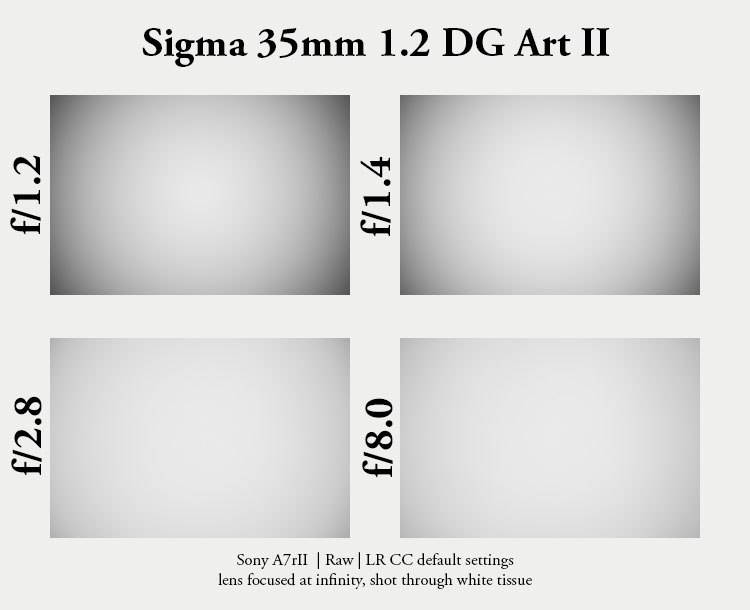
| f/1.2 | 3.0 EV |
| f/1.4 | 2.7 EV |
| f/2.0 | 2.0 EV |
| f/2.8 | 1.7 EV |
| f/4.0 – f/16 | 1.5 EV |
It should not come as a surprise: the smaller size takes its toll here as the vignetting figures are slightly higher – especially stopped down – compared to the first generation Sigma 35mm 1.2 DG DN Art and also the Viltrox AF 35mm 1.2 LAB as well as the Nikon Z 35mm 1.2 S. At wider apertures the differences are so small they are hardly relevant, stopped down they are around 0.5 EV which can be visible.
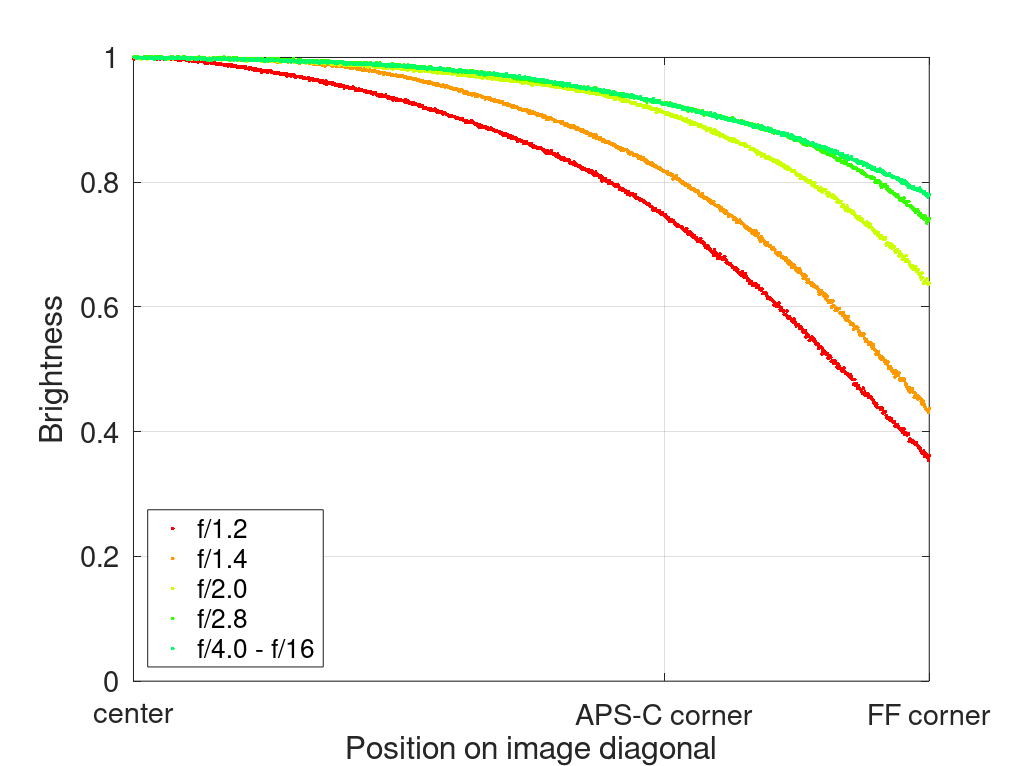
It is recommended to have a look at this article first to get an idea how this brightness graph works.
optical vignetting
Very fast lenses often show optical vignetting. Without going too much into technical details optical vignetting leads to the truncation of light circles towards the borders of the frame.
In the center of the frame almost every lens will render a perfect circle, but only lenses with very low optical vignetting will keep this shape in the corners.
So in the following comparison we move from the center (left) to the extreme corner (right) and see how the shape of the light circle changes.
optical vignetting
I did shoot the Sigma II, Viltrox and Nikon side-by-side and with a test target it was ensured the focus distance is exactly the same. The sizes of the circles between these three lenses are directly comparable.
Despite its huge size the first generation Sigma 35mm 1.2 Art DG DN shows high optical vignetting and sadly – but not unexpectedly -this newer lens shows even slightly higher optical vignetting. There is more: this newer Sigma lens apparently has undercorrected spherical aberration, as the light circle in the center shows a soft instead of a well defined edge. Off center we also see lemon shaped highlights with a bit of light spill, similar to the Laowa 35mm 0.95.
Here the Viltrox AF 35mm 1.2 LAB as well as the Nikon Z 35mm 1.2 S show noticeably less optical vignetting.
All these lenses feature aspherical elements, the quality of the polishing is comparable.
Sharpness
MTF Graphs
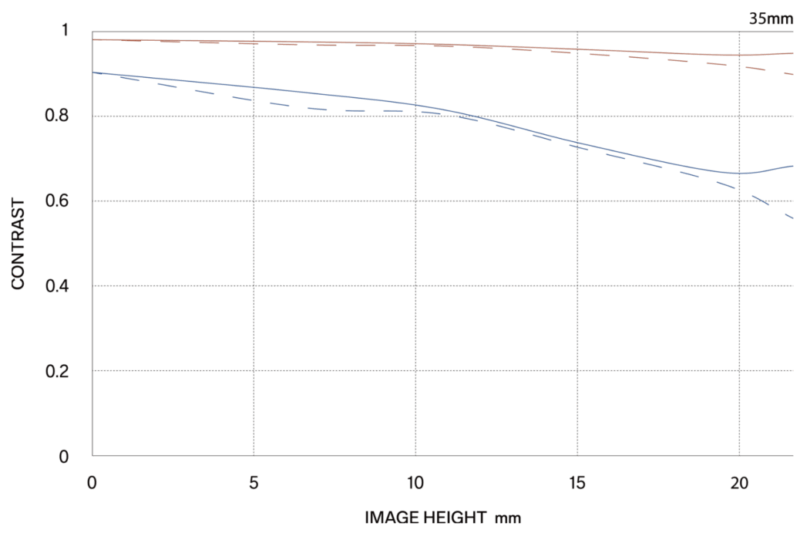
According to Sigma’s MTF graphs this lens should show a great performance across most of the frame with hardly any Astigmatism. Towards the corners we see a decrease in resolution and in the extreme corners a bit of Astigmatism.
Focus shift
Sony A7rII | Sigma 35mm 1.2 DG Art II | 33% crops
These modern mirrorless AF lenses focus at working aperture anyhow, so focus shift wouldn’t actually be much of a problem. I still checked and I do not see any focus shift here.
infinity (42mp Sony A7III, 24mp Nikon Zf)
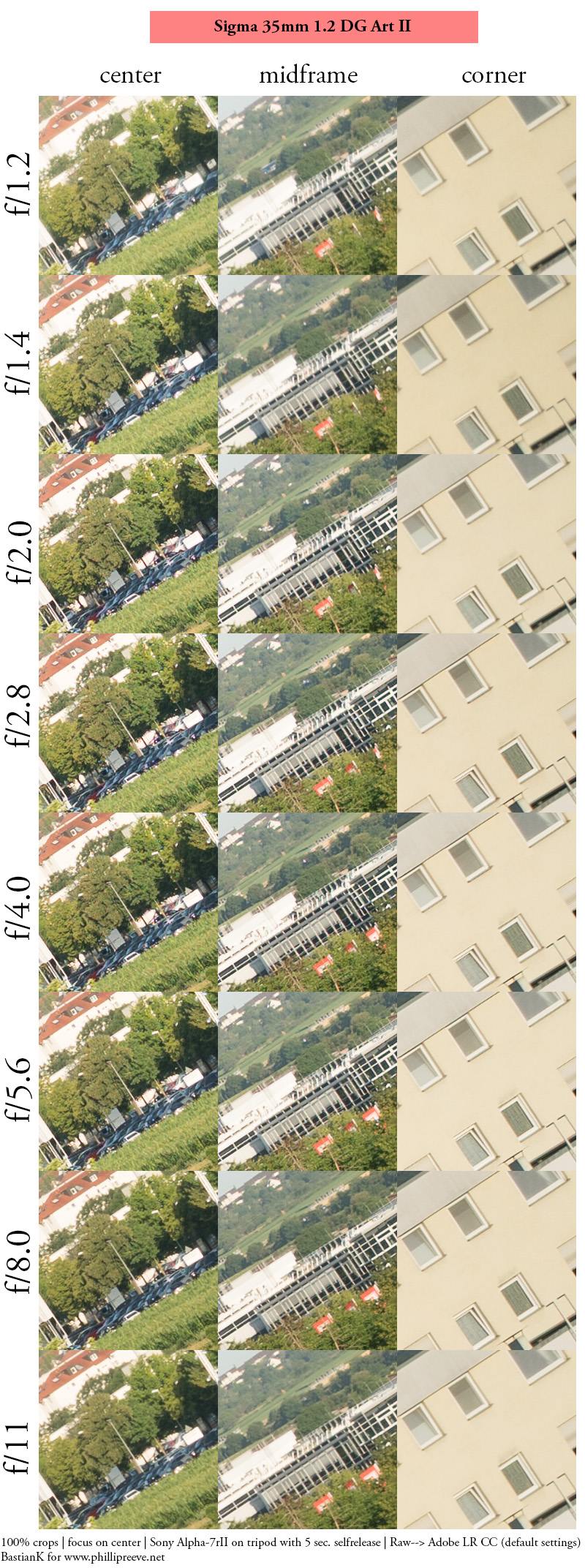
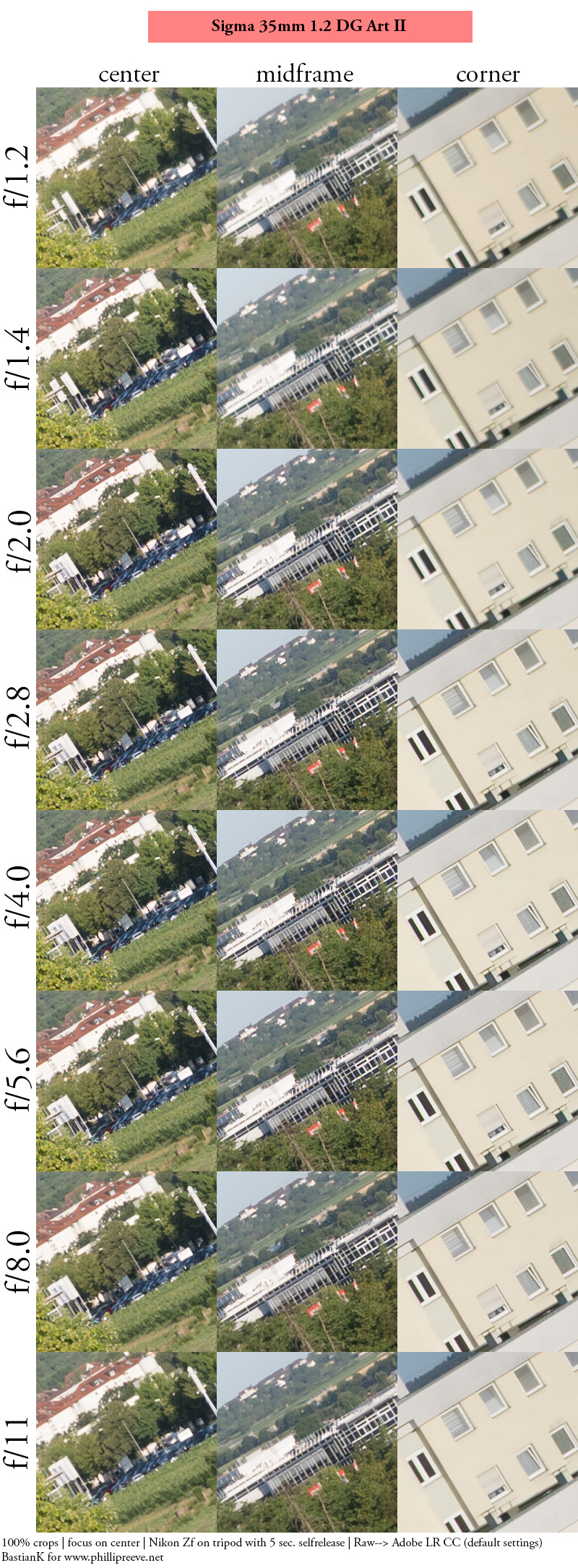
This Sigma 35mm 1.2 DG Art II shows a very good performance here, but due to the slightly undercorrected spherical aberration its predecessor Sigma 35mm 1.2 Art DG DN as well as the Viltrox 35mm 1.2 LAB show an even more impressive performance in this category without that slight softness at f/1.2. Stopped down to f/1.4 these lenses all perform practically the same.
I included crops taken on the Nikon Zf and here this lens performs just as well – despite the camera’s different filter stack.
portrait distance 1.0 m (42mp Sony A7rII)
I refocused for every shot and aperture to get the best possible result at different locations in the frame (center, inner midframe and outer midframe).
The circle of the dollar bill is more or less the size of a human eye.
f/1.2 <—> f/2.0
Sony A7rII | Sigma 35mm 1.2 DG Art II | 100% crops
This Sigma 35mm 1.2 DG Art II shows a very good performance here. The first generation Sigma 35mm 1.2 Art DG DN actually showed more moiré at its maximum aperture in my tests, the Viltrox AF 35mm 1.2 LAB showed a similar performance.
close 0.28 m, 1:4.6 (42mp Sony A7rII)
Sony A7rII | Sigma 35mm 1.2 DG Art II | 100% crops from center
Also here the Sigma 35mm 1.2 DG Art II is slightly softer due to spherical aberration at f/1.2 which is already gone by f/1.4. The field is also very flat at close distances.
The Viltrox AF 35mm 1.2 LAB and the Sigma 35mm 1.2 DG DN Art both perform similar at close distances, the Nikon Z 35mm 1.2 S is softer at f/1.2 to f/1.4.
Flare resistance
The Sigma 35mm 1.2 Art DG DN had some issues in this category and it is one of the few lenses where I always used the hood to at least get rid of some of the artefacts. Did Sigma manage to make some improvements for their second generation lens?
Sony A7rII | Sigma 35mm 1.2 DG Art II | f/1.2
This is a positive surprise: no artefacts whatsoever.
Sony A7rII | Sigma 35mm 1.2 DG Art II | f/11
Also stopped down – where lenses are often more prone to showing ghosts – I did not manage to create any artefacts in these staged scenarios.
This is a very good performance and a clear improvement over its predecessor. That being said, the Viltrox 35mm 1.2 LAB as well as the Nikon Z 35mm 1.2 S performed least as well in my tests.
Coma
Sony A7rII | Sigma 35mm 1.2 DG Art II | 100% crops from extreme corner
The small light sources look perfectly round from f/1.2, without any artefacts. Around the street lamps we see more irregular shapes though.
The Viltrox 35mm 1.2 LAB performed slightly better in my direct comparisons, its predecessor Sigma 35mm 1.2 DG DN Art and the expensive Nikon Z 35mm 1.2 S showed a similar performance.
Distortion

While the first generation Sigma 35mm 1.2 Art DG DN features rather strong (but uniform) barrel distortion, this Sigma 35mm 1.2 DG Art II shows almost no distortion.
Because I found this result rather surprising, I double checked this with the lens slightly detached from camera to bypass any potential digital corrections, but that did not change the result.
Bokeh

The first generation Sigma 35mm 1.2 Art DG DN did very well in this category, the only thing I didn’t like was the strong optical vignetting. Reducing the weight by about 30% and decreasing the size significantly surely didn’t help with that, as we have also reason in the corresponding section. We will still check if there have been additional changes.
Close Distance


I found the optical vignetting (cat’s eyes) to be strongest near the minimum focus distance. The depth of field is also really thin here, so you may want to stop down a bit anyhow. Thanks to the effective floating elements design contrast and resolution are very good at close distances, adding to the impression of depth in the pictures.
Mid Distance



All of the 35mm 1.2 AF lenses create an appealing bokeh at these distances. The Sigma’s bokeh looks best in the central part of the frame where a bit of residual spherical aberration behind the focal planes leads to an especially soft rendering. Towards the corners the bokeh looks less nice in some scenarios due to the strong optical vignetting.
Long Distance


Long distances are where things get interesting. Similar to the predecessor Sigma 35mm 1.2 Art DG DN and the Viltrox 35mm 1.2 LAB also this has a flat field and manages to create a generally nice background blur – despite the strong optical vignetting. Whenever there is foliage in the background the undercorrected spherical aberration also helps.
How does this Sigma lens compare to the Viltrox AF 35mm 1.2 LAB and the Nikon Z 35mm 1.2 S released in the same year in detail? To find that out have a look at my comparison of these three lenses here.
Sunstars
Sony A7rII | Sigma 35mm 1.2 DG Art II | 100% crops
Similar to its predecessor and many of Sony’s GM primes and the Viltrox 35mm 1.2 LAB also this Sigma 35mm 1.2 DG Art II makes use of a diaphragm made of 11 rounded aperture blades. With this configuration not in many situations you will see distinct sunstars, from f/5.6 to f/16 they look clean with an even length of the rays though.
If you want to know more about sunstar rendering of different lenses, have a look at this article.
The halos at f/1.2 are a clear sign of the undercorrected spherical aberration.
Chromatic aberration
lateral
The Sigma 35mm 1.2 DG Art II features a built-in lens correction profile for lateral CA that will be recognized and automatically applied in most raw converters.
I usually check the actual amount of lateral CA with the lens slightly detached from camera. Here that isn’t possible, as the Sigma immediately looses its focus position when without power.
longitudinal
Sony A7rII | Sigma 35mm 1.2 DG Art II | 100% crops
The first Sigma 35mm 1.2 DG DN Art showed a medium amount of bokeh fringing. This Sigma 35mm 1.2 DG Art II shows a clear improvement over its predecessor, as hardly any bokeh fringing is visible.
When comparing the f/1.2 and f/1.4 background crops we can also see the undercorrected spherical aberration at f/1.2, giving the background that soft look.
Sony A7rII | Sigma 35mm 1.2 DG Art II | 100% crops
Purple fringing is corrected almost perfectly and again we can see the softer look at f/1.2.
Conclusion
good
|
average | not good
|
When Sigma announced this successor to their Sigma 35mm 1.2 Art DG DN I surely met it with some skepticism due to it being significantly smaller and lighter.
Unsurprisingly this neither helped with the light falloff nor the optical vignetting, but in many other categories this new lens actually improved on its predecessor: CA are lower, Flare resistance has been improved, the maximum magnification has been improved and the distortion is lower and all that while the price stayed the same.
The slightly undercorrected spherical aberration is a bit of a mixed bag. I definitely embrace it for creating a more appealing bokeh (the Sony FE 85mm 1.4 GM and the Voigtländer 50mm 1.2 E are similar in this regard) but point light sources at night take on noticeable halos (see sunstar section) at f/1.2 which isn’t the case for the first generation Sigma 35mm 1.2 Art DG DN or the Viltrox AF 35mm 1.2 LAB. If you are looking for a 35mm 1.2 lens to take blue hour cityscape pictures without a tripod at f/1.2 this second generation Sigma might not be the best choice among the 35mm 1.2 lenses for you.
Nevertheless, if you have a look at my comparison between this Sigma 35mm 1.2 DG Art II, the Viltrox AF 35mm 1.2 LAB and the Nikon Z 35mm 1.2 S Nikkor, you will see there are actually only minor differences between these lenses and this Sigma being the smallest and lightest is an impressive engineering achievement. Highly recommended.
buy from amazon.com | amazon.de | B&H | ebay.com | ebay.de (advertisement/affiliate links) for $1499
Alternatives
I will only talk about the most notable 35mm lenses which are faster than f/1.4 here. You can find many more 35mm discused in our 35mm guide.
Viltrox AF 35mm 1.2 LAB:
I already talked about the Viltrox AF 35mm 1.2 LAB in most of the sections above as I think it is the main competitor. The Sigma 35mm 1.2 DG Art II, the Viltrox AF 35mm 1.2 LAB N and the Nikon Z 35mm 1.2 S Nikkor have also all been part of my second fast 35mm comparison which should answer all your questions how these three lenses compare.
buy from manufacturer’s shop (use the code “BK3512LAB5” for 5% discount) | Pergear | amazon.com | amazon.de | B&H | ebay.com | ebay.de (advertisement/affiliate links) for $999
Sigma 35mm 1.2 Art DG DN:
The first generation Sigma 35mm 1.2 can be found at attractive prices on the used market these days. If the size and weight doesn’t bother you, it offers similar performance – minus its worse flare resistance. If you want to shoot blue hour scenes without a tripod I would actually prefer the first generation lens as it doesn’t have that undercorrected spherical aberration having a big influence on how point light sources are rendered at f/1.2.
buy from amazon.com | B&H | ebay.com | ebay.de (advertisement/affiliate links) for about $1499 (new) or starting at $750 (used)
Nikon Z 35mm 1.2 S Nikkor:
The Sigma 35mm 1.2 DG Art II, the Viltrox AF 35mm 1.2 LAB N and the Nikon Z 35mm 1.2 S Nikkor are part of my second fast 35mm comparison which should answer all your questions how these three lenses compare.
buy from amazon.com | amazon.de | B&H | ebay.com | ebay.de (advertisement/affiliate links) for $2897
Laowa 35mm 0.95 Argus:
If you don’t need autofocus the Laowa 35mm 0.95 Argus creates a look you cannot achieve with any other 35mm lens due to its even faster maximum aperture.
buy from the manufacturer’s homepage | ebay.com | B&H (advertisement/affiliate links) for $649
Voigtlander 35mm 1.2 SE:
The Voigtlander 35mm 1.2 SE is noticeably smaller and lighter but also features a simpler optical design than all the aforementioned lenses iand it is also a manual focus lens and on top of that it has already been discontinued.
buy from amazon.com | amazon.de | B&H | ebay.com for $699 (advertisement/affiliate links)
Sample Images


Most of the sample images in this review can be found in full resolution here.
Further Reading
Support Us
Did you find this article useful or just liked reading it? Treat us to a coffee!
 via Paypal
This site contains advertisement/affiliate links. If you make a purchase using any of the links marked as advertisement/affiliate links, I may receive a small commission at no additional cost to you. This helps support the creation of future content.
My name is Bastian and I am your expert here when it comes to ultra wide angle lenses, super fast portrait lenses (ranging from a 50mm f/0.95 to a 200mm f/1.8) and I also have reviewed way too many 35mm lenses.
Don’t ask me anything about macro or wildlife shooting though.


