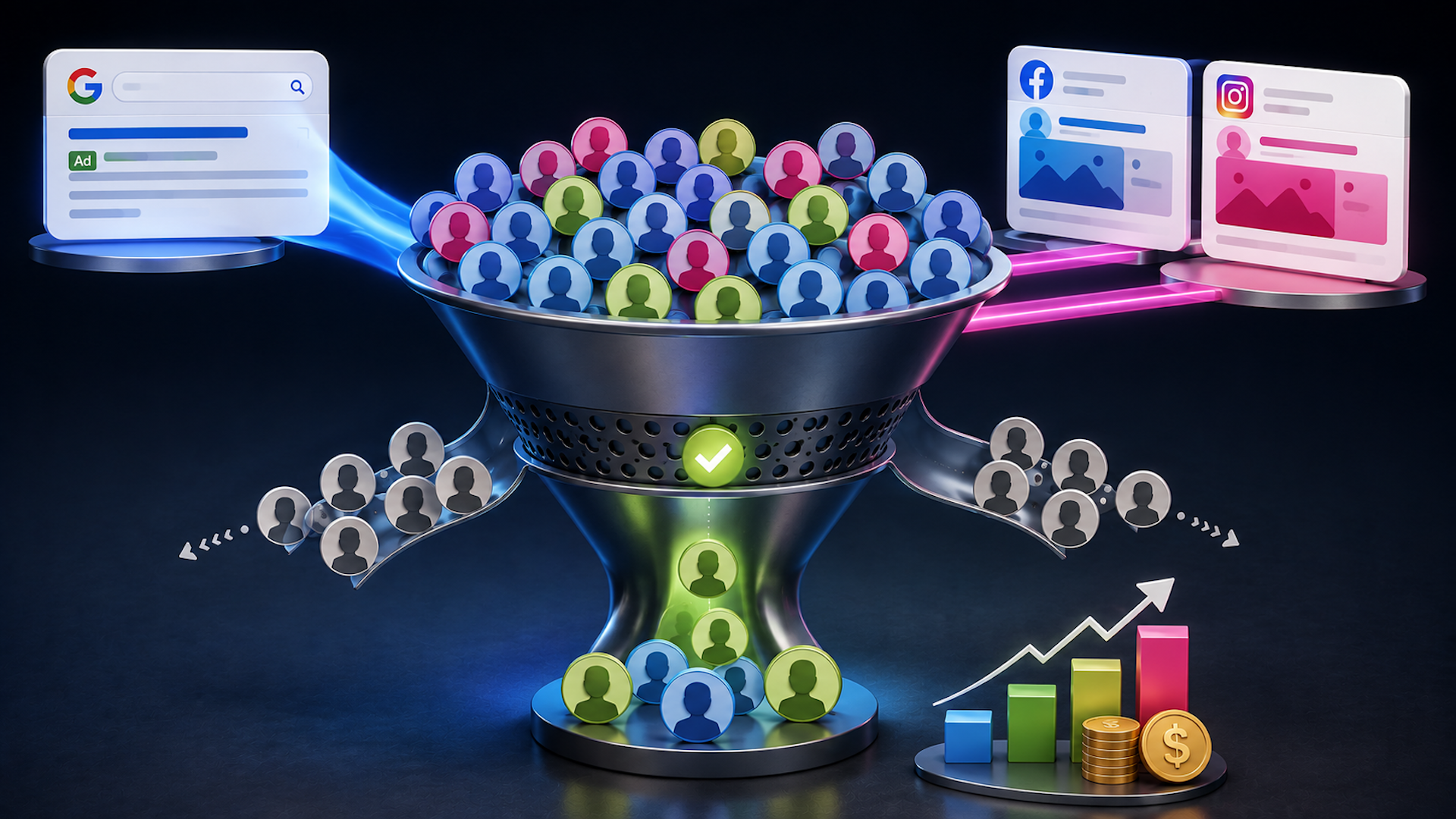
There’s a familiar conversation in almost every marketing organization: “We need more leads.” Then, a few weeks later: “The leads we’re getting aren’t good enough.”
So the marketing team tightens targeting, changes creative, adds qualification requirements, and raises the bar for conversion. Lead volume drops, and the cycle begins again.
The problem is the assumption that lead quantity and lead quality are competing strategies. They’re different growth objectives that require different inputs, signals, and channel levers.
The question you should be asking is: “What does the business need right now, and have we given our advertising platforms the signals necessary to achieve it?”
Start with the business objective, not the media metric
The first mistake is jumping directly into channel metrics. If the business says it needs 30% more leads, the media team shouldn’t automatically start optimizing toward cost per lead.
If the business says it needs more revenue from marketing, lowering CPL might actually make the problem worse. A $30 lead that never becomes a customer isn’t necessarily better than a $100 lead that consistently closes.
Think about the funnel as a progression: Impression → Click → Lead → Qualified lead → Opportunity → Customer. Your optimization strategy should reflect where the business is trying to create growth.
When volume is the priority
A volume objective makes sense when:
- You have insufficient leads to support sales capacity.
- A new campaign or market needs to build demand.
- Your sales team can handle substantially more opportunities.
- You’re intentionally expanding your addressable audience.
- You need more data before you can confidently identify quality signals.
In this scenario, you want to remove unnecessary constraints that prevent the platform from finding more potential customers.
When quality is the priority
A quality objective makes more sense when:
- Sales is overwhelmed with poor-fit leads.
- Lead-to-opportunity rates are weak.
- Close rates are declining.
- Customer acquisition costs are rising despite healthy lead volume.
- Sales capacity is limited.
- You have enough CRM data to identify what a valuable lead looks like.
You want to find more people who resemble those who ultimately become customers.
Dig deeper: 5 ways to improve PPC lead quality
Uncover the keywords, ads, landing pages, and strategies driving your competitors’ paid search success—and find your next opportunity to outperform them.
If you need more leads, remove friction and expand the funnel
When volume is the priority, look for opportunities to increase eligible audience size and reduce barriers to conversion.
That might mean:
- Expanding keyword coverage.
- Broadening match types.
- Testing additional geographic markets.
- Expanding paid social audiences.
- Using automated audience expansion.
- Introducing additional inventory, such as Display, Demand Gen, YouTube, or other video placements.
- Testing shorter forms.
- Reducing unnecessary qualifying questions.
- Creating additional landing pages or offers.
- Increasing creative variety.
Google Search
For volume, look beyond the handful of exact queries that already perform well.
Expand keyword coverage and give Google’s automation more room to find incremental demand. Broad match and automated bidding can help when conversion tracking and negative keyword management are strong enough to protect against obvious waste.
You can also expand beyond Search into Google’s broader inventory when incremental volume is the goal. But there’s an important caveat: More inventory means more responsibility for your conversion signals.
If Google is rewarded for every form submission, it has little reason to distinguish between a future customer and someone who submitted a form simply because it was easy.
Paid social
Paid social can also be useful when reach and lead volume are the priority. The volume-oriented playbook generally means giving the algorithm more room to work:
- Broader audiences.
- Automated placements.
- More creative variations.
- Fewer targeting restrictions.
- Lower-friction lead forms.
- More conversion opportunities.
The objective is to maximize the number of people who can potentially enter the funnel without unnecessarily restricting the algorithm.
That doesn’t mean “target everyone.” It means being intentional about which constraints are actually helping performance and which are simply limiting scale.
Dig deeper: How to measure paid social’s impact on paid search performance
If quality is the priority, teach the platforms what ‘good’”’ means
This is where many lead-generation programs break down.
The advertising platform sees 1,000 form submissions. Your CRM sees 1,000 leads → 300 qualified → 75 opportunities → 20 customers.
If the platform only receives the first data point, it doesn’t know what happened to the other 999 people.
You’re asking an increasingly sophisticated machine-learning system to optimize with an incomplete definition of success. The solution is to close the feedback loop.
Google’s current lead generation framework supports qualified-lead and converted-lead conversion goals, allowing advertisers to feed deeper-funnel outcomes back into Google Ads. Google says these goals can provide more information for optimization and help advertisers balance lead volume and quality.
Meta’s Conversions API similarly connects CRM and other first-party data to its optimization systems. Meta says advertisers can use down-funnel lead data to help optimize for people more likely to become customers rather than simply maximizing lead submissions.
In other words, the conversion doesn’t necessarily have to be the form fill.
It can be what happens after the form fill.
Dig deeper: How to improve Google Ads lead quality with CRM data
Google Search
When quality is the priority, consider optimizing toward a deeper-funnel event:
- Qualified lead.
- Sales-qualified lead.
- Opportunity.
- Application.
- Purchase.
- Closed customer.
The challenge is finding the lowest-funnel event with enough volume to provide a useful signal. If you generate only a handful of customers each month, optimizing exclusively toward customers may not provide enough data for effective automated bidding.
A higher-volume but still meaningful event — such as qualified leads or opportunities — may be the better optimization point. Choose the deepest conversion that still gives the platform enough signal to learn.
Paid social
The same principle applies to Meta and other paid social platforms.
Connect CRM data where possible and use your actual business outcomes to inform optimization. Meta specifically supports sending down-funnel CRM data through the Conversions API so its systems can learn which leads are more likely to convert.
Help the platform find people who are more likely to become customers, rather than simply people who submit forms.
Don’t overlook creative: It can be a quality filter
Creative is one of the most underappreciated levers in lead quality. Your messaging determines who recognizes themselves in your offer.
An ad that simply says “Get started today” is likely to attract a broader audience than one that communicates something specific about the product, price, experience, eligibility, or outcome.
That isn’t necessarily bad. But creative can function as a qualifier. When quality is the priority, make your value proposition more explicit. Tell people:
- Who the product is for.
- What problem it solves.
- What makes it different.
- What the commitment looks like.
- What the next step requires.
You may see CTR or raw lead volume decline. That’s OK if the people who remain are more likely to progress through the funnel.
When volume is the priority, the opposite may be appropriate. Test broader messages, more entry points, and more creative concepts designed to capture different motivations.
Your business objective should influence your creative brief.
Different channels can have different jobs
Another common mistake is expecting every channel to chase the same KPI. They don’t have to.
- Search can capture existing intent.
- Paid social can create or shape demand.
- Display and video can expand reach.
- Retargeting can bring high-intent prospects back into the funnel.
For example:
| Objective | Search | Paid social |
| Lead volume | Expand keywords, broaden match types, and test additional inventory | Broader audiences, more creative, lower-friction forms |
| Lead quality | Optimize toward qualified/offline conversions | CRM signals, Conversions API, qualified-lead optimization |
| Revenue | Optimize toward valuable downstream actions | Value optimization and high-value customer signals |
The point isn’t that one channel is inherently better for quality or quantity. It’s that different channels can play different roles in the customer journey.
Your media plan should reflect those jobs rather than forcing every channel to chase the same CPL.
The most dangerous KPI is the one that looks good in isolation
A $25 CPL looks great. Until you discover those leads convert to customers at 1%. A $100 CPL looks terrible. Until you discover those leads convert at 20%.
That’s why you should monitor multiple layers of performance simultaneously.
- Volume metrics
- Leads.
- CPL.
- Conversion rate.
- Quality metrics
- Qualified lead rate.
- Cost per qualified lead.
- Lead-to-opportunity rate.
- Opportunity-to-customer rate.
- Business metrics
- Customer acquisition cost.
- Revenue.
- Lifetime value.
- Return on ad spend.
The exact metrics will vary by business, but the principle is universal:
Don’t let the easiest metric to measure become the definition of success.
The answer isn’t always quality or quantity
Sometimes the business needs both. You may have a highly efficient campaign generating 50 great leads, but the business needs 100. Instead of sacrificing quality to chase volume, establish a quality floor and a volume ceiling.
- Define what makes a lead valuable: Work with sales and leadership to identify the characteristics and actions that correlate with meaningful business outcomes.
- Feed those signals back into your platforms: Connect CRM and offline conversion data where possible.
- Establish a minimum acceptable quality threshold: Know the lowest qualified-lead rate or the highest cost per qualified lead the business can tolerate.
- Scale within that boundary: Expand audiences, inventory, keywords, and creative to find incremental volume.
- Watch what happens to quality as you scale: If quality deteriorates rapidly, identify which lever is responsible.
- Pull back selectively: Don’t necessarily shut down the entire campaign. Reduce the specific source of inefficient volume.
See where competitors are investing, which keywords drive their results, and how to capture more of the market.
Stop asking, ‘How do we get more leads?’
The better question is: “What kind of growth does the business need?”
If the answer is volume, give your channels room to find more people. If it’s quality, give them better signals. If it’s revenue, connect your advertising platforms to the outcomes that actually generate revenue.
If the business needs both, give different campaigns and channels clearly defined jobs, and make sure the metrics you’re optimizing toward reflect those jobs.
The real advantage is building a marketing engine that can scale when the business needs volume, tighten when quality starts to suffer, and continuously learn from what happens after the lead is generated.


