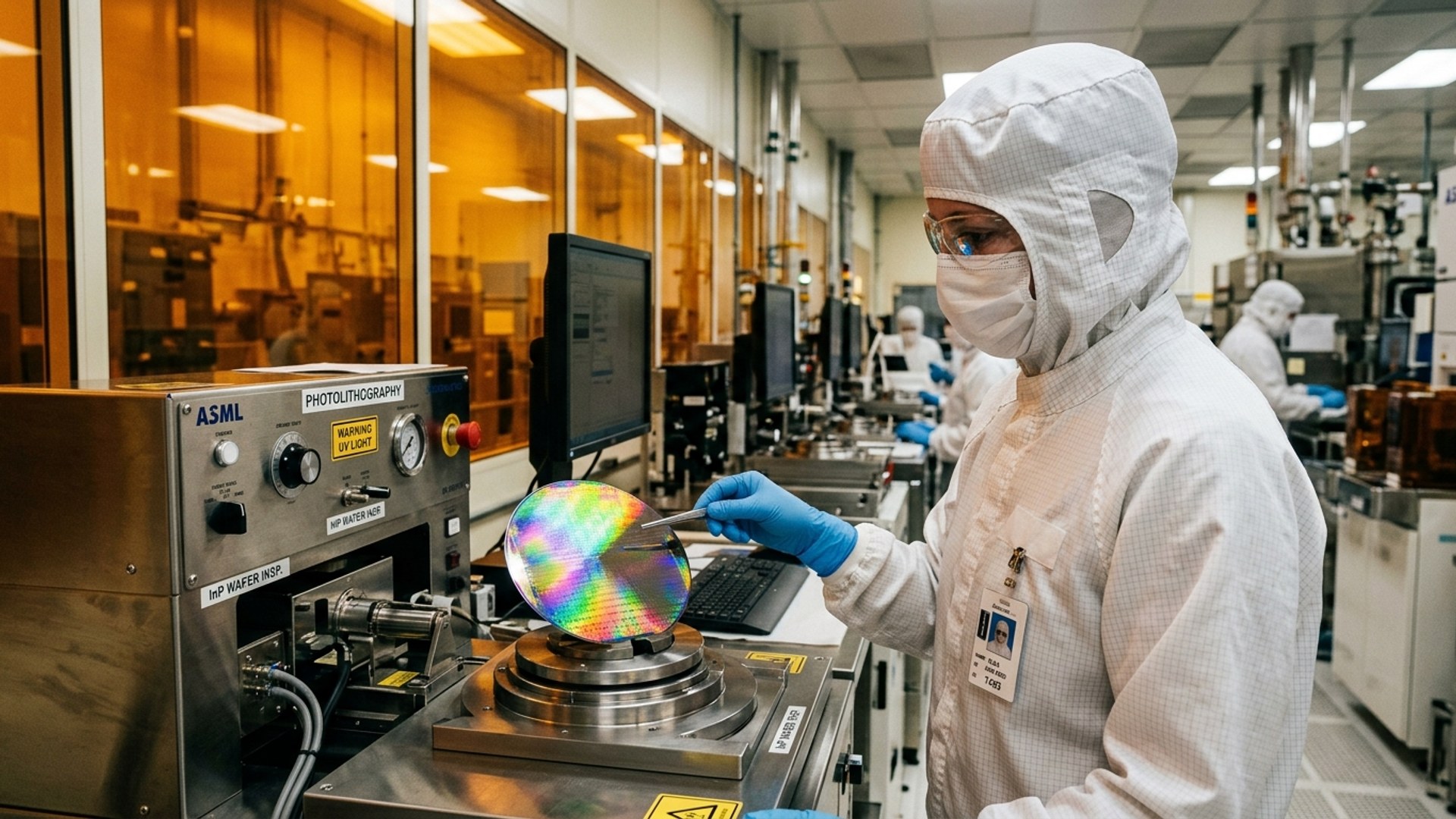
Sivers Semiconductors AB said on September 3, 2026, that it will invest USD 30 million to expand its Indium Phosphide (InP) manufacturing facility in Glasgow, Scotland, as the company prepares for anticipated customer production ramps tied to AI datacenter and optical networking demand.
According to the company’s announcement, the expanded facility is expected to support annual production of more than 100 million CW DFB lasers once complete. The program will add new process capabilities, increased automation and greater manufacturing flexibility at the Glasgow site.
Capacity Timeline
Work on the expansion program is scheduled to begin in the second half of 2026, and the upgraded facility is expected to become operational in the fourth quarter of 2027. The company framed the investment as preparation for anticipated customer production ramps rather than a response to orders already in hand, stating it is designed to ensure manufacturing capacity is available as customer programs advance toward volume production.
The company said the decision reflects increasing customer engagement across AI datacenter and advanced optical interconnect applications. Those applications sit within Sivers’ photonics business, which supplies laser components used in optical connectivity. The announcement positioned the capacity addition against what the company described as a broader build-out of AI infrastructure by hyperscale operators.
Shift to Hybrid Manufacturing
The investment marks what Sivers described as an important step in its transition from a Fab-Lite manufacturing model to a Hybrid Manufacturing strategy. Under that strategy, expanded in-house manufacturing capabilities are combined with strategic foundry, packaging and manufacturing partners.
The Glasgow expansion is intended to complement Sivers’ broader manufacturing ecosystem, which includes foundry, packaging and manufacturing partners in Asia. The company said the Hybrid Manufacturing approach is designed to provide greater production scalability, geographic flexibility and supply-chain resilience while maintaining strategic in-house capabilities for its core photonics technologies.
CEO Vickram Vathulya linked the capacity decision to customer requirements around supply certainty. “Our customers need significantly more laser production capacity and, just as importantly, the confidence that supply will be there when their programs ramp,” he said in the announcement.
Optical Interconnect Demand
The announcement places the expansion against a shift in datacenter networking. As hyperscale operators build larger AI clusters and move toward higher-speed networking architectures, the company said, demand for advanced optical interconnect technologies is accelerating.
Sivers said it believes InP-based lasers and semiconductor optical amplifiers will play an increasingly important role in enabling the high-performance, energy-efficient optical connectivity those systems require. CW DFB lasers, the product line at the center of the Glasgow expansion, are a category of continuous-wave distributed feedback laser built on indium phosphide and used as light sources in optical links.
Sivers’ photonics documentation describes its high-power DFB laser chips and arrays as components for pluggable modules, co-packaged optics and silicon photonics platforms used in AI and high-performance computing systems. The company states that its DFB lasers target optical interconnects supporting both the scale-up and scale-out of datacenter architectures, with products built on its InP100 platform, a four-inch indium phosphide processing platform.
COO Neeraj Chopra said scaling photonics for AI infrastructure requires a manufacturing strategy built for flexibility, quality and long-term customer demand, rather than capacity increases alone. “By combining our planned expansion in Glasgow with the manufacturing capacity of our external foundry partners, we can scale efficiently while maintaining the supply flexibility our customers need,” he said. He added that the approach gives Sivers the ability to support high-volume production as AI infrastructure deployments accelerate.
Company Background
Sivers Semiconductors is headquartered in Kista, Sweden, and develops laser and RF beamformer technologies. The company describes its products as serving customers in AI data centers, satellite communications, defense and telecom.
The Glasgow facility is the company’s in-house InP manufacturing base. The announced program expands that existing site rather than establishing a new one, and it sits alongside the external foundry, packaging and manufacturing relationships the company maintains in Asia. The expansion is intended to support the photonics side of the business, which produces the DFB lasers and semiconductor optical amplifiers used in optical interconnects.
The company said the expansion program remains subject to the uncertainties it outlined in the release, including equipment lead times, installation and qualification timelines, customer program decisions, currency movements and general market conditions. No equipment vendors, construction contractors or specific customer names were disclosed in the announcement.
With the program scheduled to start in the second half of 2026, the company said the expanded Glasgow facility is expected to become operational in the fourth quarter of 2027, at which point it is expected to support annual production of more than 100 million CW DFB lasers.


