The Government Accountability Office (GAO) released a report this week assessing federal broadband programs and releasing specific recommendations for the NTIA and FCC.
The report was conducted as mandated by a statute included in House Report 118-124 requiring GAO to “review the efficacy of recent federal broadband programs.” As such, GAO said it examined “selected agencies’ progress in deploying broadband, their approaches to targeting underserved areas, and NTIA’s efforts to encourage sustainability in its BEAD program, among other things.”
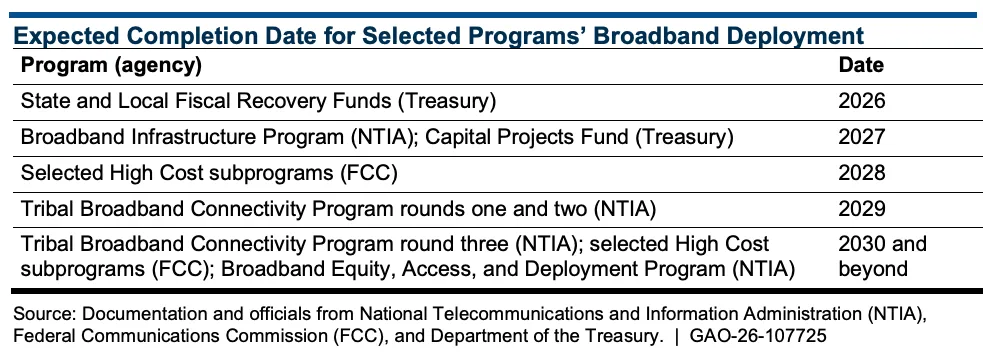
The GAO focused its attention on four federal agencies (NTIA, FCC, Treasury and USDA) in charge of administering nine programs, including BEAD, all of which began distributing funding as of February 2026. (See the chart below for the specific programs GAO assessed, excluding USDA programs “because expected completion dates vary by funding round,” according to the report.)
GAO recommendations for FCC
The report’s recommendations essentially fell into two main buckets, with one focused on the FCC’s national broadband map – which dictates where broadband access does and does not exist in the country – and specifically the challenge process involved in addressing map inaccuracies.
“Some program participants and stakeholders said this challenge process was burdensome and unclear. For example, challenging a large number of locations in an area could be difficult for smaller communities and providers with limited resources,” GAO wrote in its report. “Without targeted outreach to smaller communities and providers to address such difficulties, FCC may not be able to obtain the most accurate information about broadband availability and therefore may not be able to effectively identify and target funding to underserved areas.”
The report also highlighted concerns around service providers defaulting on their federal broadband awards and how those defaults can result in certain areas remaining underserved. “Agencies have taken some steps to address these potential service gaps. However, concerns remain that some unserved areas affected by defaults will remain unserved,” GAO stressed.
The report acknowledged the complex communication needed amongst agencies and stakeholders to keep federal broadband data up to date in order to not impede progress amongst programs.
“In particular, the accuracy and timeliness of project location data shared by the agencies and reported by FCC in its maps must be continuously maintained as programs offer new funding opportunities to continue to fill the underserved areas in those maps. The accuracy of FCC’s maps depends, in part, on stakeholders’ ability to submit challenges to inaccuracies in the maps’ underlying data. However, this check is not effective if stakeholders with necessary information choose not to participate due to hurdles in submitting such challenges,” wrote GAO.
As such, GAO said that the “Chair of FCC should conduct targeted outreach to smaller participants (such as local and tribal governments and providers), to identify and address difficulties they have experienced completing the bulk Broadband Data Collection challenge process.”
GAO recs for NTIA
The GAO’s report also honed in on the $42.5 billion BEAD program. The NTIA recently announced it issued approval for final BEAD proposals for all 56 states and territories, with Illinois coming in last, and with roughly $21 billion going toward deployment. The agency is expected to release guidance on how states can use $21 billion in “non-deployment funding” before the end of summer (tick, tock, by the way).
In terms of BEAD, the GAO focused its concerns and recommendations on ensuring the financial stability of providers deploying networks in high-cost areas.
“In October 2025, NTIA announced a requirement that BEAD providers certify that they will not accept federal funding from other sources for broadband deployment and operations costs for locations funded by BEAD for at least 10 years. This provision is intended to ensure that BEAD projects are financially self-sustainable without additional federal funding. NTIA’s BEAD documentation for states and territories states that there may be a basis for them to request certain data from providers. However, NTIA did not detail the circumstances that could warrant such a request,” wrote GAO.
Thus, GAO’s concerns are that the states may not have access to the information necessary to become aware if a provider’s network is at risk.
“As one of the largest of the broadband programs we reviewed, BEAD holds great potential to help close the digital divide. But BEAD also faces risks if the program does not take additional steps to support its commitment to financial sustainability. In particular, NTIA risks that some projects may falter in the future before the state could potentially flag concerns and work with providers to prevent a possible service lapse for consumers using a BEAD-funded network,” wrote GAO.
In turn, the report suggested that the NTIA administrator “should provide information to NTIA’s partner states and territories on when and why to request additional information from BEAD subrecipients, to monitor and support their ability to remain financially sustainable in offering affordable broadband during the 10-year federal interest period.”
According to the report, both the FCC and NTIA have “agreed with these recommendations,” and the GAO will track progress on the status of those open recommendations here.


