Synthetic materials have a lot of advantages in the backcountry. They’re easy to waterproof, dry quickly, and are light and durable. But they also have one big drawback: They’re made out of oil. With global warming currently devouring America’s long trail season alive and microplastics popping up in the continent’s most remote water sources, Tom Bonamici, a designer who teaches at the University of Oregon, started wondering if he could make an ultralight backpacking kit with no synthetics in it whatsoever. With everything from backpacks to tents made out of the stuff, he knew it would be a challenge, but Bonamici managed, creating a tarp from oiled silk, shoes with natural rubber, and trekking poles made out of Calcutta bamboo.
Here, Bonamici explains what went into making his no-plastic kit, and what it was actually like to use. For more about the process, read our article on the designer and his mission.
Transcript
I was just curious to explore academically what it would mean to use a full backpacking kit without any petrochemicals at all, not to say that everyone should, but just to explore what compromises we’d make if we did that. And going in, I kind of anticipated it was going to be heavier, it was going to not perform as well, it might be weaker, but how cool to make a collection that could actually completely compost. I thought that would just be an interesting experiment and exploration.
But the materials are what makes this compostable. So, I used a Ventile material. It’s basically a super strong, densely woven cotton material, and this one especially is ripstop. Same thing for the side pockets, it’s a Ventile, but a much lighter weight version. We’ve got cotton cord forming the drawstring in those side pockets and aluminum toggles with a metal spring, so that’s all plastic free. The back pocket is a stretch 100 percent Merino jersey, and we’ve got some more metal hardware holding that in place, another metal hook for the top closure. And the shoulder straps are lined with that same Merino jersey, Ventile on the outside, cotton webbing, and then I used a thick Merino felt as the padding for that back strap. And it’s a little on the stiff side. The more it gets used, the more it’s going to kind of conform. Felt is really good at that.
But the challenge throughout this whole collection, and especially in something like a pack that needs to be really strong, is the thread. So, I used 100 percent cotton thread. This is kind of a super heavy-duty thread that is meant for sewing on buttons, for like a fancy suit coat. I ended up with a lot of formal wear overlaps with the materials I was using here. So, the thread I think is pretty strong, but it’s, you know, I can break it if I really yank on it, this very heavy-duty thread. And that’s not a great sign because with a synthetic, you know, typically backpacking packs are sewn with polyester thread, and I can’t break that, you know, like a Tex 80, Tex 100 thread. So, that’s a pretty heavy gauge. And this stuff I can totally break. So, I did adapt by, you know, sewing several times over some seams. If you sew too many times, you’re just going to over-perforate a fabric, and then it can tear like a check out of a checkbook. But we’ll just see how it goes. As as throughout the whole collection, it’s an experiment. But I’m quite excited about the pack. And again, I wasn’t getting weird with the design of it, just with the materials.
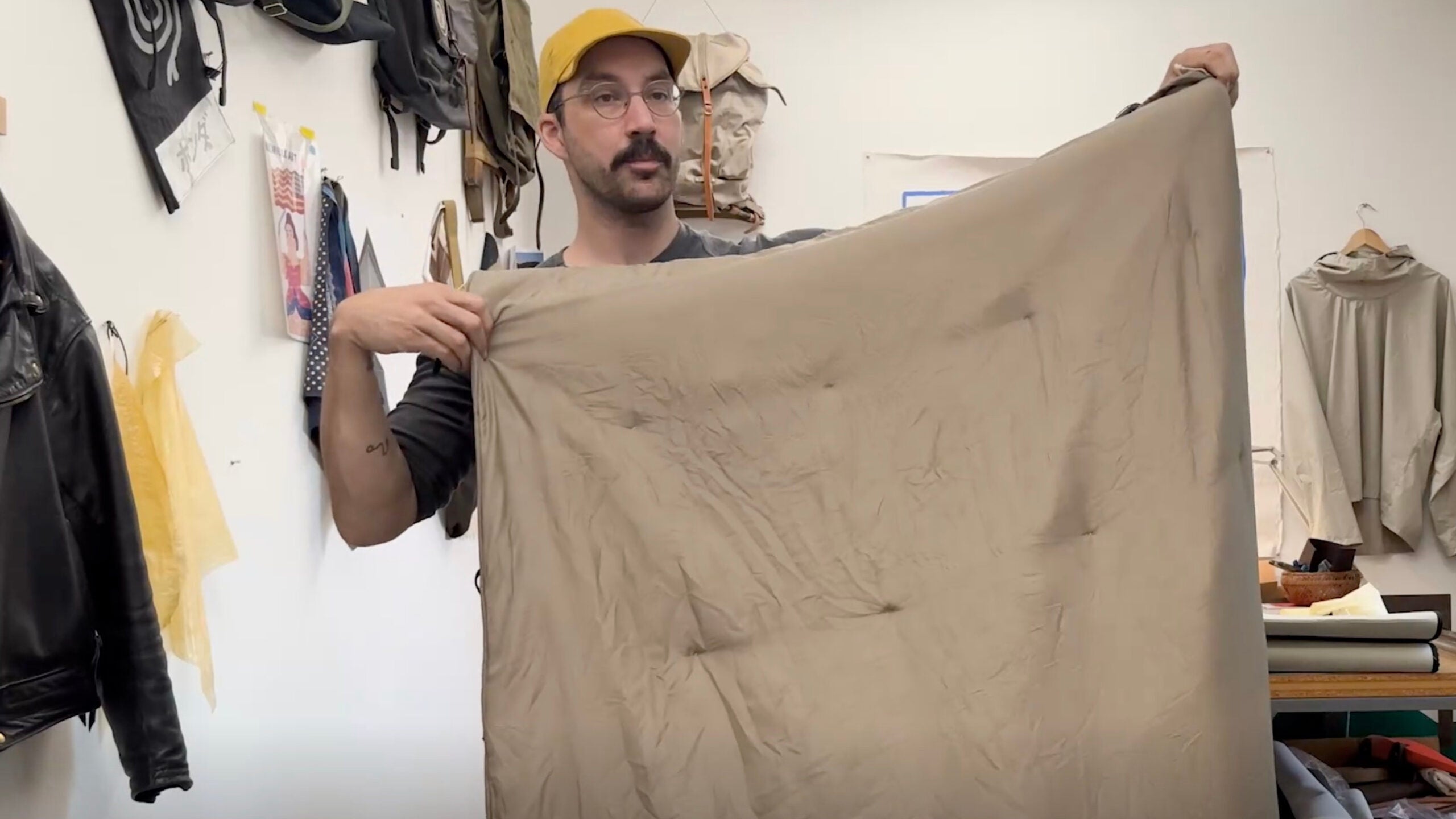
For the sleeping bag, I did a sleeping quilt. This is the same quilt design that I’ve done in the past with synthetic materials, which is super light and super comfortable. I use my homemade quilt all the time. It’s the kind of usual idea where you have a somewhat tapered rectangle, and then it forms a footbox, and you can kind of tie up that footbox and cinch it at the bottom, and it works great. Instead of a zipper, although I could use a cotton taped, metal-toothed zipper, I just went ahead and used some little ties because I’ve done quilts with zippers in the footbox and I’ve also done quilts with just snaps across, and they both work just fine. This is for summer backpacking, so I don’t need like full Arctic enclosure.
The shell material is a silk-cotton blend. This is meant for the lining material of a formal suit. So, again, one of those like formal wear overlaps with this collection. Cotton tape and cotton cord for the ties and the draw cord, and cotton thread. And then the material on the inside is a wool material. It’s called Lavalan, and it’s this puffy wool batting. Got a scrap here. That’s kind of very, very cleaned from how wool comes off the sheep, and then kind of spun and matted into this lighter weight and fluffy material. It’s really nice, it’s really warm. I used kind of a layer and a half. This is their almost heaviest weight and then I used a little bit more very lightweight quilt batting in there that was Merino quilt batting. This material is nice because it’s a little bit more resilient than some of the synthetic options. It is heavier.
This quilt weighs a little under 2 pounds, and my homemade quilt weighs a little over 1 pound. So, it’s definitely heavier, but I think it’s going to be plenty warm. The feeling of that fabric is so nice, and totally compostable as with everything else. So, I’m excited about this one. It’s quite bulky. That’s one of the downsides of using the wool instead of a synthetic and certainly a down. But it actually compresses pretty well once you jam it into the backpack, then it holds its form, and it’s actually kind of nice when you’re backpacking with a frameless pack to let the pack be full because then you don’t have any flopping or shifting.
You might wonder why didn’t I use down? Because down is natural. When you make something with down, it needs to use downproof fabric. And typically what that is is a really, really lightweight synthetic material that’s calendared. So, calendering means that you’re taking that material and putting it through these heated rollers, and it’s almost melting it, but it’s just like smushing the the yarns of that woven textile together and closing up all of the gaps in between the warp and the weft fibers, bringing those gaps together. And that means that those little stems on the down puffs can’t work their way through and pop out like they do on your pillows at home. So, there are there are certainly natural materials that could fit the bill. In fact, the Ventile materials that I used are probably dense enough to be downproof or like functionally downproof. And there are some upholstery materials that are all cotton that are meant to be downproof. But they’re super heavy. So, it would end up tripling maybe the weight of the of the quilt and adding to the bulk, too.
Imade this with, again, some of that Ventile material, the super lightweight, and then a really thin layer of cork, which is not going to hold up long term, I know it, because it kind of crumbles. And that’s sandwiched in with some Melton wool. And Melton wool is a a very dense, almost felted thick woven wool material. Sometimes it’s made with a Merino, usually it’s more of a strong wool because it’s just felted in so much, you don’t need that softness and kind of luxurious hand of Merino. And then the whole thing is bound with cotton twill tape and, again, cotton thread. And then I sewed across in some channels just to try to hold that cork into place long term. This is something where, as I said, the collection is about exploring compromises, and it’s a big compromise in comfort. I was backpacking last weekend and just loving my big plush, Big Agnes pad, you know, just like sprawled out on that and sleeping like a baby. And this isn’t going to be like that. It’s also heavy. This is just under 2 pounds, which is pretty painful because that’s well over double a Z Lite. So, if I’m going to be less comfortable, I’d rather have a Z Lite. But, you know, that’s just straight petrochemicals, so it didn’t work for this project. So, again, the the collection was about exploring compromises, and I’ve definitely found some compromise area with the sleeping pad. And that’s okay.
I did look into whether or not it’d be possible to do inflatable natural pads and also just like thicker, squishier materials, you know, wool felt. I looked into kapok, which is this kind of tree seed pod husk material that was used for insulation and also for life jacket flotation before petrochemicals. It’s not as good as foam for a life jacket, so don’t get any ideas. And all this is possible. Like with natural latex rubber, it would theoretically be possible to make an inflatable pad, but roughly running the numbers, it would be much, much heavier than this, like 5 to 8 pounds for just the pad. They were available, you know, you look in old Abercrombie & Fitch catalogs from the early 1900s, and they had inflatable pads, and they weighed 10 to 15 pounds. So, you know, if you’re horse packing, maybe that’s a good option, but for the purpose of this project, again, I was trying to keep everything as light as possible.
For trekking poles, I knew I wanted to use trekking poles, and I need them for my 40-year-old knees, and also to set up the tarp. And I looked into making them out of aluminum because metal was allowed in the confines of this project, but to make them extendable, adjustable, I think it could be done. You know, if I were a really amazing machinist, I’m sure I could make all those parts out of aluminum and have it be fine. I’m not an amazing machinist, and I didn’t want to use those plastic adjusters, which are so great and so good at what they do, but again, for the confines of this project, I wanted to keep it original. So, I ended up using Calcutta bamboo. And this is a species of bamboo that’s insanely strong. It’s still used for ski poles and for fishing gaffs, that’s the like big hook that you use to yank that 200-pound tuna in the boat. It’s way stronger in flexion than aluminum, which is pretty sweet, and not too heavy at all. It has a really thick wall. So, this is a little chunk of it, and it’s got this thicker, denser wall, and it’s just a lot tougher than normal bamboo. And then in Slovenia, of all places, I found a ski pole DIY supply house. With the tariffs, I paid a phenomenal amount of money to get these ferrules, which are meant to be used with bamboo poles. So, these are all aluminum with a carbide tip, just like a normal trekking pole. So, we’ve got a really durable way to hit the ground.
I used a suede grip. I made a wrist strap, adjustable with an aluminum buckle, Merino wool lining, Ventile outer shell. And then I even found some I put in a brass threaded insert in the top of the pole and a really nice bolt to hold the whole thing in place. So, it’s super comfortable, it’s super strong, I think stronger than my carbon fiber poles, which I’ve broken, just crossing a river and I don’t think these are going to have that issue at all. And then in order to avoid, you know, I didn’t want this project to look too hippy-dippy or Ren Faire or like, you know, Civil War reenactor or anything, so while the bamboo is beautiful naturally, I just coated the whole thing in some ink, some Sumi calligraphy ink. I had that for woodworking marking, and it applied beautifully. I had to just sand the outside of the bamboo to remove that natural waxy finish, and then the ink went on, and it’s staying on, and it doesn’t rub off or anything. So, these poles I think are going to be maybe the the strongest part of this collection, like physically strongest. I think a lot of the textiles have to be a little bit weaker, mostly because of using a natural thread, but these poles are going to be stronger than the aluminum or carbon fiber equivalents that are at REI. I’d say the only bummer or compromise about these is that they’re not height adjustable. No problem to just make them appropriate for my height for use, but I wouldn’t then be able to adjust it even taller to use with a a tent, for instance. And it’s possible to lash two poles together, but it’s a lot easier with like a Voile strap, or something, you know, synthetic. So, it’s it’s just interesting how the the confines of this project, the rules of the project, just put a lot of constraints on the decision making all throughout.
For the tent or shelter, I did a tarp, and I usually sleep under a tarp when I’m backpacking, and they work great. I live in the West, and am blessed to have pretty predictable stretches of good weather and fewer bugs. For the situation we get to backpack in out West, it’s nice to not need to worry about the bugs so much. So, I did this very lightweight tarp design. Again, it’s very similar to tarps that I’ve made in the past. So, it’s basically a 9-foot long tarp, and it’s, you know, catenary-cut curves so that the tension is really even on the seams and on the sides, and tensioning lines, and I use trekking poles to set it up. The difference about this tarp, being petrochemical free, is that it’s made out of oiled silk. And this is a really unusual material nowadays. I found a lot of references to it in literature from over 100 years ago, but almost nothing since then. And that’s probably because synthetics are a lot stronger and a lot more predictably waterproof, and that’s okay. But given the confines of the project, I needed to find something lightweight and waterproof enough. So, this is waterproof enough. I haven’t done a hydrostatic head test on it, but I can fill up a embroidery frame with this material on it with water, and it doesn’t drip through even over 24 hours. And, you know, with a rough garden hose test, it’s managed to just kind of bead that water off really, really nicely.
What is oiled silk? It is a silk taffeta, so it’s a really, really lightweight almost a ballgown type material, and then I soak it in a blend of linseed oil and natural turpentine. Turpentine is basically distilled pine tar or pine sap. You distill it like you would distill whiskey and you end up with turpentine. That’s the same stuff that artists use to cut their paints. And I use the turpentine to cut down the linseed oil so that it can flow through the fabric more easily and that I can wring it out more easily. If there’s too much in there, it’ll end up getting really sticky and like, yeah, too too sticky and gross. Ugh. But with with the right blend and the right amount of kind of wringing out and careful drying, I can get it to where it’s this really nice, predictable hand and waterproof enough without being too sticky. You can see that it’s yellowed, and some of my older samples have yellowed a lot more. This is a kind of interesting anecdote because what we read about as oilskins, that’s what fishermen wore, like in Captains Courageous or something, you know, those books from 150 years ago about people fishing in the North Sea, they’re all wearing oilskins. Oilskins are basically a canvas smock soaked in linseed oil. And as it ages and oxidizes, it turns yellow, and that’s why Paddington Bear and, you know, all those traditional raincoats are yellow, because it’s kind of an inheritance from the oilskin. Kind of an interesting detail.
When I first made this tarp, it was this like just ivory off-white, and that was 2 months, 3 months ago, and it’s already turned started to turn yellow, and the older it gets, the more yellow it’s going to get. So, I did use some reinforcements at important areas, like the the main seam attachment point of the tarp. I used a kind of a Ventile patch in some areas and just a self-fabric patch in other areas. I used cotton tape to reinforce those attachment points. I did a lot of kind of repetitive straight stitching, but again, not too close together, so it doesn’t get perforated and just rip out. We’ll see how this holds up. This is not nearly as strong as synthetics, but this is one where I’m pleased to say it’s actually lighter weight. I used, due to the width of the fabric, this tarp is even a little bit smaller than the one I usually use, that’s sil- sil-coated polyester. And this is this is 440 grams, so that’s just under a pound. It’s like about, I don’t know, 14 ounces or something, the the weights that we expect out of ultralight shelters.


