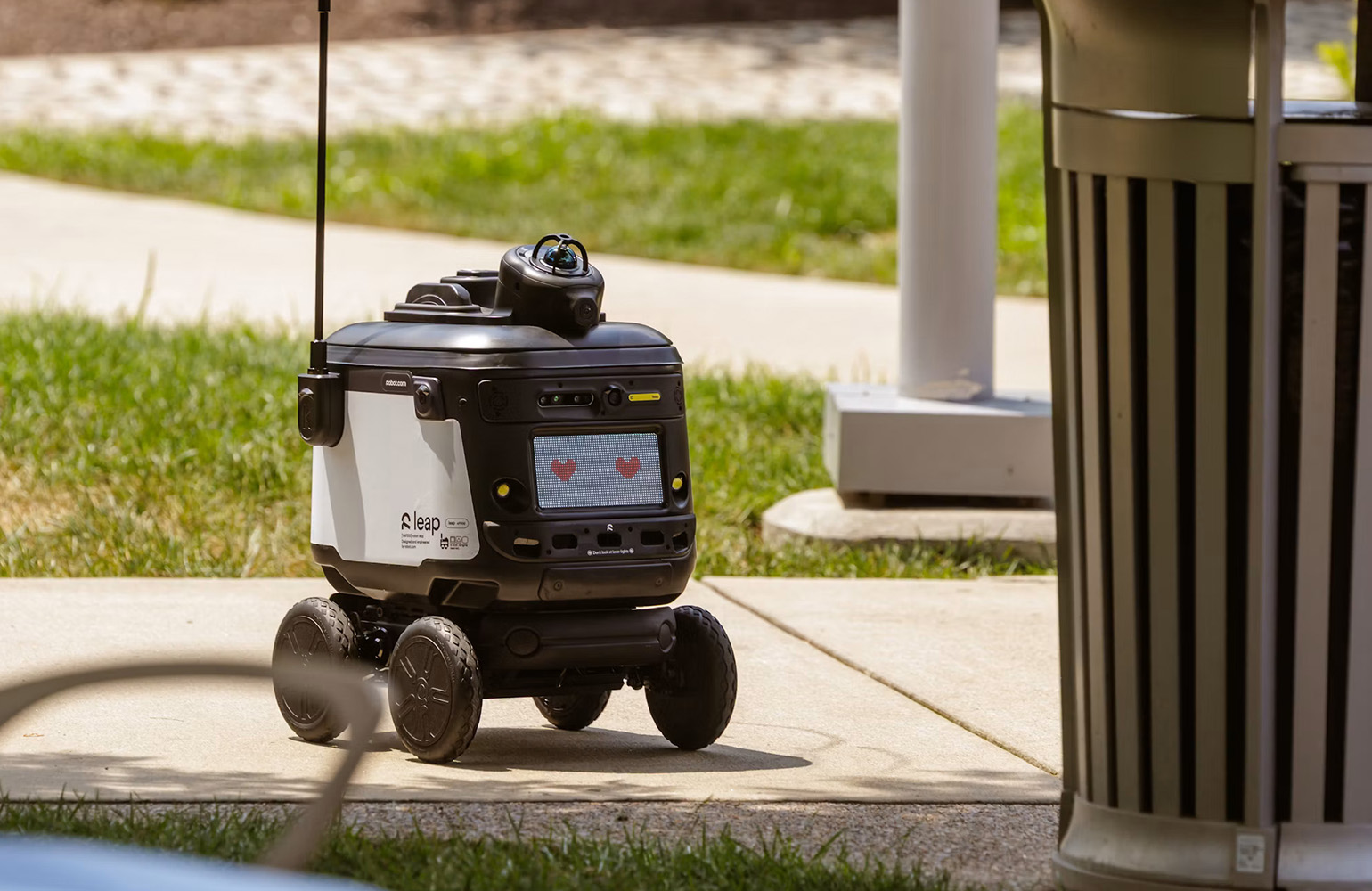
Robot.com’s sidewalk delivery robot R-Kiwi has completed 2.4 million tasks across campuses and city sidewalks. | Source: Robot.com
Robot.com recently announced a seven-year commercial agreement with Sodexo Group. This new agreement builds on a partnership that began in 2021 and that has expanded across select Sodexo-operated college campuses in North America.
“Sodexo is an amazing partner, and it has around 400,000 employees globally, and 120,000 full-time employees in the U.S.,” Felipe Chavez Cortes, the co-founder and CEO of Robot.com, told The Robot Report. “It’s one of the companies that is suffering from labor shortages and has been unable to fulfill its open positions.”
He noted that Robot.com and Sodexo’s long-standing relationship paved the way for the seven-year contract.
“Seven-year contracts don’t come right away,” Cortes said. “It was a learning process for both companies on what it takes to implement robotics, and what it takes to add value on both sides.”
This seven-year contract represents Robot.com’s largest single enterprise deployment. Cortes asserted that it also demonstrates Sodexo’s leadership in bringing practical, scalable technologies to complex service environments.
“It’s important to say that Sodexo was the first company to implement food delivery robots on college campuses, and one of the first companies to scale up food delivery in general,” Cortes said.
 Register now and save on your pass to RoboBusiness 2026
How is Robot.com making sidewalk delivery work?
College campuses have emerged as a proving ground for sidewalk delivery robots. In recent years, however, some providers have pulled back from these deployments. For example, Starship Technologies recently announced plans to wind down its campus deliveries in favor of groceries.
San Francisco-based Robot.com, founded in 2017 as Kiwibot, is taking a different route. “I do feel that college campuses are a very good staging environment. You’re outside. You have people, but it’s not as crazy as urban,” Cortes said.
So how is Robot.com making it economically viable? Cortes said it’s all about the company‘s Remi implementation platform.
“Remi is our robot implementation intelligence, and it’s a product and platform that we have been developing for almost a decade,” he explained. “That allows us to bring the best classical robotics mixed with the best brain third-party software and very smart advertising technology. Remi is basically our secret sauce.”
“When we implement Remi, we basically get better economics on the costs of implementing the robots,” added Cortes. “Also, we can increase our revenue when we mix advertising in, so we don’t just get revenue from delivery.”
R-Dog to join Robot.com robotic delivery fleet
Right now, Robot.com deploys its sidewalk delivery robot, but it plans to add the R-Dog quadruped to its portfolio. Cortes said R-Dog is more versatile than the company’s other delivery robots.
The wheeled and legged robot can drop packages, unlike other systems. Most delivery robots require the person receiving the delivery to open up the robot’s compartment and retrieve items themselves.
With the ability to drop off packages, R-Dog could deliver a wider range of items, said Cortes. The mobile robot can also go upstairs or get into autonomous vehicles without needing to modify the vehicles.
How does Robot.com keep its robots running?
Robot.com has already deployed more than 500 of its R-Kiwi delivery robots. With so many system running across the country, ensuring that they all keep running smoothly is a challenge. To keep up with the robots, Robot.com takes a layered approach.
“We actually have implementation intelligence that allows us to intervene in the right moment,” Cortes said. “There are different layers of intelligence, from on-site attention, teleoperation attention, and even AI agent attention.”
To ensure the robots work safety, Robot.com has partnered with Field AI and Physical Intelligence.
“As we deploy new embodiments and we go into more challenging environments, we are not just relying on our technology,” acknowledged Cortes. “We are also partnering with the best companies in the world that have world-class researchers and engineers to support us on those safety targets.”
When it comes to scaling in the years ahead, Cortes asserted that he is focusing on one metric: the number of hours his company’s robots are operational.
“For this first half of the year, we already did a quarter of a million hours generating revenue,” said Cortes. “Our goal is to get to a million hours per year very soon.”
Robots move from sidewalk delivery to industrial use cases
Outdoor deliveries on college campuses are helping to prepare Robot.com for industrial use cases in the future. “When we jump into industrial cases, it’s actually much easier. You have normal access to Wi-Fi. The environment is much more controlled,” Cortes said.
“Our foundation is food delivery robots in college campuses,” he continued. “But that foundation is what basically allows us to build Remi, and on top of Remi, we are introducing industrial robots. We’re introducing humanoids. We also will introduce to the market the R-Dog for urban environments.”
Robot.com’s humanoid robot, R-noid, features a wheeled base and two arms. Cortes said the company can sell its humanoids to the same customer base it’s working with on sidewalk robots.
“There are some potential customers that could be incredible customers for humanoids, but maybe they’re not ready yet, or maybe they are still skeptic about humanoids,” Cortes said. “So, they start with delivery robots or they start with advertising, and in that way we start building up the business relationship.”
Down the road, Cortes also said there could be an opportunity where legs make sense and are more economically viable, but right now, a wheeled platform provides the performance, reliability, and economics that work for its customers.
“We measure carefully the number of hours that our robots are out there generating revenue, and how much it costs us to generate that revenue,” Cortes said. “So, the decision of wheels against legs is related to that. It’s basically, ‘How can we ensure that when we deploy humanoids, they’re going to be more affordable?’”
The post Robot.com partners with Sodexo to roll out more sidewalk delivery robots appeared first on The Robot Report.


