
Active Gear Review is supported by its audience. If you purchase through links on our site, we may earn an affiliate commission.
As product reviewers, cameras are among the most important tools we carry. And the action camera may be the one we reach for most often.
It is the camera we can toss into a pack, strap to an e-bike, carry on a run, or pull out in the rain without treating it like a piece of fine china. It goes where our more expensive camera either cannot go or simply is not worth risking. If we are testing a pair of running shoes, riding singletrack, hauling an e-bike down a two-track, or setting up camp while the weather falls apart, an action camera is usually within reach.
For most of Active Gear Review’s history, that camera wore a GoPro badge. There was a brief Sony phase when the company was doing clever things with its video remote-control setup. Sony, why did you walk away from that? You had something there. Otherwise, the HERO line has been our default, and it has served us well.
When our latest upgrade cycle came around, though, we looked at the three companies that now define the category: GoPro, DJI, and Insta360. We chose the DJI Osmo Action 6 as our new grab-it-and-abuse-it review camera.
So far, we are happy that we did.
This is not going to be a frame-by-frame laboratory shootout review. There are already plenty of comparisons online that put footage from these cameras side by side in every resolution and lighting condition imaginable. Our question was different: Which action camera makes it easiest to come home with the shots we need?
We May Have Reached Peak Useful Action Camera
There will always be another resolution bump, a higher frame rate, or a new processing mode to put on the box. The Action 6 itself can now record 8K at 30 frames per second after a firmware update. That is impressive, but it had almost nothing to do with our decision.
For our work, 4K is already the sweet spot. It gives us sharp footage, useful frame grabs, manageable files, and plenty of flexibility for a website or social post. We would rather bring home a clean, well-framed 4K clip than fill a card with 8K files that slow down the rest of the workflow. There are situations where 8K leaves more room to crop, but most adventurers do not need it running all day.
GoPro, DJI, and Insta360 are not using the same hardware, so it would be inaccurate to say their image quality is identical. The Osmo Action 6 has a 1/1.1-inch square sensor. The Insta360 Ace Pro 2 uses a 1/1.3-inch sensor, while the GoPro HERO13 Black uses a smaller 1/1.9-inch, 8:7 sensor. The Action 6 can capture approximately 38-megapixel stills, the Ace Pro 2 goes up to 50 megapixels, and the HERO13 Black captures 27-megapixel photos.
Those numbers do not choose a winner by themselves. Sensor size, lens aperture, processing, sharpening, color, stabilization, and the way each camera reads its sensor all shape the finished image. More megapixels do not automatically produce the better photo.
What has changed is the performance floor. In good daylight, all three flagships can produce sharp, stabilized footage that is more than good enough for our product reviews. Their differences still show up if you start pixel peeping, and each camera has situations where it comes out ahead, but basic video competence is no longer the deciding factor it once was.
That pushes the buying decision toward everything surrounding the image: how quickly the camera mounts, how it handles mixed light, whether it has storage when the card is sitting at home, how fast files come off it, how usable the controls are, how easily a microphone connects, and whether it is tough enough to be treated like an action camera.
That is where the Osmo Action 6 stood out for us.

What’s in the Box?
The DJI Magnetic Mount Keeps the Camera Moving
DJI’s dual-direction magnetic quick-release system may be our favorite part of the camera. Magnets guide the adapter into place, but spring-loaded clips provide the actual lock. It snaps on with a reassuring click and releases by pinching the two sides of the adapter.

During a gear test, the camera rarely stays in one place. It may start on a tripod for a walkaround, move to the handlebars for riding footage, shift to a chest or helmet mount, and finish on a short grip for detail shots. A thumb screw is not difficult, but repeating that process while wearing gloves or trying to keep a group moving gets old. With DJI, the camera moves between prepared mounts in seconds.

DJI no longer has magnetic mounting to itself. The Insta360 Ace Pro 2 also uses a magnetic quick-release mount, and the HERO13 Black works with GoPro’s Magnetic Latch Mount. GoPro also builds folding fingers and a 1/4-20 tripod thread into the camera, which gives it excellent compatibility even without another adapter.

Magnetic Car Mount
Our preference comes down to DJI’s compact implementation and how naturally it fits the way we shoot. It is quick, solid, and compatible with mounts from several recent Osmo cameras. Just remember that traditional GoPro-style accessories still require DJI’s quick-release adapter.
Photos Matter More to Us Than They Do to Most Action-Camera Buyers
Action cameras are marketed around video, but we often ask ours to produce review photos. That means catching an e-bike moving through a corner, a runner in stride, or a piece of gear being used instead of sitting perfectly still on a table.

Burst mode is a lifesaver for that job. The Action 6 can capture up to 30 images over three seconds, which gives us a much better chance of getting the wheel position, foot strike, body position, and product angle right in the same frame. A video frame grab is useful in a pinch, but a dedicated still gives us more resolution to crop for a review header or product gallery.
The Action 6’s standard photo mode produces approximately 38-megapixel images and can save JPEG or RAW files. Its square sensor should not be confused with square still photos. Maximum-resolution stills are 4:3. The square design pays its biggest framing dividend in 4K Custom video, which records a 3840 x 3840 frame that can later be cropped horizontally or vertically.
We have also liked what the Action 6 does in the uneven light common on wooded trails. On mountain-bike rides, it has held onto useful detail while moving in and out of tree cover instead of letting every opening in the canopy turn into a white patch. DJI claims up to 13.5 stops of dynamic range from the new sensor. Manufacturer dynamic-range figures are not always directly comparable, but our early files support the broader point: the camera handles changing outdoor light well.

Color matters in product coverage, too. A camera can make every clip look exciting by pushing saturation and contrast, but that is not always helpful when a reader needs to see the actual shade of a jacket or the finish on a bike frame. The Action 6’s standard output has given us a good starting point without forcing us to undo an overly aggressive look first. RAW photos and 10-bit D-Log M video are available when we want more control.
A Larger Sensor and Variable Aperture on the DJI Osmo Action 6 Help When the Light Gets Challenging
The Action 6 pairs its 1/1.1-inch sensor with a variable f/2.0 to f/4.0 aperture. Opening to f/2.0 lets in more light than the fixed lenses used by its main competitors, while f/4.0 increases depth of field and shortens the minimum focus distance to about 7.9 inches. That closer focus can be useful for buckles, controls, ports, stitching, and other gear details.

Macro Lens Shot
An optional Macro Lens goes farther for tight detail work, but it should not be confused with the standard removable glass cover. The camera’s main lens is fixed. DJI lets you unscrew the protective cover and replace it with the Macro Lens or FOV Boost Lens.
The larger sensor and brighter aperture give the Action 6 a meaningful advantage when light drops, but expectations still need to stay grounded. It is better in dim conditions than many action cameras, not a replacement for a full-size camera or a modern phone that can stack several exposures while held relatively still. SuperNight can brighten a dark scene, but moving subjects and stabilization still demand faster shutter speeds, and noise does not disappear.
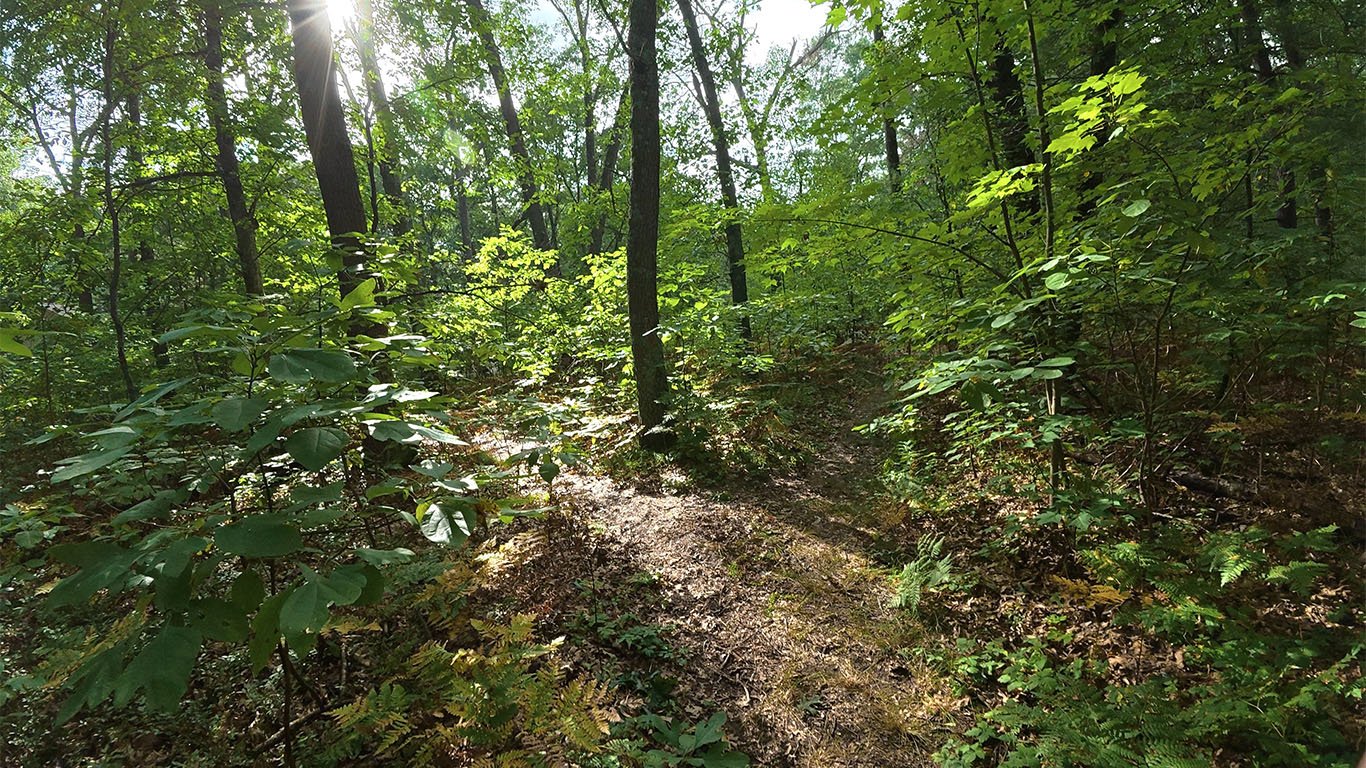

For us, the bigger win is not filming in near darkness. It is getting cleaner footage at dawn, under heavy tree cover, indoors, or when a ride keeps bouncing between sun and shade. Those are the conditions we run into far more often.
The DJI Osmo Action 6 Built-In Storage Fixes a Very Human Mistake
The Osmo Action 6 contains 64GB of internal storage, with roughly 50GB available to use. GoPro’s HERO13 Black and Insta360’s Ace Pro 2 both require a microSD card.

We still use a card in the DJI, and it accepts capacities up to 1TB. The internal storage is the backup plan for the day the card is full, fails, or is still sitting in a computer after the previous shoot. The camera does not need to make that mistake impossible. It only needs to keep it from ending the test.

DJI lets us pull files from either storage location through the Mimo app or over a USB-C cable. A card reader remains the fastest option for a big batch stored on microSD. The camera can also send selected files to OneDrive, Google Drive, or network-attached storage through Mimo. That combination gives us several ways to get footage home instead of forcing every shoot through one app.

Controls That Work Without Turning the Camera Into the Project
An action camera should not require a menu refresher every time it comes out of the bag. The Action 6 has a responsive rear touchscreen, and the front screen is touch-enabled as well. That makes it easier to change a setting when the camera is facing us or mounted where the back is difficult to reach.

Easy to use and read touchscreen.
The customizable Quick Switch button can cycle through selected modes, while SnapShot can power up the camera and immediately begin recording with the shutter button. Pre-Rec can continuously hold from five seconds up to five minutes of video before the record button is pressed. That last feature can save a shot when a rider clears an obstacle before the camera operator is ready.

The optional Osmo Action GPS Bluetooth Remote Controller adds start and stop control while recording GPS data for overlays. Mimo can also pair video with activity data imported from services including Garmin and COROS, which is useful when speed, heart rate, elevation, or route data helps tell the story. GoPro and Insta360 offer capable remotes and data tools as well, so this is not a DJI-only advantage. It is still a box we wanted checked. A phone is a poor remote when it is buried under layers, mounted to a bike, or being used for something else.

The DJI Osmo Action 6 Makes Wireless Audio Almost Too Easy
We do not use an external microphone on every gear test, but the Action 6 is ready when we need commentary on a trail or a cleaner voice track at camp. Compatible DJI Mic transmitters can connect directly through OsmoAudio without hanging a separate receiver from the USB-C port.

That matters because receivers, cages, cables, and adapters work against the reason we brought an action camera in the first place. Direct pairing keeps the setup compact and leaves less hardware to snag or shake loose. A third-party wired microphone can still be connected with DJI’s 3.5mm audio adapter when the job calls for it.
GoPro also supports Bluetooth audio, and Insta360 has expanded its wireless-audio options, so DJI is not the only company making progress here. DJI’s advantage is how well its cameras and microphone system fit together if you already use a DJI transmitter.
The DJI Mimo App and File Workflow Are Part of the Camera
The DJI Mimo app handles camera control, live preview, settings, firmware updates, basic editing, and wireless downloads. It is not the most ambitious action-camera editor. Insta360 still has the deeper bag of automatic effects and social tools. For our use, Mimo’s simpler approach works because we mostly need to review a burst, grab selected files, trim a clip, or control the camera without digging through layers of extras.

Unlike GoPro’s subscription-centered cloud and premium editing services, DJI does not require a recurring plan for the core control, transfer, and editing tools we use. GoPro’s subscription may still be valuable to someone who wants unlimited cloud backup, automatic uploads, or its premium editing features. We simply do not want a subscription to be a central part of our field-camera workflow.
One 8K limitation is worth knowing. DJI currently restricts downloading and editing Action 6 8K files in Mimo to the iPhone 15 Pro series and newer. That makes 8K even less useful for our Android-based mobile workflow. The files can still be handled on a computer, but 4K remains the practical setting for us.
The DJI Osmo Action 6 is Built for the Places We Take It
Portability and durability are not side benefits for this camera. They are the point.

The Action 6 weighs 149 grams, putting it in the same compact class as the HERO13 Black and noticeably below the 182-gram Ace Pro 2. It is waterproof to 20 meters without a separate case, compared with 10 meters for the GoPro and 12 meters for the Insta360. We have already had it out while camping in the rain without issue, but the extra waterproofing also leaves more margin for paddling, beach use, and the moment a camera mount ends up somewhere it was not supposed to.

The screw-on glass lens cover is replaceable, scratch-resistant, and treated to shed water. If the camera takes a rock, slides across the trail, or gets shoved into a pack beside something sharper than expected, damaging the cover does not mean replacing the camera. That is exactly the sort of design decision we want on equipment expected to have a rough life.

The removable 1,950mAh battery is rated to operate down to -4 degrees Fahrenheit, and DJI claims as much as four hours of recording under a very light 1080p/24 test with the screens and wireless features turned off. High-resolution recording, active screens, cold weather, and frequent reviewing will shorten that number. We care more that the battery is replaceable and shared with several recent DJI cameras than we do about the laboratory maximum.

What the Other Cameras Still Do Better
Choosing the Action 6 does not make the HERO13 Black or Ace Pro 2 poor choices.
GoPro still has the deepest accessory history, three mounting routes, excellent 8:7 capture, and an unusually developed HB-Series lens system. Folding fingers and a 1/4-20 thread are built into the camera, while its Magnetic Latch Mount is optional. Its Macro Lens Mod has adjustable focus, the Ultra Wide Lens Mod expands the field of view, and the Anamorphic Lens Mod gives video shooters an option DJI does not currently match.
Insta360’s Ace Pro 2 brings an excellent flip screen, 8K recording, a 50-megapixel photo mode, strong low-light processing, and what may be the most feature-rich mobile editing app of the three. That flip screen is especially useful for low-angle framing and solo shooting.

All three cameras offer excellent stabilization, high-frame-rate 4K, replaceable batteries, magnetic mounting options, pre-recording, waterproof bodies, and capable still modes. Depending on the job, any of them could have worked for us.
The Action 6 simply put the most checkmarks in the places that affect our day: the lightest body of the three, the deepest case-free waterproof rating, fast dual-direction mounting, usable internal storage, a large sensor, burst photos, direct DJI microphone support, and several sensible ways to unload files.

Final Thoughts on the DJI Osmo Action 6
The action-camera market has reached a point where the big three can all make excellent footage in good light. We did not choose the DJI Osmo Action 6 because every GoPro or Insta360 comparison ends with DJI winning every frame. It does not.
We chose it because an action camera is more than the file it produces. It is the mount we move six times during a ride, the burst that catches the right foot strike, the internal storage that rescues a forgotten card, the lens cover we can replace after a bad landing, and the app or cable that gets the files where they need to go without turning the review into another project.
The Action 6 has already joined us for e-bike rides and reviews, mountain-bike outings, hiking-gear tests, running-shoe coverage, and a wet camping trip. It has been easy to carry, quick to deploy, and capable of producing the photos and video we need across all of them.
We cannot say what will win our next upgrade cycle. GoPro, DJI, and Insta360 are moving too quickly for brand loyalty to make that decision years in advance. But for this cycle, though, the DJI Osmo Action 6 was our pick, and we are happy with the choice. For more info or to check one out for yourself, visit djiusa.com or amazon.com.


