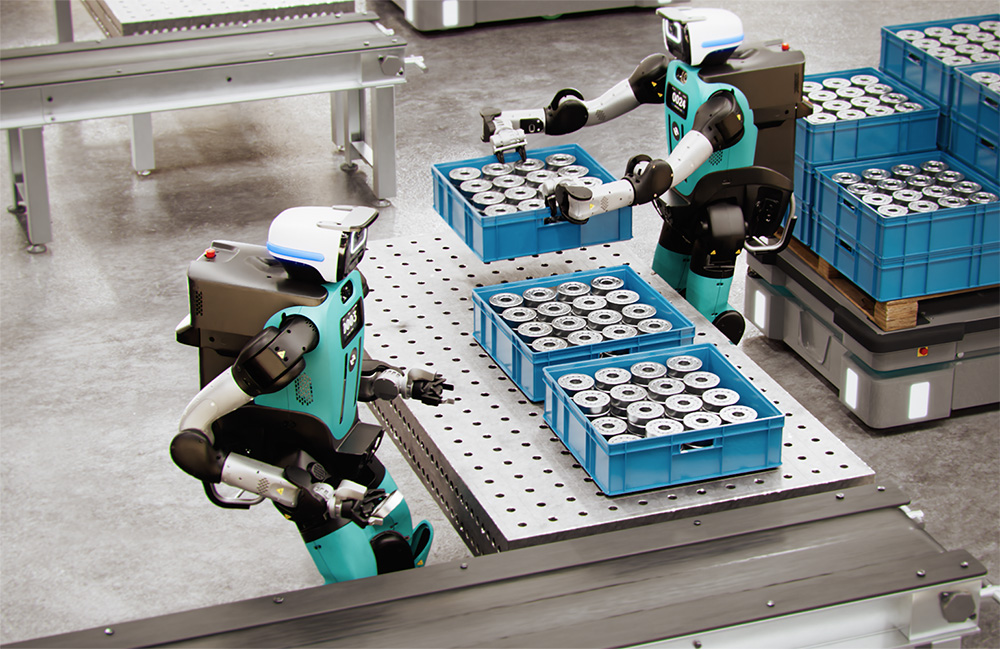
Agility said it engineered Digit 5 for cooperatively safe work at scale. | Source: Agility Robotics
Agility Robotics today unveiled Digit 5, the latest version of its humanoid robot. The news comes as Agility prepares to go public through a proposed SPAC merger with Churchill Capital Corp. XI.
The latest version of Digit includes new legs, upgraded batteries, and a more comprehensive safety architecture. Agility Robotics told The Robot Report Digit 5 can work in close proximity to people without physical safety barriers.
“Digit 5 is removing a major barrier to scaling humanoid robots in industrial environments,” said Peggy Johnson, CEO of Agility Robotics. “We built it to the exact requirements our customers gave us after three years of Digit 4 working on their production floors, and the market has responded with more than $300 million in multi-year orders and a growing pipeline of customers across manufacturing, warehousing, and logistics. That’s value that compounds as Digit’s capabilities expand, backed by real demand.”
According to recent filings with the SEC, Agility Robotics generated $1.8 million in net sales in 2025. The SPAC values Agility at $2.5 billion. Agility expects to begin early access to Digit 5 in the first half of 2027. It expects general availability for manufacturing, warehouse and distribution operators by the end of 2027.
Agility plans to make Digit 5 available for commercial deployment outside North America for the first time, starting with the European Union and United Kingdom. The company said it expects Digit 5 to carry a CE mark and additional regulatory marks to enable market access to the EU, Great Britain, and Northern Ireland.
What has Agility learned from deployments?
Digit is one of the only humanoid robots currently working in manufacturing, distribution, and logistics environments. Jonathan Hurst, co-founder and chief robot officer at Agility, said earlier versions of Digit were part of the company’s proof-of-concept phase.
“I remember having this eye-opening moment for us when we were early on working with Amazon,” Hurst told The Robot Report. “We were doing the job, moving the bins off the putwall and doing the task, and we’re like, ‘Great, now can we scale this up? How many would you like to buy? Can we deploy these?’”
Hurst said this is when the team encountered the reality of FCC requirements, UL certifications, ISO certifications, and more that come with deployments. Doing the task on its own wasn’t enough to deploy robots at scale.
“We actually started to learn what the blockers are, what are the things that are going to keep us from deploying,” Hurst said. “Now with the inside knowledge of the 10 use cases on our roadmap that Digit 5 will do, and deep understanding with multiple customers, what is absolutely necessary for a robot to achieve those things?”
This extends beyond safety requirements and standards, Hurst said. It also comes down to the logistics of running a robot in any facility. It includes things like the size of the aisles the robot will operate in, where chargers can be bolted down, what does the workflow look like, and much more. As Agility works with customers on specific use cases, these constraints turn into hundreds of engineering requirements, Hurst said.
“That is the foundation of the design for Digit 5,” Hurst said. “That’s not something we’ve ever done before, organizationally. That’s a very hard thing. It’s a very different thing than designing a robot that can do what engineers imagine as a technology demonstration.”
Some of these practical changes come in Digit’s hardware. For example, Digit 5 comes with a faster autonomous charger. Now, Digit can operate for 90 minutes and be fully charged up in just nine. This gives Digit 5 a 10:1 run-to-charge ratio, up from Digit 4’s 2:1. It enables Digit to work more than 20 hours in a 24-hour day.
Since its first commercial deployments, Digit 4 has largely focused on automating tote-based material handling. Digit 5 will add more manipulation skills and expand to cover a facility’s full workflow, Agility said. This includes depalletizing goods as they arrive, machine tending, kitting and sequencing, quality inspection as items move through the facility, and finally palletizing them for shipment as they leave.
Digit’s new knees to handle industrial work
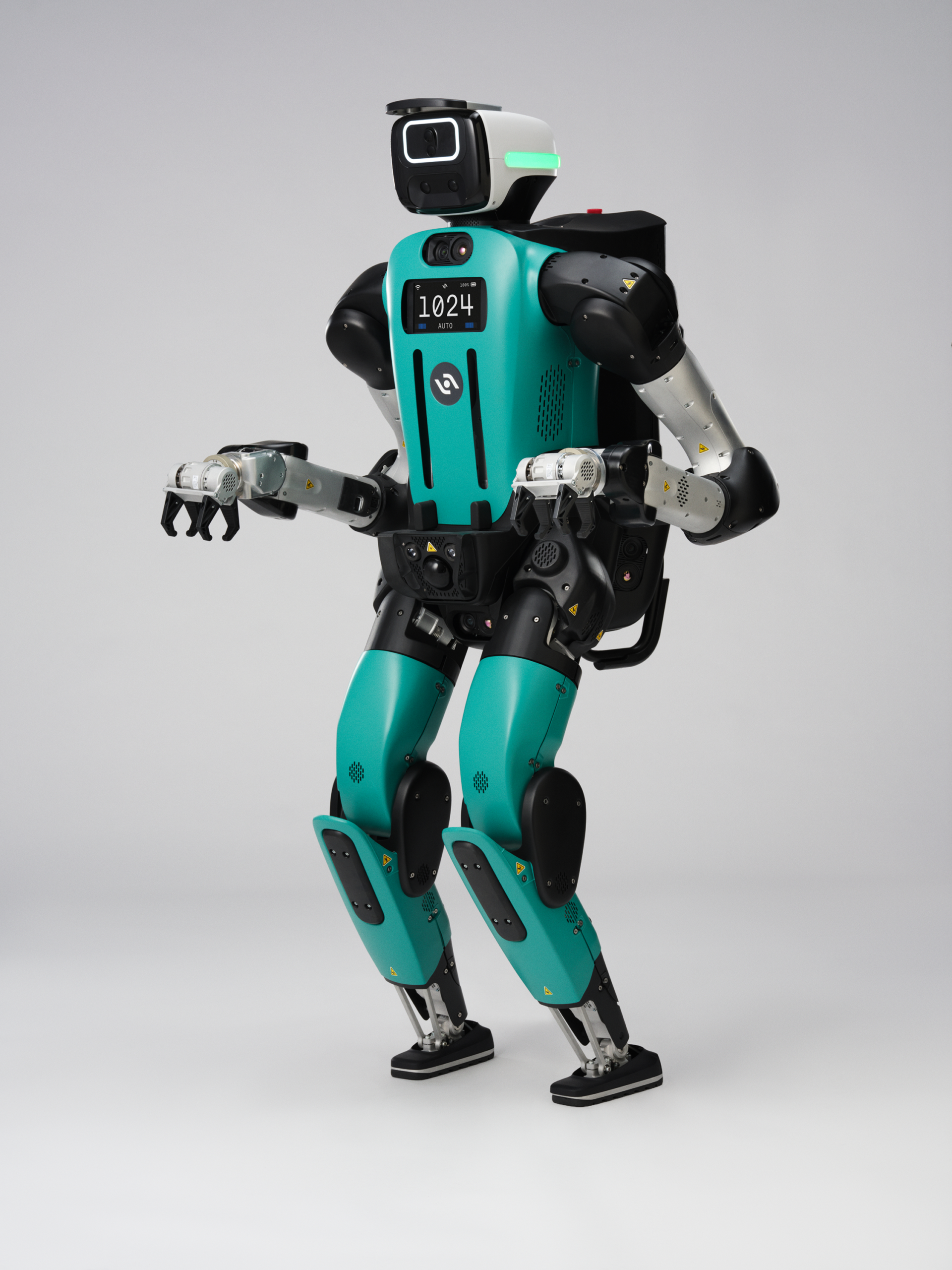
Digit 5 has a higher payload, taller reach, faster charging, and swappable end-effectors. | Source: Agility Robotics
One of the most noticeable changes to Digit 5 is its legs. Instead of the company’s ostrich-like backwards knees, Digit 5 has more traditional, human-like legs.
“The previous leg configuration was really optimized for very good walking and running,” Hurst said. “The new configuration is optimized for lifting heavy things and getting up and down off the ground a lot.”
The new legs are powered by proprietary cycloidal actuators, which enable it to repeatedly lift up to 50 lb (22.7 kg) loads. Hurst said this enables Digit to fully cover single-person lift tasks in OSHA-regulated facilities.
“The product requirements push us in the direction of lifting heavy things all the time,” Hurst said. “Then, as we try to do the engineering to solve this new priority, we end up with something that looks a bit more humanoid. That’s encouraging, but it’s really important that we are not trying to copy what a person looks like or what an animal looks like. This is where the engineering took us. Future configurations may look different depending on the requirements.”
Digit also features padding on its knees that help it kneel. Additionally, it’s new legs allow sit to squat down into a stable position. This gives Digit the ability to sit down on the ground and turn off its motors when a person approaches, a core part of Agility’s safety strategy. “The robot needs to be in a statically stable post and be able to turn off its motors before a person can touch it,” Hurst said.
Digit 5 is also taller and heavier than past models, weighing in at 284 lb (129 kg) and standing at 5’ 11” (1.81 m). The robot can reach heights of up to 7.2 feet (2.2 m), up from Digit 4’s 5.5 ft.
How does Agility approach manipulation?
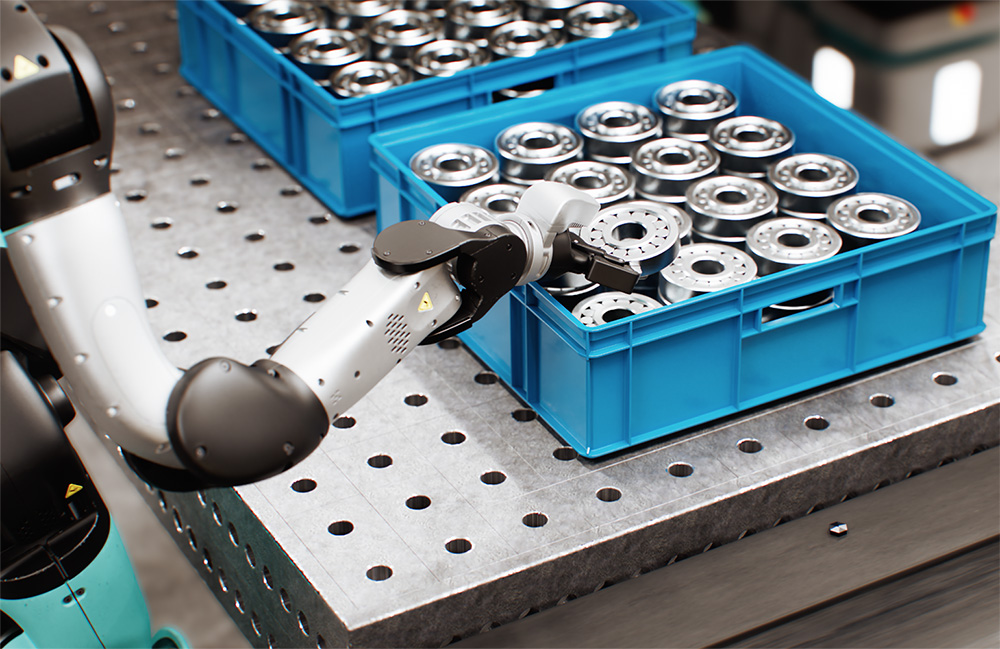
Agility protects Digit’s platform with end-to-end encryption, strict access controls, and localized data processing. | Source: Agility Robotics
“One thing we learned is that general-purpose hands don’t exist. There are none on the market. There are none coming soon. There are hands that look like a human hand, but they’re not very good,” Hurst said.
Agility is currently using a two-fingered gripper, and the team’s inspiration comes from Cybathlon, an event where amputees use prosthetics to complete in different manipulation challenges.
“The winners the last two years, and thus the most dexterous manipulator on planet Earth that is artificial, is a parallel-jaw gripper,” Hursts said. “All of these people had five-fingered hands, but the woman who won in the last two years has a single-degree-of-freedom, parallel-jaw gripper with a single degree of freedom rotation at the wrist.”
Hurst believes there will be better end effectors in the future. But, for now, the company is focused on what works. “No hand that exists on the market can pick up 25 kilogram bins and do complex manipulation with them, but our manipulator can,” Hurst said.
The new robot features a swappable gripper design with ISO-standard mounting flanges. This allows Digit’s tools to be changed for the job at hand.
“We are investing a lot in [building end-effectors] in house, but we want to be very careful not to suffer from the ‘not invented here syndrome,’” Hurst said. “If somebody else creates a hand that is better than what we have in-house for our use case, we will absolutely buy that, stick it on the robot, and use it.”
Safety is the biggest barrier for humanoids in industrial settings
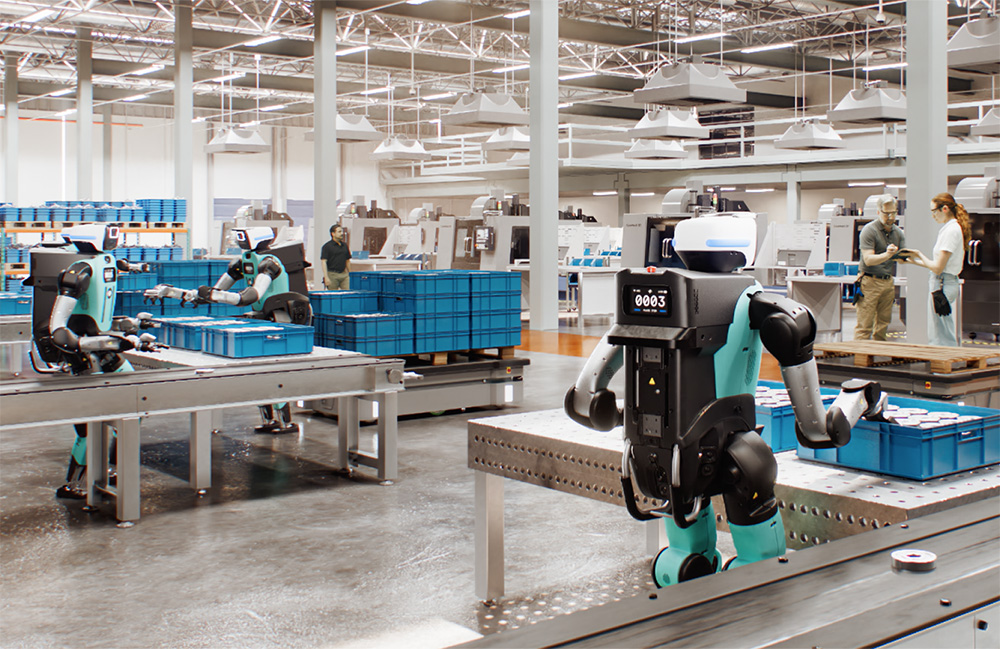
Digit 5 remains fully integrated with Agility Arc, Agility’s cloud platform for deploying and managing Digit fleets. | Source: Agility Robotics
The few humanoids that are being tested in industrial facilities currently aren’t working near human workers. Instead, they’re working in roped-off areas far away from any people. Agility said this won’t be necessary with Digit 5, which can work in close proximity to people.
When it comes to safety, Hurst said there is no silver bullet. “It is not possible to take an existing robot, add a safety hat on it, and then have it operate safely,” Hurst said. “It is completely holistic. It touches every feature of the robot electrically, mechanically, sensors, computing, everything.”
To be able to operate near people, Agility equipped Digit 5 with proprietary AI algorithms and multiple sensor technologies to continuously monitor for people. The robot takes action by autonomously avoiding, stopping or assuming a seated position. As people get closer to the robot, it evaluates the risk, slows then, and eventually stops completely. According to Agility, the robot responds dynamically to situations to decide its behavior, there are no defined zones.
“In order to step out of that physical barrier, the key is being able to reliably, and in a certifiably safety way, detect people who are approaching and how far away they are,” Hurst said. Digit 5 can detect people within a 360º radius around the robot.
Digit 5 uses visual and auditory cues to convey intent to nearby people. As a final layer of safety, an independent safety controller oversees Digit’s response to the detection of people within an unsafe distance and instantly triggers the appropriate safety responses.
“There’s a difference between safety as a personal opinion about how safe you think a robot is, and safety as the industrial standard and regulatory process that you go through to ensure third parties who are unfamiliar with the technology will be safe around these devices,” Hurst said.
Editor’s Note: Hurst will be taking part in the keynote, “The Next 20 Years of Robotics” at RoboBusiness on October 20-21. Pras Velagapudi, Agility’s CTO, will take part in the “State of Humanoids” keynote. Buy your full conference pass for the show now.
 Register now and help us celebrate 20 years of RoboBusiness!
The post Agility’s Digit 5 humanoid has new legs, batteries and safety upgrades appeared first on The Robot Report.


