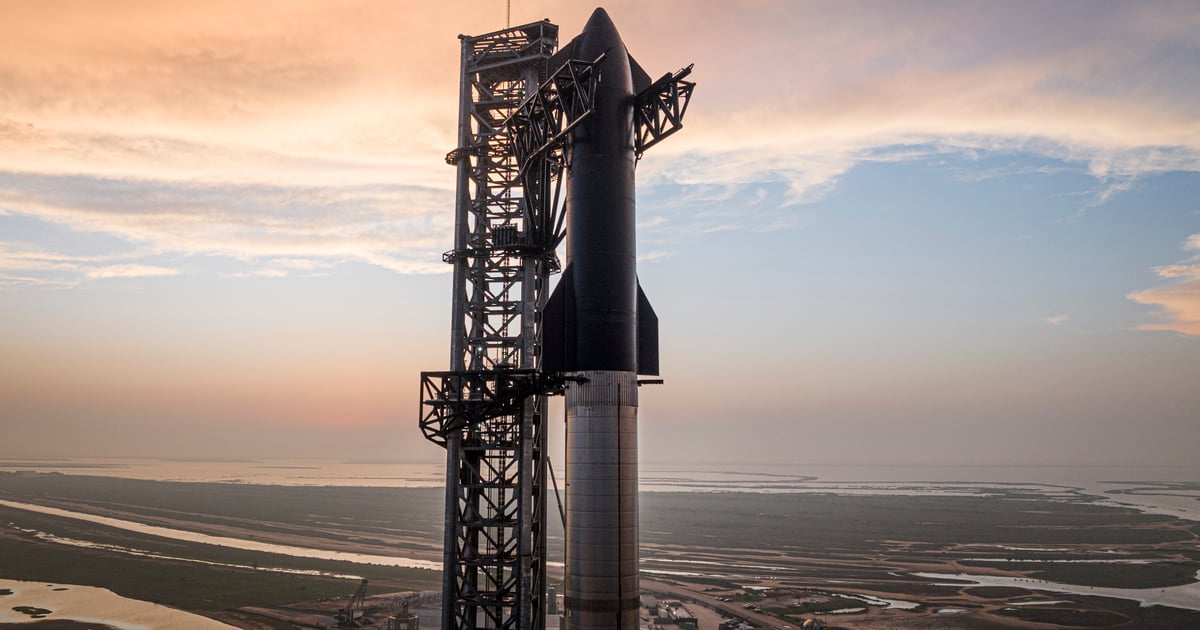
In July, SpaceX’s 13th Starship test flight successfully deployed 20 “V3” Starlink satellites into sub-orbital trajectories for a series of speed tests before they “demised” some 20 minutes later to burn up in the Earth’s atmosphere. The company’s 14th Starship test flight, set to launch as soon as September 28 (pending regulatory review), intends to put 26 V3 satellites into orbit to join the Starlink constellation.
In the July test, the V3s were deployed from SpaceX’s heavy-duty rocket Starship like candies from a Pez dispenser. Tests of the extension of the satellites’ solar arrays and antennas and their communication with ground systems followed.
If next week’s planned deployment is successful, it will be the first time the new, high-capacity V3 will get into orbit and enter service.
Each V3 supports about 1 Tbit/s of downlink capacity and 160 Gbit/s of uplink capacity as well as 2,0249 transmission and receiving beams. Each of the satellites will deliver a 10x improvement on the downlink and a 22x improvement on the uplink when compared to the Starlink V2 satellite. The combined payload of V3s for next week’s test will support about 26 Tbit/s of total capacity, according to SpaceX.
When deployed at scale, the V3s will help Starlink bulk up on the bandwidth and support more users, and further its lead against rivals such as Amazon Leo. The future rollout of V3s will also give Starlink the ability to extend access into some denser areas, though analysts still see Starlink being largely suited to low-density markets.
“Flight 14 is the first point where Starship can begin adding usable broadband capacity rather than only proving the vehicle,” Evercore ISI analysts said in a research note. “A successful orbital insertion and V3 deployment would provide the first tangible proof point for the next leg of the broadband capacity ramp and begin validating the broader connectivity ambitions enabled by Starship.”
The analysts also pointed out that the technology for the V3 will support the Gen 2 satellites for Starlink Mobile and its next-gen direct-to-device (D2D) service, which will tap into spectrum acquired from EchoStar.
SpaceX said the 75-minute launch window on September 22 will open at 7:15 a.m. CDT.
Starship also set for first orbital flight
The V3 deployment will serve as an important test flight for Starship itself, as it aims to be the first to put the vehicle’s upper stage into orbit before employing a controlled reentry and splashdown in the Pacific Ocean west of Chile. SpaceX said Starship’s first orbital mission is intended to fly about 275 kilometers above the Earth and complete six orbits over the course of a nearly 10-hour flight.
Prior tests sent Starship’s upper stage into suborbital trajectories. SpaceX said Starship’s booster, which has been equipped for the next flight with some modifications to address hardware and software issues, is set to perform a “landing burn” at a point in the Gulf of Mexico.
“By going to orbit, the next phase of developing Starship to be fully and rapidly reusable can begin,” SpaceX explained in its rundown of the planned test.
SpaceX’s longer-term plan is to turn the Starship rocket into a fully reusable vehicle. If the upcoming test 14 is successful, SpaceX will attempt to catch the upper ship stage using arms attached to a tower during test 15, SpaceX CEO Elon Musk said this week during a panel at the All-In Summit hosted by venture capitalists and resident rich guys Chamath Palihapitiya, Jason Calacanis, David Sacks and David Friedberg.
Musk gave a 50% to 60% chance that the ship stage would be caught successfully on the first attempt.
From ‘mostly’ to ‘fully’ reusable
SpaceX has successfully re-flown the booster portion of Starship but will try to re-fly the booster and ship elements either by the end of this year or “more likely” in early 2027, Musk said. “Once we can re-fly the ship, we will have made the first fully reusable orbital rocket.”
He said SpaceX’s Falcon 9 rocket is “mostly reusable,” noting that the upper stage is lost with each launch and costs as much as a medium-sized jet. And it takes time to get the fairing (the part that protects the payload being delivered into orbit) and rocket back for some refurbishment work.
With Starship, the aim is for the booster and the ship to return to the launch pad.
“It’s designed not just for reusability, but also rapid reusability like an aircraft,” Musk said.
Test flight 14 will double-check that everything works before trying to catch the upper ship stage on land, he said.
“What we’re most concerned about is if the ship were to break up over land and rain debris on people, our popularity would diminish very rapidly,” Musk said to chuckles in the audience. “I think it’s extremely likely that we’ll achieve full reusability with rapid re-flight next year.”
SpaceX also plans to use Starship for future moon and Mars missions and to deploy its “Starmind” AI data center satellites.
SpaceX President Gwynne Shotwell said the company is on track to start launching orbital compute satellites sometime in 2027.
Editor’s note: The story has been updated to reflect that SpaceX now expects the next test flight to occur as soon as Monday, September 28. Previously, the company said the test could occur as soon as September 22.


