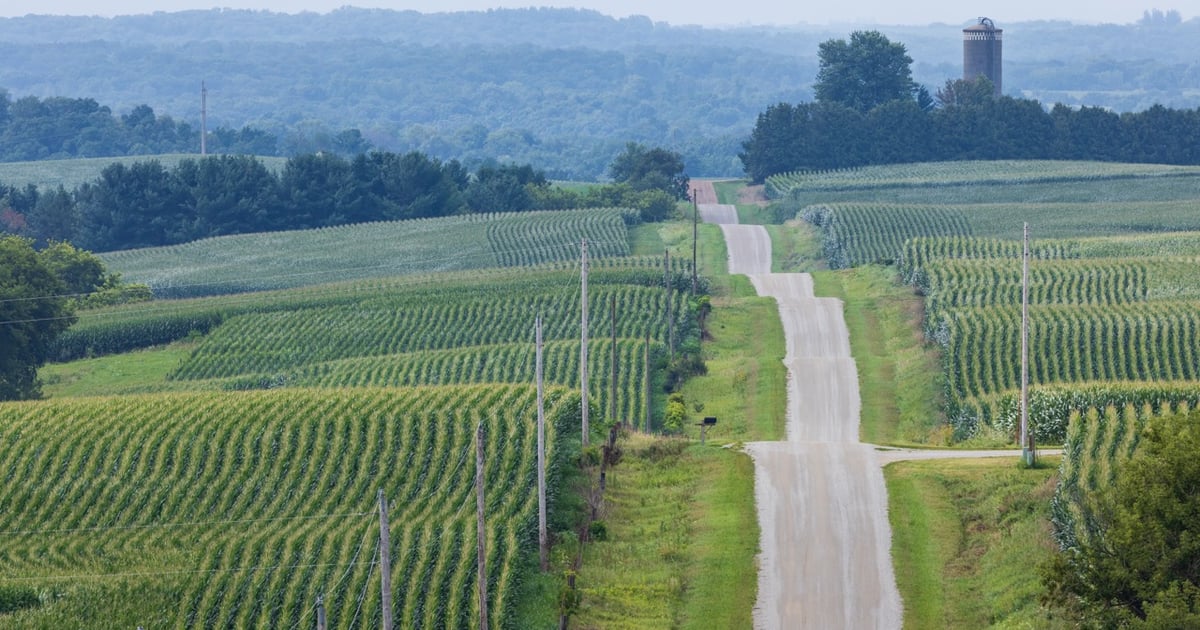
A quick catch-up for anyone joining late. On Aug. 28, the FCC gave the ARA testbed at Iowa State University an Innovation Zone designation: five years of experimental spectrum across Ames and the surrounding farmland, including two municipal airports and a drone control band.
The reason that matters sits in the nearby corn and soybean fields: John Deere’s machines produce more data than the networks supporting rural farms can typically carry, and new technologies requiring constant connectivity only make the story messier as we start down the rocky road between academic research and commercial applications.
Broadband urgency
Ask Deere CTO Jahmy Hindman about the rural broadband gap, and he doesn’t really describe a crisis. Seventy percent of acres in the US and Canada have terrestrial cell coverage, he said. For the remainder, “Starlink for us has largely solved the problem,” delivering something like 10 to 20 times the bandwidth of terrestrial cell at comparable latency, on hardware that keeps shrinking. “I’m bullish on our ability to get every acre connected,” said Hindman. “We’re remarkably closer to that today than we were three years ago.”
Deere is not waiting for the digital divide to disappear. Than Hartsock, John Deere’s VP for precision upgrades and its AI data accelerator, said the company now offers integrated satellite connectivity as base equipment from its Brazil factory, where rural coverage is thinner, and as an option in the US. Its systems are deliberately built to survive without a link. The See & Spray system computes on the edge, and Deere’s autonomous tractors run without continuous connectivity, storing and forwarding data.
“We’ve also designed our systems to not require continuous connectivity,” Hartsock said, “because we know that our machines, I mean, even just southwest of where we sit right now, there are ag fields that do not have reliable continuous cellular connectivity. Just a few miles south of here.”
I should point out that he said those words while standing inside the boundary the FCC had just drawn.
Even though John Deere’s fleet architecture is designed around relative broadband scarcity, the machines are still generating data at rates that such scarcity, however elegantly designed, simply can’t handle. The execs I spoke with deserve a huge amount of credit for their candor; they can see that wall coming at them fast.
Guaranteed connectivity, on the other hand, “allows you to start to rethink what compute do I put on the machine versus what compute do I put off the machine,” Hindman said. “And we’re interested in architectures that explore those options because we’re not too far away from that.”
ARA is working with John Deere on something, but the details aren’t public yet. “I may be unable to discuss the details,” ARA’s principal investigator Hongwei Zhang wrote in an email to Light Reading, “but the several topics from the Deere folks’ questions at the workshop reflect the kind of collaboration topics we are working on.” Neither Deere executive raised the collaboration in our conversations.
Bureaucracy now
An Innovation Zone designation is an experimental authorization. Every operation inside it gets registered, coordinated through NSF and delayed by a notification window. The output is measurements, techniques and, if things go well, something a vendor eventually ships.
That’s how it should work. But that last step – going from research to commercialization – is a doozy.
Amanda Toman, who directs NTIA’s Public Wireless Supply Chain Innovation Fund, joined the ARA workshop remotely and was candid about the effort she runs. “I don’t know that Open RAN adoption has been as wildly successful as I would have hoped, probably three years ago when I started,” she told the room. “But I do think it’s been a stepping stone to get us to sort of a point where I think it’s a real opportunity for the US to be leaders again, by virtualizing the network, by making it an AI-native network architecture.”
Agriculture, she went on, could be “one of those great use cases where that is the killer application, or whatever it might be, that demonstrates the real utility of this network.” What she is looking for are “some of the promises that we were supposed to get out of 5G that didn’t necessarily come to fruition. The really ultra-reliable, low-latency, massive machine or massive IoT sensor enablement.” NTIA has not prescribed the use cases in its funding notice, she said, and named agriculture, industry and transportation as all on the table.
Indeed, “killer app” could be a fair description of 1,500 sprayers making 100-millisecond decisions, all at once, in a single month.
Erwin Gianchandani, the NSF’s assistant director for technology, innovation and partnerships, told the workshop that Platforms for Advanced Wireless Research (PAWR) represents about $50 million of NSF money matched by an equal amount from more than 30 industry partners. The newer programs, including RINGS, VINES and Breaking Low, are meant to carry results further toward the tech and telco industries.
NSF is “not doing product development,” Gianchandani said, but is trying to “grease the skids” between research and translation. He has a phrase for the gap: the valley of death, “or micro valleys of death, as I often talk about them.”
A different NSF program director was less diplomatic. Sudharman Jayaweera, a program director for emerging technologies in the same directorate, presented a slide titled “What is holding us back?” Under the heading “Lack of translational pathways,” it read:
-
No direct agency or hub responsible for moving basic research outcomes to translational impact;
-
No systematic coordination of industry and academia;
-
No recognition of the value of translational activities in the academic community.
Jayaweera said beforehand that the analysis was his own and not the agency’s position.
Zhang, who has spent five years doing exactly this kind of work, did not argue with the diagnosis. Asked how the AgWireless workshop had gone, he said it went better than he expected, and that the room held three or four members of the National Academy of Engineering along with leadership from both the wireless and agriculture industries.
Zhang also said many of the best minds there had stayed quiet, and he described himself as an engineer, more at home in the work itself than in making the case for it. Then he added the part that matches Jayaweera’s third bullet: “It’s not an easy task, and it’s definitely not easy for academics to pursue this in particular.”
ARA’s next evolution
When I asked Zhang what comes after the Innovation Zone designation, he referred to ARA’s impressive testbed, combined with its new status, as a tool.
“The past five years, it has been great progress,” he said. “Now we have this tool. It’s a great tool for the two ecosystems to effectively use to collaborate. However, the tool also has to evolve.”
Two things come next, Zhang said. One is building the community around the platform so the tool actually gets used. The other is sharpening the tool itself, and his reasoning underscores why a testbed exists at all.
“This is also why we should not use the same approach we used to tackle the electricity last century to tackle the broadband issue,” he said. “Because every five to 10 years we get a new generation of technologies.”
Rural electrification was a one-time capital problem. You ran the wire, and the wire was the answer for a century. Broadband regenerates. When ARA started, Zhang pointed out, non-terrestrial networking was barely a factor and the penetration of AI into telecom was hard to imagine. Both now have to be designed into the platform, which is why he talks about integrating terrestrial and non-terrestrial links and “embedding AI into every element.”
In the car ride between a farm in Ames and the airport in Des Moines, the big picture started to become clearer. Most folks agree that the rural broadband issues in the US are urgent, but the clock in everyone’s office is running at a different speed.
At Deere, FurrowVision, autonomous vehicles and factory-fitted satellite broadband are all shipping. An AI assistant that will eventually want every byte a machine can produce went into early access just last week.
In a different set of offices, the public alternative filed its spectrum application in November 2023 and got an answer in August 2026. Now it has five years to show what a rural network might look like if somebody designed one for farms instead of Netflix bingers.
The clocks are syncing up, but slowly.
ARA-NRDZ has AT&T, Ericsson, Collins Aerospace and Keysight attached to it, and ARA is working with Deere. Progress is made one project at a time, with principal investigators assembling their own partner lists at the speed of university research grant cycles.
Why should the rest of the industry care? Zhang has an answer, and his argument rests on the idea that the hardest version of a problem is the useful one.
“What we want to make sure is rural communities, rural use cases, are not always an afterthought,” he said. “It needs to be one of the key areas of focus as we evolve technology. That’s not only important for the rural ag use cases and for communities. It’s also important for the tech industry as a whole, because there are some very key capabilities that can be matured. We can leverage the ag industry, rural industries in general, to drive and mature this technology, so that we don’t miss out on what the ag and rural space can offer.”
As I raced down I-35, just outside Ankeny, I was eager to talk through my notes with an editor, but my calls kept dropping. Whoever solves that problem first will learn something the rest of the network desperately needs to hear.


