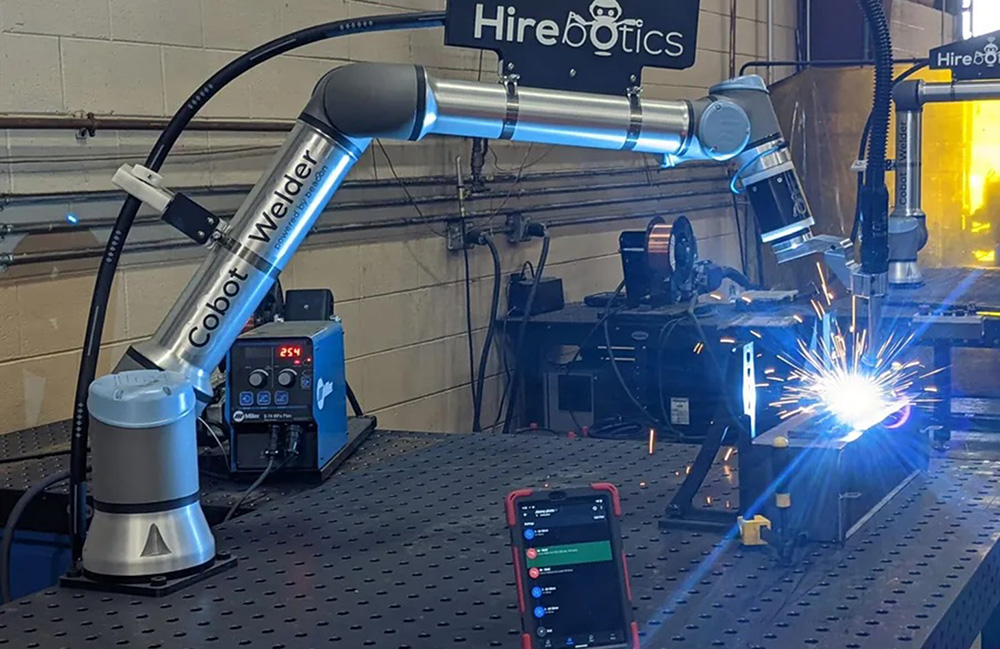
With a new linear rail, Hirebotics cobots, like ones used for welding above, can extend beyond a 68.9-in. reach. | Source: Hirebotics
Hirebotics LLC has added extensions to its collaborative robots that enable manufacturers to paint moving parts and reach large, difficult-to-handle materials and assemblies without changing existing workflows. The new extensions include line tracking and modular rail capabilities.
The company said these new capabilities extend the working range of the cobots, giving manufacturers greater flexibility to automate conveyor-based finishing operations and projects requiring large parts. Hirebotics unveiled the technologies at IMTS 2026 this week in Chicago.
“Both capabilities come out of the same problem, from two directions: The work doesn’t fit inside a fixed work envelope. One is about how big or awkward the part is. The other is about the part not holding still,” Matthew Bush, the CEO of Hirebotics, told The Robot Report.
Founded in Nashville in 2015, Hirebotics’ portfolio includes cobot welding, plasma cutting, and painting systems powered by the Beacon platform. The company claimed that its systems combine robotics, process equipment, and software into turnkey systems that fabricators can deploy and operate without dedicated robotics programmers or engineering teams.
Linear tracking lets cobots paint on moving production lines
Line tracking allows Hirebotics’ Cobot Painter to follow the movement of a part and maintain its programmed painting path while the conveyor continues running. A sensor detects the arriving part and starts the operation automatically.
While traditional robotic line-tracking systems can require specialized programming and integration, Hirebotics said its offering operates within the no-code, cloud-based Beacon platform.
“Line tracking addresses moving production,” said Bush. “It’s available on the Cobot Painter for conveyor-based painting and coating operations where stopping the line or removing every part to accommodate a stationary robot would add handling and interrupt production flow. The cobot follows the moving part and maintains its programmed painting path while the conveyor continues running.”
The line tracking enables the Cobot Painter to:
- Calibrate line tracking through Beacon, teaching the robot the direction and movement of the conveyor
- Detect conveyor movement using an encoder and sensor, providing the information the robot needs to respond to production in motion
- Maintain the programmed painting path relative to the moving part, automatically compensating as conveyor speed changes
- Automatically detect an arriving part, begin the programmed operation and follow the part as it travels through the robot’s working area
Extending cobot reach for large workpieces
Manufacturers rarely work with the same size parts that fit neatly within a single standardized robotic work envelope. A Hirebotics force- and power-limited robot has a 68.9-in. (175 cm) reach, but moving a 12-ft. (3.6 m) frame, a 20-ft. (6 m) structural assembly or a large weldment, for example, extends well beyond that envelope.
Hirebotics customers already use configurations such as magnetic Magswitch mounting, inverted mounting, and headstock-tailstock positioners to adapt their cobots to different applications. The new linear rail, available in 5-ft. (1.5 m) increments or custom lengths, adds another option by allowing the cobot to move along the length of a large workpiece and reach the next section of weldment or other process locations without repositioning the part.
The linear rail is designed to work across Hirebotics applications, including welding, plasma cutting and painting, giving manufacturers another way to adapt automation to different processes and workpiece sizes.
“Linear rail is particularly useful in industries working with large, long or difficult-to-move parts and assemblies, including shipyards and marine fabrication, structural and heavy fabrication, trailers and truck bodies, agricultural and construction equipment, and tanks and vessels,” said Bush. “When a frame, structural assembly or large weldment extends beyond the cobot’s work envelope, the rail lets the cobot move along the work instead of repeatedly repositioning the part.”
“It can also expand A/B workflows. A cobot can work on one side while an operator unloads and sets up the next part on the other, then move to the opposite side when the first operation is complete,” he continued. “Manufacturers can use that workflow without a rail today, but linear travel extends the concept to larger parts and work areas outside a single fixed cobot envelope. Once rail movement is automated, moving between those positions can become part of the programmed process.”
The rail is available now with manual positioning, allowing manufacturers to extend cobot reach without the complexity of a traditional automated axis. Position verification within the Beacon platform is planned to guide operators through position changes, while a fully automated version is planned for the end of 2026 to move the cobot automatically between positions.
Hirebotics hopes to help its customer automate complex tasks
Bush said Hirebotics pursued manual and automated capabilities because of what manufacturers were asking them to help automate.
“On the rail side, we’ve watched customers get increasingly creative about reaching large and awkward workpieces, using magnetic Magswitch mounting, inverted mounting, and headstock-tailstock positioners,” Bush said. “Even with those configurations, manufacturers still encounter applications that extend beyond the cobot’s fixed work envelope.”
“The linear rail turns that customer ingenuity into a standard Hirebotics offering,” he added. “Instead of each manufacturer having to engineer its own way to reposition the cobot along the work, customers will have a repeatable way to extend the system’s working range, with that movement ultimately integrated into the Beacon workflow.”
Hirebotics plans to focus on adding more capabilities to Beacon, according to Bush.
“Today, Beacon pauses the process when the cobot needs to move and prompts the operator to reposition it,” he said. “Next, Beacon will verify that the cobot is in the correct position before work continues. By the end of the year, the target is for Beacon to control that movement itself, creating an automated seventh axis while keeping the operator experience inside the platform they already know.”
“More broadly, we’re continuing to expand what manufacturers can automate across welding, cutting, and painting while building Beacon as the common platform underneath those applications. As customers add cobots, applications and capabilities, we don’t want each addition to create another operating model their team has to learn,” said Bush. “The larger goal is the same one behind these launches: make automation applicable to more of the work manufacturers already do without requiring them to build a robotics department around it.”
 Register now and help us celebrate 20 years of RoboBusiness!
The post Hirebotics adds line tracking and linear rail capabilities to its cobots appeared first on The Robot Report.


